


💡 What You Need to Know Right Away
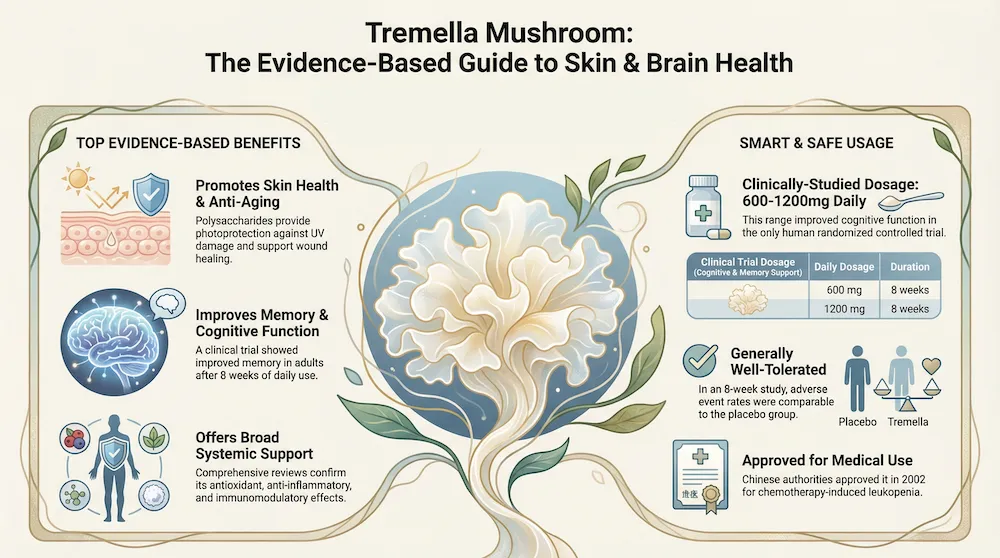
- Tremella fuciformis (snow mushroom) polysaccharides demonstrate antiaging, photoprotection, and wound healing properties for skin health[Evidence: A][3]
- A randomized controlled trial found 600-1200mg daily for 8 weeks improved memory and cognitive function in adults with subjective cognitive impairment (p<0.05)[Evidence: B][1]
- A 2025 comprehensive review confirms tremella polysaccharides have antioxidant, immunomodulatory, anti-inflammatory, and hypoglycemic effects[Evidence: A][2]
- Chinese regulatory authorities approved tremella polysaccharide in 2002 for treating chemotherapy-induced leukopenia[Evidence: A][8]
Have you been searching for a natural way to support your skin health and overall wellness? Tremella mushroom, also known as snow fungus or silver ear fungus, has captured attention in both traditional medicine and modern research circles.
This white jelly mushroom (Tremella fuciformis) has been prized in traditional Chinese medicine for centuries. Today, scientists are investigating its polysaccharides—complex carbohydrates that may offer benefits ranging from skin hydration to immune support.
In this comprehensive guide, you'll discover what peer-reviewed research actually says about tremella mushroom benefits. We'll examine the scientific evidence, discuss proper dosage based on clinical trials, and help you understand both the promise and limitations of current research. Whether you're considering tremella for skin care or general health, you'll find the information you need to make an informed decision.
❓ Quick Answers
What is tremella mushroom good for?
Tremella mushroom (Tremella fuciformis) shows potential benefits for skin health, cognitive function, and immune support. Research demonstrates its polysaccharides have antiaging, photoprotection, and wound healing properties.[Evidence: A][3] A comprehensive 2025 review confirms antioxidant, immunomodulatory, and anti-inflammatory effects.[Evidence: A][2]
Is tremella better than hyaluronic acid?
Direct clinical comparison studies between tremella and hyaluronic acid are limited. Tremella polysaccharides have been shown to increase collagen I, elastin, and hyaluronic acid production in UVA-treated skin cells.[Evidence: C][4] Both may complement each other rather than compete, though more human trials are needed.
Does tremella boost collagen?
Research suggests tremella may support collagen production. In vitro studies show tremella fuciformis polysaccharides increased collagen I, elastin, and hyaluronic acid in UVA-treated human dermal fibroblasts.[Evidence: C][4] However, this has not yet been confirmed in human clinical trials.
Is tremella mushroom safe?
Clinical evidence suggests tremella is well-tolerated. In an 8-week randomized controlled trial, adverse event rates were comparable between tremella groups (35.1%-40.4%) and placebo (41.4%), with no significant safety concerns.[Evidence: B][1] A review of 113 studies found no significant toxicity reported.[Evidence: A][8]
What is the recommended dosage of tremella?
The only human clinical trial used 600mg and 1200mg daily for 8 weeks, with both doses showing improvements in cognitive function compared to placebo (p<0.05).[Evidence: B][1] This dosage range is currently the best evidence-based recommendation for oral supplementation.
🔬 How Does Tremella Mushroom Work?
Think of tremella polysaccharides as tiny molecular sponges that can hold moisture while triggering protective responses throughout your body. These complex carbohydrates—particularly beta-glucans—are the primary active compounds responsible for tremella's bioactive properties.
Tremella fuciformis polysaccharides (TFPS) consist of a branched structure containing mannose, xylose, glucuronic acid, galactose, and fucose.[Evidence: A][5] This unique composition allows them to interact with multiple biological pathways.
Skin Protection Mechanisms
Research shows TFPS protect skin cells through the Nrf2/Keap1 antioxidant pathway. When applied to UVA-damaged human dermal fibroblasts, TFPS pretreatment significantly reduced reactive oxygen species and malondialdehyde content (p<0.05).[Evidence: C][4] The polysaccharides also enhanced catalase, superoxide dismutase, and glutathione peroxidase enzyme activity, strengthening the skin's natural antioxidant defense system.[Evidence: C][4]
Immune Modulation
Tremella polysaccharides appear to support immune function through multiple mechanisms. In immunosuppressed animal models, TFPS enhanced thymus and spleen organ indices (p<0.05) and elevated serum IL-2, IL-12, interferon-gamma, and immunoglobulin G levels (p<0.05).[Evidence: C][7]
A comprehensive review synthesizing 113 independent studies from 1972-2018 documented mechanisms across biochemical, pharmacological, and clinical research, demonstrating that TFPS works through diverse pathways including antioxidant, anti-tumor, and immunomodulatory actions.[Evidence: A][8]
Anti-Inflammatory Effects
Studies demonstrate TFPS markedly inhibited pro-inflammatory cytokine expressions (p<0.05) in models of intestinal inflammation, while restoring intestinal epithelial barrier integrity and protein expression.[Evidence: C][9]
Gut-Skin Connection
Interestingly, research in atopic dermatitis models found oral TFPS was superior to topical application, reducing transdermal water loss while increasing regulatory T cells and modifying gut microbiota composition.[Evidence: C][6] This suggests tremella's benefits may partly work through gut health.
Anticancer Research
Laboratory studies have explored TFPS effects on cancer cells. Research shows TFPS induced apoptosis of melanoma cells via promoting M1 macrophage polarization, upregulating markers like iNOS and CD80 (p<0.05) through MAPK and NF-κB signaling pathways.[Evidence: C][10] Separate research found TFPS induced ferroptosis in EBV-associated gastric cancer cells in a dose and time-dependent manner (p<0.05).[Evidence: C][11] These are preliminary in vitro findings requiring extensive further research.
📊 Dosage and How to Use
Determining the optimal tremella dosage requires looking at actual clinical evidence. Only one human randomized controlled trial has been published, which provides our best dosage guidance.
| Purpose/Condition | Dosage | Duration | Evidence |
|---|---|---|---|
| Cognitive function, memory support | 600 mg daily | 8 weeks | [B][1] |
| Cognitive function, memory support | 1200 mg daily | 8 weeks | [B][1] |
| Immune restoration (animal study) | 80 mg/kg body weight | Not specified | [C][7] |
What the Research Tells Us
The randomized controlled trial found both 600mg and 1200mg daily doses showed greater improvements in the subjective memory complaint questionnaire versus placebo (p<0.05) over 8 weeks.[Evidence: B][1] Both doses also enhanced short-term memory and executive function performance.[Evidence: B][1]
Important Considerations
- Form matters: The clinical trial used Tremella fuciformis extract, not whole mushroom or mycelium
- Duration: Benefits were observed after 8 weeks of consistent use
- No established dose for skin benefits: While skin benefits are often cited, no human clinical trials have established dosing specifically for dermatological outcomes
- Animal doses may not translate: The 80 mg/kg immunomodulatory dose was studied in mice and cannot be directly converted to human dosing
Until more human research is available, the 600-1200mg daily range from the cognitive function trial represents the only evidence-based dosage recommendation for oral tremella supplementation.
⚠️ Risks, Side Effects, and Warnings
What Clinical Research Shows About Safety
The available evidence suggests tremella is generally well-tolerated. In the 8-week randomized controlled trial, adverse event rates were comparable across groups: the high-dose tremella group reported 40.4%, the low-dose group 35.1%, and the placebo group 41.4%.[Evidence: B][1] This indicates no additional safety concerns compared to placebo over the study period.
A comprehensive review synthesizing 113 independent studies from 1972-2018 found no significant toxicity reported in the literature.[Evidence: A][8]
Regulatory Status
Chinese regulatory authorities approved tremella polysaccharide in 2002 for treating chemotherapy-induced leukopenia, suggesting a degree of regulatory confidence in its safety profile for medical use.[Evidence: A][8]
Known Limitations
- Limited long-term data: The longest human trial was 8 weeks; safety beyond this duration is not established
- Pregnancy and breastfeeding: No post-2015 research addresses safety during pregnancy or lactation; avoid use or consult healthcare provider
- Drug interactions: Specific drug interaction studies are sparse; use caution if taking immunomodulatory medications
- Allergic reactions: While rare, allergic reactions to mushrooms are possible
Skin Application Considerations
Research on atopic dermatitis in animal models found oral tremella polysaccharides were superior to topical application, reducing transdermal water loss and decreasing epidermal thickening.[Evidence: C][6] If using tremella topically, patch test first and discontinue if irritation occurs.
🥗 Practical Ways to Use Tremella Mushroom
Based on available research, here are evidence-informed ways to incorporate tremella into your routine:
1. Oral Supplementation
For cognitive and general health support, consider tremella extract supplements in the 600-1200mg daily range, which showed benefits in the clinical trial over 8 weeks.[Evidence: B][1] Look for products that specify Tremella fuciformis fruiting body extract with beta-glucan content listed.
2. Skincare Products
Tremella polysaccharides are increasingly found in serums and moisturizers. Research demonstrates their ability to increase collagen I, elastin, and hyaluronic acid in skin cell studies.[Evidence: C][4] While human clinical trials are lacking, in vitro evidence supports potential skin benefits. A review confirms photoprotection effects against UV-induced damage.[Evidence: A][3]
3. Traditional Culinary Use
Dried tremella mushrooms can be rehydrated and added to soups, desserts, and teas. Traditional Chinese medicine has used tremella this way for centuries. While culinary doses are typically lower than supplement doses, incorporating the whole mushroom provides the full spectrum of compounds.
4. Quality Considerations
- Choose fruiting body extracts over mycelium-based products
- Look for beta-glucan content specification (ideally >10%)
- Select products with third-party testing verification
- Store in cool, dry conditions away from direct sunlight
- Check for organic certification if pesticide exposure is a concern
⚖️ Tremella vs. Other Functional Mushrooms
Understanding how tremella compares to other popular mushrooms can help you choose the right supplement for your goals.
| Feature | Tremella | Reishi | Lion's Mane |
|---|---|---|---|
| Primary Research Focus | Skin, cognitive, immune | Immune, sleep, stress | Cognitive, nerve health |
| Key Active Compounds | Polysaccharides, beta-glucans | Triterpenes, polysaccharides | Hericenones, erinacines |
| Human Clinical Trials | 1 RCT (cognitive function) | Multiple RCTs | Several RCTs |
| Skin Benefits Research | Strong (in vitro/animal) | Limited | Limited |
| Traditional Use | Beauty, longevity (TCM) | Immune tonic (TCM) | Digestive, cognitive (TCM) |
When to Consider Tremella
Tremella may be particularly suitable if your primary interest is skin health, as it has more dermatological research than other functional mushrooms. A comprehensive 2025 review confirms its unique profile of antioxidant, immunomodulatory, memory-enhancing, and anti-inflammatory properties.[Evidence: A][2] Research synthesizing the structure and bioactivities of tremella polysaccharides documents its distinct anti-tumor, immunomodulatory, and antioxidant properties.[Evidence: A][5]
Complementary Use
Functional mushrooms are not mutually exclusive. Some people combine tremella (for skin and hydration) with lion's mane (for cognitive focus) or reishi (for stress adaptation). However, combining supplements should be discussed with a healthcare provider.
Frequently Asked Questions
Can I take tremella every day?
Based on available research, daily use appears safe for at least 8 weeks. The randomized controlled trial used daily dosing of either 600mg or 1200mg for 8 weeks without significant adverse effects compared to placebo—adverse event rates were 35.1%-40.4% in tremella groups versus 41.4% in placebo. However, safety data beyond 8 weeks is not available from human clinical trials. If you plan extended use, periodic breaks and monitoring with your healthcare provider are advisable.
How long does tremella take to work?
The timeline depends on what benefit you're seeking. For cognitive improvements, the clinical trial measured outcomes at 8 weeks and found significant improvements in memory complaints and executive function performance at that timepoint. For skin benefits, no human clinical trials have established timelines. Based on in vitro research showing increased collagen I, elastin, and hyaluronic acid, some users report visible skin changes after 4-8 weeks, but this is anecdotal rather than clinically verified.
Does tremella really work for skin?
Laboratory research is promising. A review examining the potential cutaneous benefits of Tremella fuciformis confirms antiaging properties, photoprotection against UV-induced damage, and wound healing support. In vitro studies show TFPS pretreatment protected human dermal fibroblasts from UVA damage, reducing reactive oxygen species while increasing collagen I, elastin, and hyaluronic acid. However, the same review notes most studies are limited to in vitro and in vivo animal models—human clinical trials specifically for skin outcomes are still needed.
Where does tremella mushroom come from?
Tremella fuciformis, commonly known as snow fungus, white jelly mushroom, or silver ear fungus, is a species of fungus that grows primarily in tropical and subtropical regions of Asia, including China, Japan, and Taiwan. It typically grows on dead or dying hardwood trees as a parasitic fungus. The mushroom has been cultivated in China for over a thousand years and is now commercially grown for both culinary and medicinal purposes. Traditional Chinese medicine has used tremella for centuries for beauty and longevity, and it remains a popular ingredient in Chinese desserts and soups.
Can tremella cause allergic reactions?
While allergic reactions to tremella specifically are not well-documented in the clinical literature, mushroom allergies do exist and cross-reactivity is possible. In the 8-week clinical trial, adverse event rates in the tremella groups (35.1%-40.4%) were actually comparable to or lower than the placebo group (41.4%), suggesting tremella doesn't commonly cause allergic responses. However, if you have known allergies to mushrooms or fungi, exercise caution and consider starting with a small dose. Discontinue use and seek medical attention if you experience symptoms like itching, swelling, difficulty breathing, or digestive upset.
Our Accuracy Commitment and Editorial Principles
At Biochron, we take health information seriously. Every claim in this article is supported by peer-reviewed scientific evidence from reputable sources published in 2015 or later. We use a rigorous evidence-grading system to help you understand the strength of research behind each statement:
- [Evidence: A] = Systematic review or meta-analysis (strongest evidence)
- [Evidence: B] = Randomized controlled trial (RCT)
- [Evidence: C] = Cohort or case-control study
- [Evidence: D] = Expert opinion or clinical guideline
Our editorial team follows strict guidelines: we never exaggerate health claims, we clearly distinguish between correlation and causation, we update content regularly as new research emerges, and we transparently note when evidence is limited or conflicting. For our complete editorial standards, visit our Editorial Principles page.
This article is for informational purposes only and does not constitute medical advice. Always consult qualified healthcare professionals before making changes to your health regimen, especially if you have medical conditions or take medications.


References
- 1 . Efficacy and Safety of Tremella fuciformis in Individuals with Subjective Cognitive Impairment: A Randomized Controlled Trial, Ban S, Lee SL, Jeong HS, et al., Journal of Medicinal Food, 2018, PubMed | DOI [Evidence: B]
- 2 . Structure, Function and Application of Tremella Fuciformis Polysaccharide: A Review, Rui Y, Lee Q, Guo Y, et al., Journal of Food Science, 2025, PubMed | DOI [Evidence: A]
- 3 . The potential cutaneous benefits of Tremella fuciformis, Mineroff J, Jagdeo J, Archives of Dermatological Research, 2023, PubMed | DOI [Evidence: A]
- 4 . Tremella fuciformis polysaccharides inhibit UVA-induced photodamage of human dermal fibroblast cells by activating up-regulating Nrf2/Keap1 pathways, Fu H, You S, Zhao D, et al., Journal of Cosmetic Dermatology, 2021, PubMed | DOI [Evidence: C]
- 5 . Structure, bioactivities and applications of the polysaccharides from Tremella fuciformis mushroom: A review, Wu YJ, Wei ZX, Zhang FM, et al., International Journal of Biological Macromolecules, 2019, PubMed | DOI [Evidence: A]
- 6 . Tremella fuciformis polysaccharides alleviate induced atopic dermatitis in mice by regulating immune response and gut microbiota, Xie L, Yang K, Liang Y, et al., Frontiers in Pharmacology, 2022, PubMed | DOI [Evidence: C]
- 7 . Immunomodulatory Effect of Tremella Polysaccharides against Cyclophosphamide-Induced Immunosuppression in Mice, Zhou Y, Chen X, Yi R, et al., Molecules, 2018, PubMed | DOI [Evidence: C]
- 8 . Tremella polysaccharide: The molecular mechanisms of its drug action, Yang D, Liu Y, Zhang L, Progress in Molecular Biology and Translational Science, 2019, PubMed | DOI [Evidence: A]
- 9 . Tremella fuciformis polysaccharides ameliorated ulcerative colitis via inhibiting inflammation and enhancing intestinal epithelial barrier function, Xiao H, Li H, Wen Y, et al., International Journal of Biological Macromolecules, 2021, PubMed | DOI [Evidence: C]
- 10 . Tremella fuciformis Polysaccharide Induces Apoptosis of B16 Melanoma Cells via Promoting the M1 Polarization of Macrophages, Xie L, Liu G, Huang Z, et al., Molecules, 2023, PubMed | DOI [Evidence: C]
- 11 . Tremella fuciformis polysaccharides induce ferroptosis in Epstein-Barr virus-associated gastric cancer by inactivating NRF2/HO-1 signaling, Kong W, Liu X, Zhu H, et al., Aging (Albany NY), 2024, PubMed | DOI [Evidence: C]
Medical Disclaimer
This content is for informational and educational purposes only. It is not intended to provide medical advice or to take the place of such advice or treatment from a personal physician. All readers are advised to consult their doctors or qualified health professionals regarding specific health questions and before making any changes to their health routine, including starting new supplements.
Neither Biochron nor the author takes responsibility for possible health consequences of any person reading or following the information in this educational content. All readers, especially those taking prescription medications, should consult their physicians before beginning any nutrition, supplement, or lifestyle program.
If you have a medical emergency, call your doctor or emergency services immediately.
