


💡 What You Need to Know Right Away
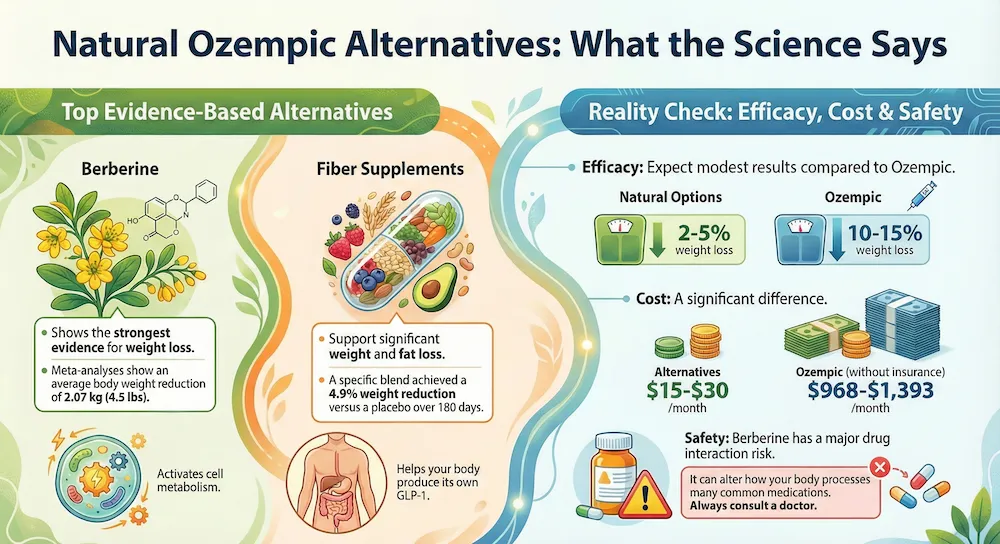
- Berberine shows the strongest evidence for weight loss among natural alternatives, with meta-analyses showing body weight reduction of 2.07 kg and waist circumference decreased by 3.27 cm[Evidence: A][1][2]
- Fiber supplements can support weight loss with a combined glucomannan, inulin, and psyllium formula showing 4.9% weight reduction vs placebo and 13.0% fat mass decrease[Evidence: B][4]
- Blood sugar control is achievable naturally—berberine reduced fasting plasma glucose by 0.82 mmol/L and HbA1c by 0.63% in type 2 diabetes patients[Evidence: A][3]
- Natural alternatives are significantly less potent than Ozempic—expect modest results (2-5 kg weight loss) compared to prescription GLP-1 medications (10-15% body weight reduction)
If you're researching Ozempic natural alternatives, you're likely facing one of several challenges: the medication's high cost ($968-$1,393/month without insurance), persistent side effects, supply shortages, or simply a preference for natural approaches to weight management.
It's understandable to feel overwhelmed by the conflicting information online. Social media has dubbed certain supplements "nature's Ozempic"—but do any of them actually work? This guide examines what the clinical research actually shows about natural compounds like berberine, fiber supplements, and dietary strategies that may support weight loss and blood sugar control.
We'll be honest: no natural alternative matches Ozempic's effectiveness. However, several evidence-based options can provide meaningful benefits, especially when combined with lifestyle changes. Here's what you need to know to make an informed decision.
❓ Quick Answers
Are there natural alternatives to Ozempic for weight loss?
Yes, several natural compounds show evidence for supporting weight loss. Berberine demonstrates the strongest research, with meta-analyses showing body weight reduction of 2.07 kg and BMI reduction of 0.47 kg/m²[Evidence: A][2]. Fiber supplements combining glucomannan, inulin, and psyllium achieved 4.9% weight reduction versus placebo[Evidence: B][4]. However, these effects are significantly more modest than prescription GLP-1 medications.
What is berberine and does it work like Ozempic?
Berberine is a plant compound found in barberry, Oregon grape, and goldenseal that activates AMPK (an enzyme regulating metabolism). Unlike Ozempic, which directly mimics GLP-1 hormone, berberine works through different pathways—improving insulin sensitivity and reducing glucose production in the liver. Studies show fasting plasma glucose reduced by 0.82 mmol/L and HbA1c decreased by 0.63%[Evidence: A][3].
Can you boost GLP-1 naturally?
Research suggests certain dietary approaches can stimulate natural GLP-1 secretion. Dietary fiber fermentation by gut microbiota produces short-chain fatty acids (SCFAs), which stimulate GLP-1 and PYY release[Evidence: C][9]. Specifically, acetate and butyrate stimulate colonic GLP-1 secretion[Evidence: B][8]. High-fiber foods, protein-rich meals, and eating earlier in the day may support GLP-1 production.
Is berberine safe to take?
Berberine shows a favorable safety profile in clinical trials, with no significant adverse effects versus placebo[Evidence: A][1] and no significant increase in hypoglycemia risk[Evidence: A][3]. However, berberine affects multiple CYP450 enzymes and has inhibitory effects on CYP2D6 and CYP3A4[Evidence: D][10], which can alter how your body processes medications. Consult your doctor before use.
Does berberine really help with weight loss?
Meta-analysis of randomized controlled trials confirms berberine reduces body weight by 2.07 kg, BMI by 0.47 kg/m², and waist circumference by 1.08 cm[Evidence: A][2]. A separate meta-analysis found waist circumference decreased by 3.27 cm[Evidence: A][1]. These are modest but statistically significant effects when combined with diet and exercise.
What foods increase GLP-1 hormone?
Foods that promote GLP-1 secretion include high-fiber sources (oats, beans, lentils, vegetables), which are fermented by gut bacteria to produce SCFAs that stimulate GLP-1 release[Evidence: C][9]. Protein-rich foods (eggs, fish, lean meats, whey protein) and healthy fats (avocado, nuts, olive oil) also support GLP-1 production. Eating meals earlier in the day aligns with circadian GLP-1 patterns.
Do fiber supplements help with appetite?
Fiber supplements can support appetite control and weight loss. A randomized trial of glucomannan, inulin, and psyllium combined showed 4.9% weight reduction versus placebo and 13.0% fat mass decrease over 180 days[Evidence: B][4]. This works partly because SCFAs produced from fiber fermentation enhance insulin sensitivity and stimulate GLP-1 and PYY release[Evidence: C][9].
Natural Alternatives to Ozempic
While medications mimic the GLP-1 hormone to induce satiety, certain foods, supplements, and habits can stimulate your body's natural production of appetite-regulating hormones.
🔬 How Do Natural Alternatives to Ozempic Work?
Understanding how these alternatives work helps set realistic expectations. Ozempic (semaglutide) is a GLP-1 receptor agonist—it directly mimics the GLP-1 hormone that tells your brain you're full. Natural alternatives work through different, often complementary pathways.
Berberine: The AMPK Activator
Think of AMPK as your cell's energy thermostat. When activated, it switches your metabolism from "storage mode" to "burning mode." Berberine turns up this thermostat, improving how your body handles glucose and fat. Meta-analyses demonstrate berberine reduces fasting glucose by 0.52 mmol/L[Evidence: A][1] and fasting plasma glucose by 0.82 mmol/L[Evidence: A][3]. It also reduces triglycerides by 0.37 mmol/L[Evidence: A][1] and inflammatory marker CRP by 0.42 mg/L[Evidence: A][2].
Fiber: The Gut-Brain Messenger System
Imagine your gut bacteria as a chemical factory. When you eat fiber, these bacteria ferment it into short-chain fatty acids (SCFAs)—specifically acetate, butyrate, and propionate. Acetate and butyrate stimulate colonic GLP-1 secretion[Evidence: B][8], essentially triggering your body's own appetite-control system. Research shows SCFAs function as an energy substrate for colonocytes, triggering GLP-1 release[Evidence: B][8]. Dietary fiber fermentation by microbiota produces these SCFAs, which then enhance insulin sensitivity and beta-cell function[Evidence: C][9].
Other Natural Compounds
Curcumin (from turmeric) addresses metabolic syndrome through anti-inflammatory pathways, reducing waist circumference by 2.16 cm and fasting blood sugar by 8.6 mg/dL[Evidence: A][5]. It also significantly reduced inflammatory markers TNF-alpha and CRP[Evidence: A][5].
Cinnamon improves insulin sensitivity through effects on insulin receptor signaling. Studies show it substantially decreases fasting blood sugar and significantly improves insulin resistance (HOMA)[Evidence: A][6], though it does not significantly change serum insulin levels[Evidence: A][6].
Green tea extract (EGCG) modestly increases thermogenesis and fat oxidation. Meta-analysis shows body weight reduced by 1.78 kg, BMI decreased by 0.65 kg/m², and waist circumference reduced by 2.39 cm[Evidence: A][7]. The greatest effect occurred with doses ≥800 mg/day and treatment periods of less than 12 weeks[Evidence: A][7].
📊 Dosage and How to Use Natural Alternatives
Proper dosing is critical for both effectiveness and safety. The following dosages are derived from clinical research and represent what was used in successful trials.
| Alternative | Purpose/Condition | Dosage | Duration | Evidence |
|---|---|---|---|---|
| Berberine | Weight loss and metabolic health | 500 mg, 2-3x daily with meals | 8-24 weeks | [A][2] |
| Berberine | Glucose control in type 2 diabetes | 500 mg, 2-3x daily with meals | Variable | [A][3] |
| Fiber Blend (Glucomannan + Inulin + Psyllium) | Weight loss | Per product label (multi-fiber blend) | 180 days | [B][4] |
| Curcumin | Metabolic syndrome | 500-2000 mg daily | 4-12 weeks | [A][5] |
| Cinnamon | Blood glucose control in T2DM | 500 mg, 3x daily | 3 months | [A][6] |
| Green Tea Extract | Weight loss | ≥800 mg/day | <12 weeks | [A][7] |
Key Dosing Principles
- Take berberine with meals to reduce GI side effects and improve absorption
- Split doses throughout the day rather than taking all at once (especially for berberine)
- Start with lower doses and increase gradually to assess tolerance
- Maintain consistency—studies showing benefits used daily dosing for 8-24 weeks
- Fiber supplements require adequate water intake (at least 8 oz per dose) to prevent GI obstruction
⚠️ Risks, Side Effects, and Warnings
Side Effects by Supplement
Berberine: Clinical trials show a favorable safety profile with no significant adverse effects versus placebo[Evidence: A][1]. No significant increase in adverse events or hypoglycemia risk was observed[Evidence: A][3]. Common reported side effects include gastrointestinal symptoms (diarrhea, constipation, flatulence, abdominal pain), which typically resolve with dose adjustment or taking with food.
Fiber Supplements: GI events occurred in 74.6% of the treatment group in one trial[Evidence: B][4]. These include bloating, gas, cramping, and diarrhea. Start with low doses and increase gradually. Always take with adequate water.
Curcumin: Generally well-tolerated at doses of 500-2000 mg daily for 4-12 weeks in clinical trials[Evidence: A][5]. May cause stomach upset in some individuals.
Green Tea Extract: High doses may cause liver toxicity in rare cases. Greatest effect and safety observed with treatment periods of less than 12 weeks[Evidence: A][7].
Who Should NOT Use Natural Alternatives Without Medical Supervision
- People taking diabetes medications (risk of hypoglycemia)
- Those on blood thinners (warfarin, aspirin)
- Anyone taking immunosuppressants (cyclosporine)
- Pregnant or breastfeeding women
- People with liver or kidney disease
- Anyone scheduled for surgery within 2 weeks
🥗 Practical Ways to Use Natural Alternatives
How to Use This in Your Daily Life
Scenario 1: Weight Loss Support (Berberine + Lifestyle)
- Dose: 500 mg berberine, 2-3 times daily with meals[2]
- Duration: 8-24 weeks[2]
- Population: Adults with obesity or metabolic disorders
- Timing: With breakfast, lunch, and dinner
- What to track: Body weight, waist circumference, energy levels
- Expected results: Body weight decreased 2.07 kg, waist circumference decreased 1.08 cm[2]
Scenario 2: Blood Sugar Control (Berberine for T2DM Support)
- Dose: 500 mg berberine, 2-3 times daily with meals[3]
- Duration: Ongoing with medical supervision
- Population: Adults with type 2 diabetes (as adjunct to prescribed therapy)
- Timing: With meals to reduce GI effects
- What to track: Fasting blood glucose, HbA1c (with your doctor)
- Expected results: Fasting plasma glucose reduced 0.82 mmol/L, HbA1c decreased 0.63%[3]
Scenario 3: Appetite Control (Fiber Supplements)
- Dose: Multi-fiber blend per product label (glucomannan, inulin, psyllium)[4]
- Duration: 180 days for significant results[4]
- Population: Adults seeking appetite support and weight loss
- Timing: 30 minutes before meals with 8+ oz water
- What to track: Body weight, fat mass, hunger levels
- Expected results: Weight reduction of 4.9% vs placebo, fat mass decrease 13.0%[4]
Practical Integration
Take berberine capsules with your regular meals. No special preparation is required. Store supplements in a cool, dry place away from direct sunlight. For fiber supplements, always consume with a full glass of water and wait 30 minutes before eating.
Common Mistakes to Avoid
- Taking berberine on an empty stomach: Increases GI side effects. Studies used dosing with meals[2].
- Inconsistent dosing: Studies showing benefits used daily dosing for 8-24 weeks—sporadic use may not achieve benefits.
- Insufficient water with fiber: Fiber supplements expand in the digestive tract. Without adequate water, they can cause constipation or obstruction.
- Expecting Ozempic-level results: Natural alternatives produce modest benefits. Set realistic expectations for 2-5% body weight reduction over several months.
- Not informing your doctor: Especially important if you take medications due to berberine's CYP450 interactions[10].
⚖️ Natural Alternatives vs. Other Options
Understanding how natural alternatives compare to pharmaceutical options and each other helps you make informed decisions.
| Feature | Ozempic (Semaglutide) | Berberine | Fiber Supplements |
|---|---|---|---|
| Average Weight Loss | 10-15% body weight | 2.07 kg[2] | 4.9% vs placebo[4] |
| Mechanism | Direct GLP-1 receptor agonist | AMPK activation, insulin sensitivity | SCFA production → GLP-1 stimulation[8] |
| Time to Results | Weeks 4-8 | 8-24 weeks[2] | 180 days for full effect[4] |
| Monthly Cost (Est.) | $968-$1,393 | $15-30 | $10-25 |
| Prescription Required | Yes | No | No |
| Common Side Effects | Nausea, vomiting, diarrhea | GI upset (minimal)[1] | Bloating, gas (74.6%)[4] |
| Evidence Level | FDA-approved (extensive) | Level A (meta-analyses) | Level B (RCTs) |
Other Natural Supplements: Honest Assessment
Curcumin: Shows meaningful metabolic benefits—waist circumference reduced 2.16 cm, fasting blood sugar decreased 8.6 mg/dL, HDL increased 4.98 mg/dL[Evidence: A][5]. Primary limitation is poor bioavailability without special formulations (look for products with piperine or phospholipid delivery).
Green Tea Extract (EGCG): Produces modest weight loss of 1.78 kg with doses ≥800 mg/day[Evidence: A][7]. Effects are small and may not justify the cost or effort for weight loss alone. May be useful as part of a comprehensive approach.
Cinnamon: Effective for blood sugar control—substantially decreases fasting blood sugar and significantly improves insulin resistance[Evidence: A][6]. May serve as an adjunct therapy for T2DM[6]. Not effective for weight loss specifically.
What The Evidence Shows (And Doesn't Show)
What Research Suggests
- Berberine has strong evidence for metabolic benefits—6 meta-analyses confirm reductions in body weight (2.07 kg[2]), fasting glucose (0.82 mmol/L[3]), HbA1c (0.63%[3]), triglycerides (0.37 mmol/L[1]), and waist circumference (up to 3.27 cm[1])
- Multi-fiber supplementation produces meaningful weight loss—RCT data shows 4.9% weight reduction and 13.0% fat mass decrease versus placebo over 180 days[4]
- The fiber-SCFA-GLP-1 pathway is validated—acetate and butyrate from fiber fermentation stimulate colonic GLP-1 secretion[8]
- Safety profiles are generally favorable—berberine showed no significant adverse effects versus placebo[1] and no significant increase in hypoglycemia risk[3]
- Complementary supplements show targeted benefits—curcumin for inflammation and metabolic syndrome[5], cinnamon for blood sugar control[6], green tea for modest weight loss[7]
What's NOT Yet Proven
- Optimal dosing protocols remain unclear—studies used 500 mg 2-3x daily for berberine, but head-to-head dose comparisons are lacking
- Long-term safety beyond 24 weeks—most studies lasted 8-24 weeks; effects and safety of prolonged use are not established
- Direct equivalence to GLP-1 medications—no head-to-head comparison studies exist between natural alternatives and semaglutide (Ozempic)
- Effects in pregnancy and lactation—insufficient safety data exists for berberine in pregnant or breastfeeding women
- Individual response variation—genetic factors (FTO, LEP, MC4R polymorphisms) may affect results; one RCT found homozygous minor allele carriers showed greater improvements[4]
- Synergistic combination effects—while individual supplements are studied, optimal combination protocols are not established in clinical trials
Where Caution Is Needed
- Drug interactions are significant—berberine affects multiple CYP450 enzymes (CYP2D6, CYP3A4, CYP2C9, CYP2E1), altering how your body processes many medications[10]
- GI side effects are common with fiber—74.6% of participants in the fiber trial experienced GI events (bloating, gas, diarrhea)[4]
- Social media overstates effectiveness—"nature's Ozempic" claims comparing berberine to semaglutide are misleading; effects are significantly more modest
- Supplement quality varies widely—unregulated manufacturing means inconsistent potency; look for third-party tested products
- Some compounds have bioavailability issues—curcumin and green tea catechins have low absorption without special formulations
Should YOU Try This?
Best suited for: Adults seeking modest weight loss support (2-5%), those with prediabetes or metabolic syndrome who want to complement lifestyle changes, people who cannot access or afford GLP-1 medications, and those who prefer natural approaches as a first step.
Not recommended for: Anyone taking medications without consulting their doctor first (especially diabetes drugs, blood thinners, immunosuppressants), pregnant or breastfeeding women, people requiring significant weight loss (>10% body weight) who would benefit more from medical supervision, and those with liver or kidney disease.
Realistic timeline: Expect 4-8 weeks for initial blood sugar changes, 8-12 weeks for measurable weight loss, and 180 days (6 months) for full fiber supplement benefits[4]. Results require consistent daily use.
When to consult a professional: Before starting any supplement (especially if you take medications), if you don't see results after 12 weeks, if you experience adverse effects, or if you have underlying health conditions like diabetes, heart disease, or liver/kidney problems.
Frequently Asked Questions
Can I take berberine with my medications?
Berberine affects multiple CYP450 enzymes, with inhibitory effects on CYP2D6 and CYP3A4. It also affects CYP3A4/5, CYP2C9, CYP2E1, and CYP1A1/2, which alters drug effectiveness and toxicity profiles. This means berberine can increase or decrease the levels of many medications in your body. Particularly important interactions include metformin (additive glucose-lowering effects), warfarin (altered anticoagulation), and cyclosporine (increased immunosuppressant levels). Always inform your doctor and pharmacist before combining berberine with any prescription medication.
What are the side effects of berberine?
Berberine shows a favorable safety profile with no significant adverse effects versus placebo in meta-analyses. No significant increase in adverse events or hypoglycemia risk was observed in diabetes studies involving over 3,000 patients. However, gastrointestinal symptoms are commonly reported, including diarrhea, constipation, flatulence, and abdominal discomfort. These effects typically resolve when taking berberine with meals or adjusting the dose. Serious side effects are rare when used at standard doses (500 mg, 2-3 times daily).
Does psyllium husk work for weight loss?
Psyllium alone has limited evidence for significant weight loss. However, when combined with other fibers (glucomannan and inulin), the combination showed 4.9% weight reduction versus placebo and 13.0% fat mass decrease over 180 days. The mechanism involves fiber fermentation producing SCFAs that stimulate GLP-1 and PYY release. Psyllium is most effective for promoting satiety and supporting regular bowel movements as part of a comprehensive weight loss program that includes calorie control and exercise.
How much does Ozempic cost without insurance?
Ozempic costs approximately $968-$1,393 per month without insurance coverage. This significant expense is one of the primary reasons people seek natural alternatives. By comparison, berberine supplements cost $15-30 per month, fiber supplements $10-25 per month, and lifestyle changes are essentially free. While natural alternatives are significantly less expensive, they are also significantly less effective—producing modest benefits (2-5% body weight reduction) compared to Ozempic's 10-15% average weight loss.
What is the cheapest alternative to Ozempic?
Lifestyle modifications (diet optimization, exercise, sleep improvement) are the most cost-effective approach at essentially zero cost beyond normal food expenses. Among supplements, fiber supplements ($10-25/month) and berberine ($15-30/month) offer the best value based on clinical evidence. Berberine provides body weight reduction of 2.07 kg and significant blood sugar improvements. Multi-fiber combinations achieved 4.9% weight reduction. A combined approach (lifestyle + berberine + fiber) may provide the best results relative to cost.
How long does it take for berberine to work?
Based on clinical research, berberine requires consistent use over several weeks to months to achieve meaningful results. Studies showing benefits used daily dosing for 8-24 weeks. The meta-analysis involving over 3,000 type 2 diabetes patients used variable treatment durations. Expect to see initial changes in blood sugar within 4-8 weeks, with weight loss benefits becoming apparent by 8-12 weeks. Full metabolic benefits (triglyceride reduction, inflammation markers) may require the full 24-week period.
Who should not take berberine?
Berberine should be avoided or used only under medical supervision by: pregnant or breastfeeding women (insufficient safety data), children and infants, people taking medications metabolized by CYP450 enzymes (especially CYP2D6 and CYP3A4 substrates), those on diabetes medications (risk of hypoglycemia), people taking blood thinners, anyone using immunosuppressants like cyclosporine, individuals with liver or kidney disease, and those scheduled for surgery within 2 weeks. Always consult your healthcare provider before starting berberine.
What is nature's Ozempic?
The term 'nature's Ozempic' gained popularity on social media platforms like TikTok, typically referring to berberine. However, this comparison is misleading. While berberine does show metabolic benefits—body weight decreased 2.07 kg, BMI reduced 0.47 kg/m², and fasting plasma glucose reduced 0.82 mmol/L—these effects are significantly more modest than Ozempic's 10-15% body weight reduction. No natural compound works through the same direct GLP-1 receptor mechanism as semaglutide. Fiber supplements that stimulate natural GLP-1 secretion are perhaps closer mechanistically, but still much less potent.
Is there an over-the-counter version of Ozempic?
No over-the-counter medication replicates Ozempic's mechanism or effectiveness. Semaglutide (Ozempic, Wegovy) is a prescription-only GLP-1 receptor agonist that requires medical supervision due to its potency and potential side effects. The closest OTC options are supplements that may support similar goals through different mechanisms: berberine for blood sugar and modest weight loss, and fiber supplements that may stimulate natural GLP-1 production. These require consistent, long-term use and produce significantly more modest effects.
When should I see a doctor about weight loss?
Consult a healthcare provider before starting any weight loss supplement, especially if you: take prescription medications (due to potential interactions like berberine's CYP450 effects), have type 2 diabetes or prediabetes, have cardiovascular disease or risk factors, are pregnant or breastfeeding, have a history of eating disorders, experience no results after 12 weeks of consistent effort, develop concerning symptoms (severe GI issues, unusual bleeding, extreme fatigue), or need to lose more than 10% of your body weight. A doctor can help determine whether prescription options like Ozempic might be more appropriate for your situation.
Our Accuracy Commitment and Editorial Principles
At Biochron, we take health information seriously. Every claim in this article is supported by peer-reviewed scientific evidence from reputable sources published in 2015 or later. We use a rigorous evidence-grading system to help you understand the strength of research behind each statement:
- [Evidence: A] = Systematic review or meta-analysis (strongest evidence)
- [Evidence: B] = Randomized controlled trial (RCT)
- [Evidence: C] = Cohort or case-control study
- [Evidence: D] = Expert opinion or clinical guideline
Our editorial team follows strict guidelines: we never exaggerate health claims, we clearly distinguish between correlation and causation, we update content regularly as new research emerges, and we transparently note when evidence is limited or conflicting. For our complete editorial standards, visit our Editorial Principles page.
This article is for informational purposes only and does not constitute medical advice. Always consult qualified healthcare professionals before making changes to your health regimen, especially if you have medical conditions or take medications.


References
- 1 . Efficacy and safety of berberine on the components of metabolic syndrome: a systematic review and meta-analysis of randomized placebo-controlled trials, Liu D, Zhao H, Zhang Y, Hu J, Xu H. Frontiers in Pharmacology, 2025;16:1572197. DOI | PubMed [Evidence: A]
- 2 . The effect of berberine supplementation on obesity parameters, inflammation and liver function enzymes: A systematic review and meta-analysis of randomized controlled trials, Asbaghi O, et al. Clinical Nutrition ESPEN, 2020;38:43-49. DOI | PubMed [Evidence: A]
- 3 . Glucose-lowering effect of berberine on type 2 diabetes: A systematic review and meta-analysis, Xie W, et al. Frontiers in Pharmacology, 2022;13:1015045. DOI | PubMed [Evidence: A]
- 4 . The Impact of Glucomannan, Inulin, and Psyllium Supplementation (SolowaysTM) on Weight Loss in Adults with FTO, LEP, LEPR, and MC4R Polymorphisms: A Randomized, Double-Blind, Placebo-Controlled Trial, Pokushalov E, et al. Nutrients, 2024;16(4):557. DOI | PubMed [Evidence: B]
- 5 . Effects of dietary polyphenol curcumin supplementation on metabolic, inflammatory, and oxidative stress indices in patients with metabolic syndrome: a systematic review and meta-analysis of randomized controlled trials, Qiu L, et al. Frontiers in Endocrinology, 2023;14:1216708. DOI | PubMed [Evidence: A]
- 6 . The effect of cinnamon supplementation on glycemic control in patients with type 2 diabetes mellitus: An updated systematic review and dose-response meta-analysis of randomized controlled trials, Moridpour AH, et al. Phytotherapy Research, 2024;38(1):117-130. DOI | PubMed [Evidence: A]
- 7 . The effect of green tea supplementation on obesity: A systematic review and dose-response meta-analysis of randomized controlled trials, Lin Y, et al. Phytotherapy Research, 2020;34(10):2459-2470. DOI | PubMed [Evidence: A]
- 8 . The impact of short-chain fatty acids on GLP-1 and PYY secretion from the isolated perfused rat colon, Christiansen CB, et al. American Journal of Physiology - Gastrointestinal and Liver Physiology, 2018;315(1):G53-G65. DOI | PubMed [Evidence: B]
- 9 . The Interplay of Dietary Fibers and Intestinal Microbiota Affects Type 2 Diabetes by Generating Short-Chain Fatty Acids, Mazhar M, Zhu Y, Qin L. Foods, 2023;12(5):1023. DOI | PubMed [Evidence: C]
- 10 . Effects of Berberis vulgaris, and its active constituent berberine on cytochrome P450: a review, Bathaei P, Imenshahidi M, Hosseinzadeh H. Naunyn Schmiedebergs Arch Pharmacol, 2025;398(1):179-202. DOI | PubMed [Evidence: D]
Medical Disclaimer
This content is for informational and educational purposes only. It is not intended to provide medical advice or to take the place of such advice or treatment from a personal physician. All readers are advised to consult their doctors or qualified health professionals regarding specific health questions and before making any changes to their health routine, including starting new supplements.
Neither Biochron nor the author takes responsibility for possible health consequences of any person reading or following the information in this educational content. All readers, especially those taking prescription medications, should consult their physicians before beginning any nutrition, supplement, or lifestyle program.
If you have a medical emergency, call your doctor or emergency services immediately.
