


💡 What You Need to Know Right Away
- Senescent cells accumulate with age across human tissues, with magnitude varying by tissue type and detection marker.[Evidence: A][1]
- Higher senescence markers are consistently found in age-related diseases, with p16INK4a being the most frequently detected marker across 103 analyzed studies.[Evidence: A][2]
- Exercise reduces senescent cell markers in healthy humans, suggesting lifestyle interventions may help manage cellular aging.[Evidence: A][10]
- Early human clinical trials show dasatinib plus quercetin (D+Q) significantly decreases senescent cell burden within 11 days.[Evidence: B][16]
Have you noticed that aging seems to accelerate after a certain point? Many people experience this, and scientists now understand one key reason: the accumulation of senescent cells, sometimes called "zombie cells." These cells stop dividing but refuse to die, lingering in your tissues and potentially causing problems.
It is common to feel overwhelmed when first learning about cellular aging. The science can seem complex, but the core concepts are straightforward. In this guide, you will learn what senescent cells are, why they matter for your health, and what evidence-based strategies exist to address them. All information is backed by peer-reviewed research, with 19 scientific sources cited throughout.
❓ Quick Answers
What are senescent cells?
Senescent cells are cells that have permanently stopped dividing but remain metabolically active. They undergo cell cycle arrest in response to harmful stimuli like DNA damage, telomere shortening, or oncogene activation. Unlike healthy cells that die when damaged, senescent cells accumulate throughout life and cause tissue dysfunction through secreted proteins.[Evidence: D][13]
Are senescent cells good or bad?
Senescent cells have both harmful and beneficial effects. They play important roles in wound healing, embryonic development, and tumor suppression through autocrine and paracrine signaling. However, chronic accumulation causes tissue dysfunction and chronic inflammation. Indiscriminate targeting could have unintended consequences.[Evidence: D][4]
Do senescent cells cause aging?
Senescent cells contribute significantly to aging. They accumulate with chronological age across various human tissues, and higher senescence markers are found in age-related diseases. The SASP (senescence-associated secretory phenotype) causes chronic inflammation linked to cardiovascular disease, metabolic disorders, and neurodegeneration.[Evidence: A][1][6]
What causes senescent cells to accumulate?
Senescence is triggered by telomere shortening, DNA damage, oxidative stress, and oncogene activation. With age, the immune system becomes less effective at clearing senescent cells. Immunosenescence accelerates aging by allowing these cells to persist, leading to progressive tissue dysfunction.[Evidence: D][5][6]
What are zombie cells?
"Zombie cells" is a popular term for senescent cells. The name reflects their behavior: they stop functioning normally (like dying) but remain alive, spreading inflammatory signals to neighboring cells. This SASP activity can turn healthy cells senescent too, creating a harmful chain reaction in aging tissues.[Evidence: D][11]
What is SASP (senescence-associated secretory phenotype)?
SASP refers to the inflammatory molecules that senescent cells release. These include cytokines, chemokines, and proteases that affect neighboring cells. SASP causes chronic inflammation (sometimes called "inflammaging") and is linked to cardiovascular disease, metabolic disorders, and neurodegeneration.[Evidence: D][5][6]
How do you reduce senescent cells naturally?
Exercise reduces senescent cell markers in healthy humans according to systematic review evidence. Dietary ingredients like resveratrol, vitamin E, and soy protein isolate have shown benefits in reducing senescence markers (p53, p21, p16, SA-β-galactosidase) in animal studies, though human evidence remains limited.[Evidence: A][10][15]
Are senolytic supplements safe?
Early clinical trials show dasatinib plus quercetin (D+Q) is feasible and generally well-tolerated, with no serious adverse events related to treatment in idiopathic pulmonary fibrosis patients. However, senolytics tested so far lack specificity and have significant off-target effects. Intermittent dosing is recommended because continuous treatment may impair tissue repair.[Evidence: B][17][8]
Senescent "Zombie" Cells
Explore the biology of aging, understanding how cells stop dividing but refuse to die, driving inflammation and age-related disease.
🔬 How Do Senescent Cells Affect the Body?
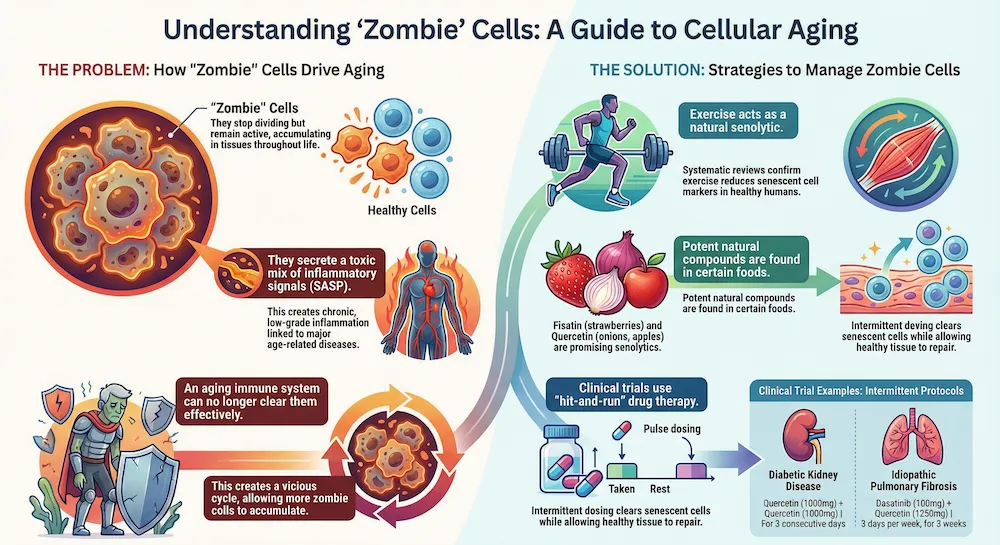
Think of senescent cells like retired factory workers who refuse to leave the building. They no longer produce useful work, but they consume resources and, worse, they constantly complain to everyone around them. This "complaining" is the SASP, a constant stream of inflammatory signals that disrupts the entire workplace.
Cellular senescence is triggered when cells experience harmful stimuli. These include telomere shortening (the protective caps on chromosomes wearing down), DNA damage, oxidative stress from reactive oxygen species, and oncogene activation. When these triggers occur, cells enter a state of permanent proliferation arrest while maintaining metabolic activity.[Evidence: D][5]
The SASP releases inflammatory molecules including cytokines and chemokines. These secreted factors create chronic inflammation throughout the body. The regulatory pathways involved include p53/p21 and p16/Rb, which control the cell cycle arrest. Research has identified SIRT1 and mTOR as regulatory targets in cellular senescence, particularly in cardiovascular contexts.[Evidence: A][3]
In the cardiovascular system, cellular senescence affects cardiomyocytes, endothelial cells, and smooth muscle cells. This contributes to myocardial infarction, atherosclerosis, and hypertension. Vascular senescence occurs through endothelial and smooth muscle cell dysfunction.[Evidence: A][3][12]
The p21 protein is a key player in senescence. It functions as a cyclin-dependent kinase inhibitor that halts cell division. Research shows that p21high and p16high cells represent distinct populations with different characteristics. Understanding these differences matters because strategies to address senescence include delaying aging, eliminating senescent cells, or rejuvenating them.[Evidence: D][7]
The immune system normally clears senescent cells. However, immunosenescence, the aging of the immune system itself, reduces this clearance capacity. This creates a vicious cycle: more senescent cells produce more SASP, which further accelerates immune aging and allows even more senescent cells to accumulate.[Evidence: D][6]
📊 Senolytic Dosage and How They're Used
Senolytics are compounds that selectively eliminate senescent cells by temporarily disrupting their anti-apoptotic defense mechanisms. The key principle is intermittent "hit-and-run" dosing rather than continuous treatment. This approach reduces senescent cell burden while allowing time for tissue repair between treatments.[Evidence: D][8]
The most studied senolytic combination is dasatinib plus quercetin (D+Q). Clinical trials have established specific dosing protocols in human subjects with various conditions.
| Purpose/Condition | Dasatinib Dose | Quercetin Dose | Duration | Evidence |
|---|---|---|---|---|
| Diabetic Kidney Disease | 100 mg/day | 1000 mg/day | 3 consecutive days | [B][16] |
| Idiopathic Pulmonary Fibrosis (RCT) | 100 mg/day | 1250 mg/day | 3 days/week for 3 weeks | [B][17] |
| Idiopathic Pulmonary Fibrosis (Pilot) | 100 mg/day | 1250 mg/day | 3 days/week for 3 weeks | [B][18] |
Important: These dosages come from clinical trials in specific patient populations. Dasatinib is a prescription cancer medication. These protocols should only be considered under direct physician supervision. The evidence demonstrates feasibility and tolerability, not approval for general use.
The hit-and-run approach is critical. In the diabetic kidney disease trial, 3 days of treatment significantly decreased senescent cell burden within 11 days, with multiple senescent cell markers and inflammatory factors reduced.[Evidence: B][16] In the IPF pilot study, intermittent D+Q significantly improved physical function measures including 6-minute walk distance, gait speed, and chair stands.[Evidence: B][18]
⚠️ Risks, Side Effects, and Warnings
Safety Profile from Clinical Trials
In the randomized controlled trial of D+Q in idiopathic pulmonary fibrosis, the combination was feasible and generally well-tolerated with no serious adverse events related to treatment.[Evidence: B][17] The diabetic kidney disease trial also showed significant reduction in senescent cell burden without major adverse events.[Evidence: B][16]
Known Risks and Limitations
Senolytics tested so far lack specificity and have significant off-target effects.[Evidence: D][8] Specific concerns include:
- Navitoclax (ABT-263): Associated with hematological toxicity (thrombocytopenia) due to BCL-XL inhibition in platelets.[Evidence: D][8]
- Continuous dosing: May impair tissue repair. Intermittent dosing is recommended.[Evidence: D][8]
- Off-target effects: Current senolytics have limitations in safety, specificity, and broad-spectrum activity.[Evidence: D][14]
Contraindications
Based on current evidence, the following groups should avoid senolytics:
- Individuals with hematological disorders (particularly for navitoclax due to platelet reduction risk)
- Those undergoing active wound healing or tissue repair
- Pregnant or breastfeeding women (no safety data available)
- Children and adolescents (no pediatric studies exist)
🥗 Practical Ways to Reduce Senescent Cells
Exercise: The Natural Senolytic
A systematic review found that exercise reduces senescent cell markers in healthy humans.[Evidence: A][10] The review noted that senolytic effects of exercise are context-dependent, showing lowered markers in obese but not healthy animals. For humans, regular physical activity appears beneficial for managing cellular senescence.
Practical application: Engage in regular aerobic and resistance exercise. The evidence does not specify optimal intensity or duration, but consistent physical activity supports overall cellular health.
Dietary Approaches
A systematic review of 83 studies (78 animal, 5 human) examined dietary ingredients' effects on cellular senescence. Resveratrol, vitamin E, and soy protein isolate showed benefits in reducing senescence markers including p53, p21, p16, and SA-β-galactosidase. However, human evidence remains limited.[Evidence: A][15]
Dietary sources:
- Resveratrol: Found in grapes, red wine, peanuts, and berries
- Vitamin E: Found in nuts, seeds, spinach, and vegetable oils
- Quercetin: Found in onions, apples, berries, and capers
- Fisetin: Found in strawberries, apples, persimmons, and grapes
Fisetin: A Promising Natural Compound
Fisetin was identified as the most potent senolytic among 10 flavonoids tested in preclinical research. It reduced senescence markers in multiple tissues and extended median and maximum lifespan in mice. Notably, late-life intervention was sufficient for health benefit.[Evidence: C][19]
What NOT to Do
- Don't expect immediate results: Senolytic effects are measured over weeks to months in clinical trials.
- Don't combine multiple senolytics without guidance: Drug interactions and cumulative off-target effects are not well characterized.
- Don't use continuous dosing: Intermittent "hit-and-run" protocols are used in all successful trials.
⚖️ Senolytics vs. Senomorphics: What's the Difference?
Two main approaches exist for targeting senescent cells: senolytics and senomorphics. Understanding the difference helps you evaluate options with your healthcare provider.
Senolytics selectively eliminate senescent cells by temporarily disrupting anti-apoptotic defense mechanisms. Examples include dasatinib, quercetin, fisetin, and navitoclax. Preclinical studies indicate potential applications in over 40 disorders.[Evidence: D][8]
Senomorphics modulate the SASP without killing the cells. They reduce harmful inflammatory signaling while preserving any beneficial functions senescent cells may have.
| Feature | Senolytics | Senomorphics |
|---|---|---|
| Mechanism | Kill senescent cells | Modulate SASP without killing |
| Administration | Intermittent (hit-and-run) | May be continuous |
| Examples | Dasatinib+Quercetin, Fisetin, Navitoclax | Metformin, Rapamycin |
| Clinical Status | Early human trials completed[16][17][18] | Under investigation |
| Key Consideration | May affect tissue repair if continuous | Preserves potential beneficial senescence |
Emerging approaches include PROTAC technology, CAR-T cells targeting senescent cells, and prodrugs that activate only in senescent cell environments. These address current limitations in safety, specificity, and broad-spectrum activity.[Evidence: D][14]
What The Evidence Shows (And Doesn't Show)
What Research Suggests
- Senescent cells accumulate with age across human tissues, with magnitude varying by tissue type and detection marker (meta-analysis of human studies).[Evidence: A][1]
- Higher senescence markers are consistently found in 103 analyzed studies of age-related diseases, with p16INK4a as the most frequent marker and 27 total markers identified.[Evidence: A][2]
- Exercise reduces senescent cell markers in healthy humans, suggesting lifestyle intervention is beneficial.[Evidence: A][10]
- Dasatinib + quercetin significantly decreases senescent cell burden within 11 days in humans with diabetic kidney disease (pilot trial, n=9).[Evidence: B][16]
- D+Q improves physical function (6-min walk, gait speed, chair stands) in IPF patients (pilot trial, n=14).[Evidence: B][18]
What's NOT Yet Proven
- Optimal dosage not established: Clinical trials used D:100mg + Q:1000-1250mg, but these were disease-specific pilot studies, not dose-finding studies for general aging.
- Long-term safety unknown: Longest trials were 3 weeks. No evidence exists on senolytic use beyond this timeframe.
- Human dietary senolytic evidence limited: Of 83 studies on dietary senotherapeutics, only 5 were in humans.[Evidence: A][15]
- No evidence in healthy adults: Human trials enrolled patients with diabetic kidney disease or IPF, not healthy aging populations.
- Pediatric, pregnancy, and lactation data absent: No senolytic studies exist for these populations.
Where Caution Is Needed
- Dual role of senescence: Senescent cells have both harmful and beneficial signaling. Indiscriminate targeting could have unintended consequences, including impaired wound healing and tumor suppression.[Evidence: D][4]
- Off-target effects: Senolytics tested so far lack specificity and have significant off-target effects.[Evidence: D][8]
- Navitoclax thrombocytopenia: Associated with hematological toxicity due to BCL-XL inhibition in platelets.[Evidence: D][8]
- Continuous vs. intermittent dosing: Continuous treatment may impair tissue repair; only intermittent dosing has demonstrated safety.
Should YOU Try This?
Best suited for: Individuals with age-related diseases who can access clinical trials or physician-supervised protocols. Exercise and dietary approaches (resveratrol, quercetin-rich foods) are appropriate for general populations seeking lifestyle interventions.
Not recommended for: Healthy individuals self-administering prescription senolytics; those with hematological disorders; pregnant or breastfeeding women; anyone without medical supervision.
Realistic timeline: Clinical trials measured outcomes over 3 weeks. Natural approaches (exercise, diet) should be considered long-term lifestyle changes rather than quick fixes.
When to consult a professional: Before taking any senolytic supplement, especially if you have existing health conditions or take medications. Dasatinib is a prescription drug requiring physician oversight.
Frequently Asked Questions
What is the difference between senolytics and senomorphics?
Senolytics and senomorphics represent two distinct strategies for targeting senescent cells. Senolytics work by temporarily disrupting the anti-apoptotic defense mechanisms that keep senescent cells alive, effectively eliminating them from tissues. Examples include dasatinib, quercetin, and fisetin. Senomorphics, in contrast, modulate the harmful SASP secretions without killing the cells, potentially preserving any beneficial functions. The NIA workshop on clinical trials emphasizes that specificity to senescent cells is important for either approach, and improved biomarkers are needed to measure effectiveness.
What foods may help reduce senescent cells?
A systematic review of 83 studies found that certain dietary ingredients reduced senescence markers in animal models, with limited human evidence. Resveratrol (found in grapes and red wine), vitamin E (nuts and seeds), and soy protein isolate showed benefits in reducing p53, p21, p16, and SA-β-galactosidase markers. Fisetin, found naturally in strawberries, was identified as the most potent senolytic among 10 tested flavonoids in preclinical research, reducing senescence markers in multiple tissues. Quercetin, found in onions and apples, is used in clinical trials combined with dasatinib.
Can exercise reduce senescent cells?
Yes, according to a systematic review examining whether exercise functions as a 'senolytic medicine.' The research found that exercise reduces senescent cell markers in healthy humans. The effects appear context-dependent: studies showed lowered markers in obese animals but not healthy animals. For humans, the evidence supports that regular physical activity helps manage cellular senescence. The review did not establish specific exercise protocols, but consistent aerobic and resistance training supports overall cellular health and may help reduce senescent cell accumulation.
How do senescent cells affect the immune system?
Senescent cells and the immune system have a complex bidirectional relationship. Normally, immune cells clear senescent cells from tissues. However, immunosenescence, the aging of the immune system itself, reduces this clearance capacity. Senescent cells release SASP factors that cause chronic inflammation, which further accelerates immune aging. This creates a vicious cycle contributing to cardiovascular disease, metabolic disorders, and neurodegeneration. Research indicates that as senescent cells accumulate with age, they overwhelm the declining immune surveillance, leading to progressive tissue dysfunction.
What role do senescent cells play in cancer?
Senescent cells have a paradoxical relationship with cancer. On one hand, cellular senescence serves as a tumor suppression mechanism. When cells experience oncogene activation or DNA damage that could lead to cancer, entering senescence prevents uncontrolled proliferation. This beneficial signaling is why indiscriminate targeting of senescent cells could have unintended consequences. On the other hand, the SASP from chronically accumulated senescent cells creates an inflammatory environment that may promote tumor growth in surrounding tissues. Understanding this dual role is essential for developing safe senolytic therapies.
Can senescent cells be measured or tested?
Yes, but primarily in research settings. A systematic review identified 27 different senescence markers used across 103 studies, with p16INK4a being the most frequently detected marker in age-related diseases. Other markers include p21, SA-β-galactosidase, and γH2AX. The NIA workshop on clinical trials emphasized that improved biomarkers and standardized measurement approaches are needed for clinical applications. Currently, no consumer tests for senescent cell burden exist. Researchers measure these markers in tissue biopsies or blood samples, but translating this to routine clinical testing requires further development.
What are the best senolytic supplements?
The most researched senolytic compounds include dasatinib (a prescription cancer drug), quercetin (a flavonoid), fisetin (found in strawberries), and navitoclax (ABT-263, a pharmaceutical). In preclinical testing, fisetin was identified as the most potent senolytic among 10 flavonoids tested. Clinical trials have used dasatinib plus quercetin (D+Q) at doses of 100mg + 1000-1250mg. Early human trials demonstrate feasibility and tolerability, but senolytics are not FDA-approved for aging. Navitoclax has hematological toxicity concerns. Natural compounds like quercetin and fisetin are available as supplements, but clinical evidence for supplements alone is limited.
Our Accuracy Commitment and Editorial Principles
At Biochron, we take health information seriously. Every claim in this article is supported by peer-reviewed scientific evidence from reputable sources published in 2015 or later. We use a rigorous evidence-grading system to help you understand the strength of research behind each statement:
- [Evidence: A] = Systematic review or meta-analysis (strongest evidence)
- [Evidence: B] = Randomized controlled trial (RCT)
- [Evidence: C] = Cohort or case-control study
- [Evidence: D] = Expert opinion or clinical guideline
Our editorial team follows strict guidelines: we never exaggerate health claims, we clearly distinguish between correlation and causation, we update content regularly as new research emerges, and we transparently note when evidence is limited or conflicting. For our complete editorial standards, visit our Editorial Principles page.
This article is for informational purposes only and does not constitute medical advice. Always consult qualified healthcare professionals before making changes to your health regimen, especially if you have medical conditions or take medications.


References
- 1 . Cellular senescence and chronological age in various human tissues: A systematic review and meta-analysis, Aging Cell, 2020, PubMed [Evidence: A]
- 2 . Senescence in tissue samples of humans with age-related diseases: A systematic review, Ageing Res Rev, 2021, PubMed [Evidence: A]
- 3 . Cellular Senescence in Cardiovascular Diseases: A Systematic Review, Aging Dis, 2022, PubMed [Evidence: A]
- 4 . Cellular senescence in aging and age-related disease: from mechanisms to therapy, Nat Med, 2015, PubMed [Evidence: D]
- 5 . Cellular senescence in ageing: from mechanisms to therapeutic opportunities, Nat Rev Mol Cell Biol, 2021, PubMed [Evidence: D]
- 6 . Recent Advances in Aging and Immunosenescence: Mechanisms and Therapeutic Strategies, Cells, 2025, PubMed [Evidence: D]
- 7 . The role of p21 in cellular senescence and aging-related diseases, Mol Cells, 2024, PubMed [Evidence: D]
- 8 . Senolytic drugs: from discovery to translation, J Intern Med, 2020, PubMed [Evidence: D]
- 9 . National Institute on Aging Workshop: Repurposing Drugs or Dietary Supplements for Their Senolytic or Senomorphic Effects, J Gerontol A Biol Sci Med Sci, 2021, PubMed [Evidence: D]
- 10 . Is exercise a senolytic medicine? A systematic review, Aging Cell, 2021, PubMed [Evidence: A]
- 11 . Senolytic Drugs: Reducing Senescent Cell Viability to Extend Health Span, Annu Rev Pharmacol Toxicol, 2021, PubMed [Evidence: D]
- 12 . Vascular senescence and aging: mechanisms, clinical implications, and therapeutic prospects, Biogerontology, 2025, PubMed [Evidence: D]
- 13 . Cellular senescence and senolytics: the path to the clinic, Nat Med, 2022, PubMed [Evidence: D]
- 14 . Senolytic targets and new strategies for clearing senescent cells, Mech Ageing Dev, 2021, PubMed [Evidence: D]
- 15 . Therapeutic effect of dietary ingredients on cellular senescence in animals and humans: A systematic review, Ageing Res Rev, 2024, PubMed [Evidence: A]
- 16 . Senolytics decrease senescent cells in humans: Preliminary report from a clinical trial of Dasatinib plus Quercetin in individuals with diabetic kidney disease, EBioMedicine, 2019, PubMed [Evidence: B]
- 17 . Senolytics dasatinib and quercetin in idiopathic pulmonary fibrosis: results of a phase I, single-blind, single-center, randomized, placebo-controlled pilot trial, EBioMedicine, 2023, PubMed [Evidence: B]
- 18 . Senolytics in idiopathic pulmonary fibrosis: Results from a first-in-human, open-label, pilot study, EBioMedicine, 2019, PubMed [Evidence: B]
- 19 . Fisetin is a senotherapeutic that extends health and lifespan, EBioMedicine, 2018, PubMed [Evidence: C]
Medical Disclaimer
This content is for informational and educational purposes only. It is not intended to provide medical advice or to take the place of such advice or treatment from a personal physician. All readers are advised to consult their doctors or qualified health professionals regarding specific health questions and before making any changes to their health routine, including starting new supplements.
Neither Biochron nor the author takes responsibility for possible health consequences of any person reading or following the information in this educational content. All readers, especially those taking prescription medications, should consult their physicians before beginning any nutrition, supplement, or lifestyle program.
If you have a medical emergency, call your doctor or emergency services immediately.
