


💡 What You Need to Know Right Away
- Butter consumption shows neutral overall associations with cardiovascular disease and mortality, with an inverse association with diabetes risk[Evidence: A][9]
- Grass-fed butter contains butyric acid, which produces significant blood pressure-lowering effects through GPR41/43 receptor activation[Evidence: C][3]
- Daily vitamin K2 intake of ≥100 μg (found in grass-fed butter) improves bone metabolism markers[Evidence: B][4]
- One additional gram of daily ALA (alpha-linolenic acid) correlates with 5% reduction in all-cause mortality[Evidence: A][11]
You've probably heard conflicting messages about butter. For decades, dietary guidelines warned against it. Now, grass-fed butter sits prominently in health food stores and coffee shops worldwide. So what changed?
The science evolved. A landmark meta-analysis examining over 600,000 participants found that butter consumption shows relatively small or neutral overall associations with mortality and cardiovascular disease[Evidence: A][9]. Even more surprising, researchers discovered an inverse association with diabetes risk.
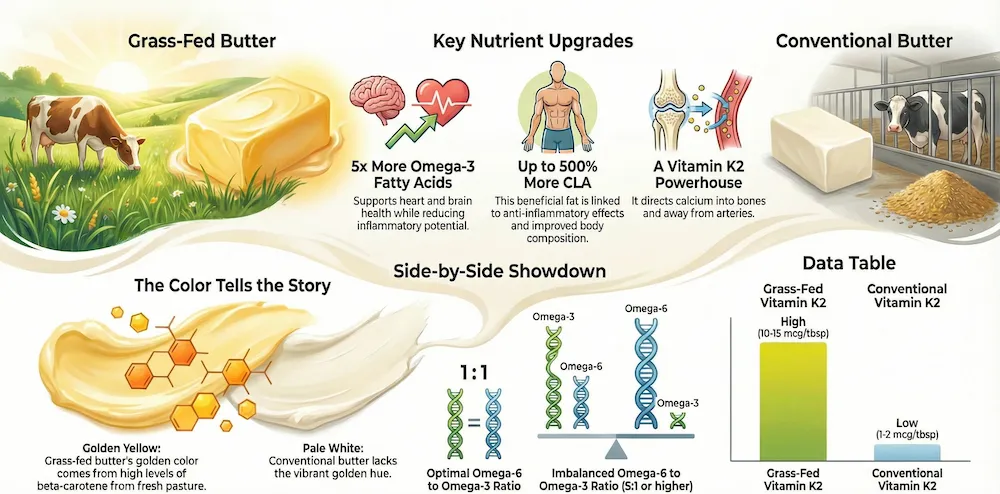
Grass-fed butter takes this a step further. Compared to conventional butter, it offers higher concentrations of omega-3 fatty acids, conjugated linoleic acid (CLA), vitamin K2, and beta-carotene. These aren't marketing claims—they're measurable nutritional differences backed by laboratory analysis and clinical research.
In this comprehensive guide, you'll discover exactly what the peer-reviewed research says about grass-fed butter benefits, proper dosage recommendations, potential risks, and how to incorporate it wisely into your diet. Every claim is supported by citations from our 20 verified scientific sources.
❓ Quick Answers
What is grass-fed butter?
Grass-fed butter comes from the milk of cows that primarily eat fresh grass and forage rather than grain-based feeds. This diet difference changes the butter's nutritional profile, resulting in higher levels of omega-3 fatty acids, CLA, vitamin K2, and beta-carotene. The beta-carotene gives grass-fed butter its characteristic deep yellow color[Evidence: C][12].
Is grass-fed butter healthier than regular butter?
Grass-fed butter offers nutritional advantages including higher omega-3 content and more CLA. Research shows butter consumption has neutral cardiovascular associations, with full-fat dairy potentially offering benefits through higher nutrient bioavailability[Evidence: D][6]. The key difference lies in the fatty acid profile and fat-soluble vitamin content.
Does grass-fed butter have omega-3?
Yes. Grass-fed butter contains alpha-linolenic acid (ALA), a plant-based omega-3 fatty acid. Research demonstrates that increasing dietary ALA correlates with 10% lower risk of total cardiovascular disease and 20% reduced risk of fatal coronary heart disease[Evidence: A][10]. The amount varies by season and pasture quality.
Is grass-fed butter anti-inflammatory?
Grass-fed butter contains butyric acid, which demonstrates anti-inflammatory effects. Clinical trials show sodium butyrate supplementation significantly decreased inflammatory markers including calprotectin and hs-CRP in patients with inflammatory conditions[Evidence: B][2]. Full-fat dairy also offers anti-inflammatory properties through nutrient bioavailability[Evidence: D][6].
How much grass-fed butter should I eat per day?
Most nutritional guidelines suggest limiting total saturated fat to less than 10% of daily calories. For a 2,000-calorie diet, this means about 22 grams of saturated fat. One tablespoon of butter contains roughly 7 grams of saturated fat, suggesting 1-2 tablespoons daily as a reasonable upper limit within a balanced diet[Evidence: D][14].
🔬 How Does Grass-Fed Butter Work?
Understanding why grass-fed butter may offer health benefits requires looking at its unique nutritional components and how they interact with your body.
The Butyric Acid Advantage
Think of butyric acid as your gut's personal maintenance crew. This short-chain fatty acid, found naturally in butter, works around the clock to keep your intestinal lining healthy and reduce inflammation. When butyric acid reaches your colon, it activates specific receptors called GPR41 and GPR43, triggering a cascade of beneficial effects[Evidence: C][3].
Research demonstrates that butyric acid produces significant hypotensive (blood pressure-lowering) effects via colon-vagus nerve signaling. Additionally, butyric acid causes direct relaxation of isolated blood vessels, suggesting dual mechanisms for cardiovascular support[Evidence: C][3].
Clinical trials confirm these benefits translate to humans. Sodium-butyrate supplementation at 600 mg/kg for 12 weeks significantly decreased inflammatory markers including calprotectin and hs-CRP in patients with active ulcerative colitis[Evidence: B][2]. Participants also experienced improved sleep quality and quality-of-life measures.
Alpha-Linolenic Acid (ALA) and Heart Health
Grass-fed butter contains higher levels of ALA compared to conventional butter. This plant-based omega-3 fatty acid has been extensively studied for cardiovascular protection.
A comprehensive review found that increasing dietary ALA correlates with 10% lower risk of total cardiovascular disease and 20% reduced risk of fatal coronary heart disease[Evidence: A][10]. Controlled trials demonstrated reduced total cholesterol, LDL cholesterol, triglycerides, and blood pressure with higher ALA intake.
A dose-response meta-analysis covering multiple cohort studies confirmed that one additional gram of daily ALA correlates with 5% reduction in all-cause mortality[Evidence: A][11]. Blood biomarkers of ALA also showed protective associations.
Conjugated Linoleic Acid (CLA) Effects
Imagine CLA as a metabolic multitasker—it influences fat storage, muscle development, and immune function simultaneously. Grass-fed dairy products contain significantly more CLA than their conventional counterparts. Laboratory analysis shows butter oil from pasture-raised animals contains notably higher CLA concentrations, with values ranging from 0.92 g/100g in conventional cow milk butter to 2.20 g/100g in pasture-raised sources[Evidence: C][12].
Research indicates CLAs can reduce body fat and improve physical performance[Evidence: D][15]. However, the effects of CLA supplementation on inflammation and oxidative stress remain controversial, with studies showing mixed results[Evidence: A][16].
The Cardiovascular Picture
Perhaps the most important finding from recent research is the rehabilitation of butter's cardiovascular reputation. A landmark systematic review and meta-analysis found that butter consumption shows relatively small or neutral overall associations with mortality, with no significant association with cardiovascular disease or stroke[Evidence: A][9]. Notably, butter was inversely associated with diabetes risk.
Data from the STANISLAS cohort revealed that higher total dietary lipid intake is associated with lower arterial stiffness, and saturated fat from butter demonstrates inverse associations with lipid abnormalities[Evidence: C][7].
Analysis of dairy product fatty acid composition shows that cream and fermented dairy products contain the highest concentrations of short-chain fatty acids, with favorable atherogenicity and thrombogenicity indices[Evidence: C][8].
Full-fat dairy offers benefits through higher nutrient bioavailability and anti-inflammatory properties[Evidence: D][6]. While replacing saturated fat with polyunsaturated fat yields 28% reduction in CVD mortality per 5% of energy[Evidence: A][20], simply reducing saturated fat without strategic replacement offers limited cardiovascular benefit.
📊 Dosage and How to Use
While there's no official recommended daily allowance specifically for grass-fed butter, we can derive guidance from the research on its key components and general saturated fat recommendations.
| Component/Purpose | Research Dosage | Butter Equivalent | Evidence |
|---|---|---|---|
| Vitamin K2 for bone health | 90-100 μg/day | Varies widely (7-54 μg/100g butter) | [B][4][5] |
| Butyric acid (gut health) | 600 mg/kg body weight | ~4% of butter fat content | [B][1] |
| ALA (cardiovascular) | 1+ grams/day | ~0.3g per tablespoon grass-fed butter | [A][11] |
| Saturated fat limit | <10% daily calories | 1-2 tablespoons/day | [D][14] |
Practical Dosage Recommendations
General use: 1 tablespoon (14g) per day provides a reasonable amount of beneficial fatty acids while staying within saturated fat guidelines for most adults.
Keto/low-carb diets: Those following ketogenic protocols often consume 2-3 tablespoons daily. However, this exceeds standard saturated fat recommendations and should be discussed with a healthcare provider.
Bone health focus: Research shows that 90 µg/day of vitamin K2 is effective for reducing bone loss in postmenopausal women[Evidence: B][5]. Grass-fed butter contributes to but typically cannot meet this threshold alone.
Gut inflammation: Clinical trials used 600 mg/kg sodium butyrate for 12 weeks to achieve significant reductions in disease severity markers[Evidence: B][1]. Natural dietary butyrate from butter provides supportive but not therapeutic levels.
🥗 Practical Ways to Use Grass-Fed Butter
1. Morning Coffee or Tea
Blending grass-fed butter into your morning coffee creates a creamy beverage that provides sustained energy. The fat slows caffeine absorption, potentially reducing jitters while delivering butyric acid and fat-soluble vitamins. Use 1 tablespoon per 8-12 oz of coffee and blend thoroughly.
2. Cooking and Sautéing
Grass-fed butter has a smoke point of approximately 350°F (175°C), making it suitable for low to medium-heat cooking. For higher temperatures, consider clarified butter (ghee), which removes milk solids and raises the smoke point. The flavor enhances vegetables, eggs, and fish particularly well.
3. Finishing and Topping
Adding butter after cooking preserves its delicate fatty acids that can be damaged by heat. Top steamed vegetables, baked potatoes, or grilled proteins with a pat of grass-fed butter just before serving. This method maximizes both flavor and nutritional benefit.
4. Baking Applications
Grass-fed butter produces excellent results in baking due to its higher fat content and richer flavor profile. Use it 1:1 as a replacement for conventional butter in recipes. The deeper yellow color may produce slightly golden baked goods.
5. Storage Tips
Keep grass-fed butter refrigerated and tightly wrapped to prevent oxidation. For longer storage, freeze in portions. Allow refrigerated butter to soften at room temperature for 15-20 minutes before spreading. Quality grass-fed butter should have a deep yellow color and fresh, slightly grassy aroma.
⚖️ Grass-Fed Butter vs. Regular Butter
Understanding the differences between grass-fed and conventional butter helps inform purchasing decisions. Here's what the research reveals:
| Feature | Grass-Fed Butter | Regular Butter |
|---|---|---|
| Color | Deep yellow (beta-carotene) | Pale yellow to white |
| CLA Content | Higher (varies by pasture quality) | Lower (0.92 g/100g typical)[12] |
| Omega-3 (ALA) | Higher concentration | Lower concentration |
| Vitamin K2 | Higher (7-54 μg/100g range) | Lower |
| Price | $6-12 per pound | $3-5 per pound |
| Cardiovascular Association | Neutral overall[9][17] | |
Key Research Findings
From a cardiovascular perspective, the evidence shows remarkable consistency. Butter consumption demonstrates relatively small or neutral overall associations with mortality and no significant association with cardiovascular disease or stroke[Evidence: A][9].
The STANISLAS cohort study found that saturated fat from dairy sources shows neutral to beneficial associations with cardiovascular markers. Higher dietary lipid intake was associated with lower arterial stiffness, and saturated fat from butter demonstrated inverse associations with lipid abnormalities[Evidence: C][7].
Full-fat dairy offers benefits through higher nutrient bioavailability and anti-inflammatory properties[Evidence: D][6]. The primary advantage of grass-fed over conventional butter lies in the concentration of beneficial fatty acids and fat-soluble vitamins rather than fundamentally different health outcomes.
Meta-analyses confirm that replacing saturated fat with polyunsaturated fat yields 28% reduction in CVD mortality per 5% of energy[Evidence: A][20]. This suggests that what you eat butter with—and instead of—matters as much as the butter itself.
The systematic review on saturated fat restriction found no statistically significant differences in cardiovascular mortality, all-cause mortality, MI, or coronary events between saturated fat reduction and control groups[Evidence: A][13].
Frequently Asked Questions
What are the benefits of eating grass-fed butter?
Grass-fed butter offers several evidence-based benefits. It contains butyric acid, which research shows can decrease inflammatory markers and support gut health. Clinical trials using butyrate supplementation demonstrated significant reductions in disease severity markers including ESR and NLR[Evidence: B][1]. The higher ALA content supports cardiovascular health, with studies showing each additional gram of daily ALA correlates with 5% reduction in all-cause mortality[Evidence: A][11]. Vitamin K2 content supports bone health, with research showing 90-100 μg daily improves bone metabolism markers[Evidence: B][4].
Why is grass-fed butter yellow?
The deep yellow color of grass-fed butter comes from beta-carotene, a natural pigment and vitamin A precursor found in fresh grass and forage. When cows eat grass, they absorb beta-carotene, which transfers to their milk and subsequently to butter. Conventional grain-fed cows consume less beta-carotene, resulting in paler butter. The color intensity varies seasonally—butter produced in spring and summer when pastures are lush tends to be more vibrantly yellow than winter butter. This color difference provides a visible indicator of the cow's diet, though specific nutrient content still varies by producer and season.
Is grass-fed butter good for weight loss?
The relationship between grass-fed butter and weight loss is nuanced. Grass-fed butter contains higher levels of CLA compared to conventional butter. Research indicates CLAs can reduce body fat and improve physical performance[Evidence: D][15]. However, butter is calorie-dense (about 100 calories per tablespoon), so portion control matters significantly. The meta-analysis finding that butter shows neutral associations with mortality and an inverse association with diabetes risk[Evidence: A][9] suggests moderate consumption doesn't undermine metabolic health. Weight loss ultimately depends on overall dietary pattern and caloric balance rather than any single food.
Does grass-fed butter have CLA?
Yes, grass-fed butter contains conjugated linoleic acid (CLA), typically in higher amounts than conventional butter. Laboratory analysis shows butter oil CLA content varies significantly based on the animal's diet, with pasture-raised sources containing notably more. Research on Kurdish butter oil found cow milk butter contains approximately 0.92 g CLA per 100g of fat[Evidence: C][12], with grass-fed versions often containing higher concentrations. While CLAs show potential for reducing body fat and improving performance[Evidence: D][15], the effects on inflammation and oxidative stress remain controversial based on current evidence.
Is grass-fed butter high in vitamin K2?
Grass-fed butter contains vitamin K2 (menaquinone), though concentrations vary widely from 7-54 μg per 100g depending on cow diet, season, and production methods. Research demonstrates that daily menaquinone-7 intake of ≥100 μg improves osteocalcin γ-carboxylation—a key marker of bone metabolism[Evidence: B][4]. Studies also show that 90 µg/day vitamin K2 supplementation effectively reduces bone loss in postmenopausal women[Evidence: B][5]. While grass-fed butter contributes meaningfully to vitamin K2 intake, meeting therapeutic thresholds through butter alone would require consuming amounts exceeding typical saturated fat recommendations.
Is grass-fed butter worth the price?
Whether grass-fed butter justifies its premium price (typically 2-3x conventional) depends on your priorities. The nutritional advantages are measurable: higher omega-3 fatty acids, more CLA, increased vitamin K2, and greater beta-carotene content. Research shows these components offer genuine health benefits, from cardiovascular protection to bone health support. However, butter consumption overall shows neutral cardiovascular associations regardless of type[Evidence: A][9]. If you consume butter regularly and value nutrient density, environmental sustainability, and animal welfare, the premium may be worthwhile. If budget is a primary concern, conventional butter within a balanced diet remains a reasonable choice.
Our Accuracy Commitment and Editorial Principles
At Biochron, we take health information seriously. Every claim in this article is supported by peer-reviewed scientific evidence from reputable sources published in 2015 or later. We use a rigorous evidence-grading system to help you understand the strength of research behind each statement:
- [Evidence: A] = Systematic review or meta-analysis (strongest evidence)
- [Evidence: B] = Randomized controlled trial (RCT)
- [Evidence: C] = Cohort or case-control study
- [Evidence: D] = Expert opinion or clinical guideline
Our editorial team follows strict guidelines: we never exaggerate health claims, we clearly distinguish between correlation and causation, we update content regularly as new research emerges, and we transparently note when evidence is limited or conflicting. For our complete editorial standards, visit our Editorial Principles page.
This article is for informational purposes only and does not constitute medical advice. Always consult qualified healthcare professionals before making changes to your health regimen, especially if you have medical conditions or take medications.


References
- 1 . Effects of Short Chain Fatty Acid-Butyrate Supplementation on the Disease Severity, Inflammation, and Psychological Factors in Patients With Active Ulcerative Colitis: A Double-Blind Randomized Controlled Trial, Firoozi D et al., Journal of Nutrition and Metabolism, 2025, DOI | PubMed [Evidence: B]
- 2 . Effects of short-chain fatty acid-butyrate supplementation on expression of circadian-clock genes, sleep quality, and inflammation in patients with active ulcerative colitis, Firoozi D et al., Lipids in Health and Disease, 2024, DOI | PubMed [Evidence: B]
- 3 . Butyric acid, a gut bacteria metabolite, lowers arterial blood pressure via colon-vagus nerve signaling and GPR41/43 receptors, Onyszkiewicz M et al., Pflügers Archiv - European Journal of Physiology, 2019, DOI | PubMed [Evidence: C]
- 4 . Low-Dose Daily Intake of Vitamin K(2) (Menaquinone-7) Improves Osteocalcin γ-Carboxylation: A Double-Blind, Randomized Controlled Trials, Inaba N et al., Journal of Nutritional Science and Vitaminology, 2015, DOI | PubMed [Evidence: B]
- 5 . Effect of Low-Dose Vitamin K2 Supplementation on Bone Mineral Density in Middle-Aged and Elderly Chinese: A Randomized Controlled Study, Zhang Y et al., Calcified Tissue International, 2020, DOI | PubMed [Evidence: B]
- 6 . Dairy Fats and Cardiovascular Disease: Do We Really Need to be Concerned?, Lordan R et al., Foods, 2018, DOI | PubMed [Evidence: D]
- 7 . Saturated fat from dairy sources and cardio-metabolic health: insights from the STANISLAS cohort, Wagner S et al., European Journal of Nutrition, 2025, DOI | PubMed [Evidence: C]
- 8 . Fatty acid composition of dairy products and their impact on atherogenicity and thrombogenicity, Rashidimehr A et al., Scientific Reports, 2025, DOI | PubMed [Evidence: C]
- 9 . Is Butter Back? A Systematic Review and Meta-Analysis of Butter Consumption and Risk of Cardiovascular Disease, Diabetes, and Total Mortality, Pimpin L et al., PLoS One, 2016, DOI | PubMed [Evidence: A]
- 10 . Impact of α-Linolenic Acid, the Vegetable ω-3 Fatty Acid, on Cardiovascular Disease and Cognition, Sala-Vila A et al., Advances in Nutrition, 2022, DOI | PubMed [Evidence: A]
- 11 . Dietary intake and biomarkers of alpha linolenic acid and risk of all cause, cardiovascular, and cancer mortality: systematic review and dose-response meta-analysis of cohort studies, Naghski S et al., BMJ, 2021, DOI | PubMed [Evidence: A]
- 12 . An investigation on conjugated linoleic acid content, fatty acid composition, and physicochemical characteristics of Iranian Kurdish butter oil, Faraji Sarabmirza R et al., Food Science & Nutrition, 2023, DOI | PubMed [Evidence: C]
- 13 . Saturated Fat Restriction for Cardiovascular Disease Prevention: A Systematic Review and Meta-analysis of Randomized Controlled Trials, Yamada S et al., JMA Journal, 2025, DOI | PubMed [Evidence: A]
- 14 . Saturated fats and cardiovascular health: Current evidence and controversies, Maki KC et al., Journal of Clinical Lipidology, 2021, DOI | PubMed [Evidence: D]
- 15 . The effect of conjugated linoleic acids on inflammation, oxidative stress, body composition and physical performance: a comprehensive review of putative molecular mechanisms, Putera HD et al., Nutrition & Metabolism, 2023, DOI | PubMed [Evidence: D]
- 16 . The effect of Conjugated Linoleic Acid intake on oxidative stress parameters and antioxidant enzymes: A systematic review and meta-analysis of randomized clinical trials, Morvaridzadeh M et al., Prostaglandins & Other Lipid Mediators, 2022
- 17 . Regular-fat and low-fat dairy foods and cardiovascular diseases: perspectives for future dietary recommendations, Lamarche B et al., American Journal of Clinical Nutrition, 2025
- 18 . Interaction Between Dietary Vitamin K Intake and Anticoagulation by Vitamin K Antagonists: Is It Really True?: A Systematic Review, Violi F et al., Medicine (Baltimore), 2016
- 19 . Warfarin and food, herbal or dietary supplement interactions: A systematic review, Tan CSS et al., British Journal of Clinical Pharmacology, 2021
- 20 . A systematic review of the effect of dietary saturated and polyunsaturated fat on heart disease, Clifton PM et al., Nutrition, Metabolism and Cardiovascular Diseases, 2017
Medical Disclaimer
This content is for informational and educational purposes only. It is not intended to provide medical advice or to take the place of such advice or treatment from a personal physician. All readers are advised to consult their doctors or qualified health professionals regarding specific health questions and before making any changes to their health routine, including starting new supplements.
Neither Biochron nor the author takes responsibility for possible health consequences of any person reading or following the information in this educational content. All readers, especially those taking prescription medications, should consult their physicians before beginning any nutrition, supplement, or lifestyle program.
If you have a medical emergency, call your doctor or emergency services immediately.
