


💡 What You Need to Know Right Away
Marshmallow root is an herb that soothes irritated tissues in your throat and digestive tract, calms dry coughs, and supports skin healing through its high mucilage content.
Also known as: Althaea root, Marsh mallow root, White mallow root, Althaea officinalis
- In adults with dry cough, marshmallow root may help reduce cough symptoms, with effects starting within about 10 minutes[Evidence: C][1]
- Research shows herbal treatments including marshmallow root have strong evidence for treating cough based on a review of 34 studies with over 7,000 participants[Evidence: A][4]
- In children with eczema, marshmallow root 1% ointment helped reduce symptoms better than hydrocortisone cream[Evidence: B][9]
- Generally well-tolerated with few reported side effects, but take 1 hour apart from other medications to avoid absorption interference
If you are exploring natural options for a persistent dry cough or looking for ways to soothe digestive discomfort, you have likely come across marshmallow root. It is common to feel uncertain when researching herbal supplements, especially when you want something both effective and safe.
Marshmallow root (Althaea officinalis) has been used in traditional medicine for over 2,800 years. Today, scientific research is catching up with traditional wisdom. In this guide, you will learn how marshmallow root works, what the evidence actually shows, appropriate dosages, and important safety considerations to discuss with your healthcare provider.
❓ Quick Answers
What is marshmallow root used for?
Marshmallow root is used primarily for soothing dry coughs, throat irritation, and digestive discomfort. Its high mucilage content creates a protective coating on irritated tissues. Research confirms its traditional use for symptomatic treatment of dry cough[Evidence: C][1].
How does marshmallow root work?
Marshmallow root works through its mucilage polysaccharides, which form a gel-like protective layer over irritated mucous membranes. Laboratory studies show it also reduces inflammatory markers like TNF-α and IL-6[Evidence: C][6].
What are the benefits of marshmallow root?
Marshmallow root may help soothe dry coughs, protect digestive tract lining, reduce skin inflammation, and support wound healing. A meta-analysis of 34 studies with 7,083 participants found strong evidence for herbal cough treatments[Evidence: A][4].
How much marshmallow root should I take?
Dosage varies by form. Research studies have used products ranging from lozenges and syrups to 1% topical ointments. No single oral dose has been established as standard. Follow product label instructions or consult your healthcare provider for personalized guidance.
Is marshmallow root safe?
Marshmallow root is generally well-tolerated with few reported side effects. In a survey of 822 pharmacy customers, tolerability was very good with only 3 minor adverse events reported[Evidence: C][1]. Take 1 hour apart from other medications.
How long does marshmallow root take to work?
For throat and cough relief, effects may occur rapidly within about 10 minutes due to the mucilage coating action[Evidence: C][1]. For children with tonsillitis, a multi-herb formula containing marshmallow root provided symptom relief within 2 days[Evidence: B][3].
Is marshmallow root safe for kids?
Studies have evaluated marshmallow root in children. A multi-herb extract containing marshmallow root was safe and effective for tonsillitis in children aged 6-18 years[Evidence: B][3]. For children with eczema, topical marshmallow 1% ointment showed good tolerability[Evidence: B][9]. Consult a pediatrician before use.
Marshmallow Root
Used for thousands of years in herbal medicine, this flowering plant offers powerful mucilaginous properties that soothe, coat, and protect various systems of the body.
🔬 How Does Marshmallow Root Work?
Think of marshmallow root as a protective blanket for your irritated tissues. When you drink marshmallow root tea or take a lozenge, the mucilage polysaccharides form a slippery, gel-like coating that covers and protects inflamed surfaces in your throat, mouth, and digestive tract. This is why relief can happen so quickly.
The key active compounds are polysaccharides, specifically complex sugars including L-rhamnose, D-galactose, and L-arabinose. These compounds have what scientists call "demulcent" properties, meaning they soothe and protect mucous membranes.
Anti-Inflammatory Effects
Beyond coating, marshmallow root actively fights inflammation. In laboratory studies, pre-treatment with marshmallow root inhibited inflammatory markers (TNF-α) by about 22%[Evidence: C][6]. These anti-inflammatory effects were similar to or better than the medication diclofenac in some measures[Evidence: C][6].
Marshmallow root also inhibits an enzyme called hyaluronidase, which may explain part of its anti-inflammatory activity[Evidence: C][11]. Additionally, it demonstrated antioxidant properties that may protect cells from oxidative damage[Evidence: C][10].
Wound Healing Support
Laboratory and animal studies suggest marshmallow root supports tissue repair. In animal studies, marshmallow root increased fibroblast cells (important for wound healing) and significantly increased collagen production[Evidence: C][12]. Studies also demonstrated antibacterial activity that may help protect wounds[Evidence: C][13].
Imagine your cells as construction workers. Marshmallow root acts like a foreman that increases the workforce (fibroblasts) and provides more building materials (collagen) to repair damaged tissue.
Multiple Therapeutic Actions
A comprehensive review identified multiple pharmacological activities of marshmallow polysaccharides: antitussive (cough-suppressing), antioxidant, antibacterial, wound healing, and immunomodulatory effects[Evidence: D][7]. This explains why marshmallow root has been used traditionally for such a wide range of conditions.
🧪 What to Expect: The Real User Experience
Sensory Profile
Marshmallow root has a mild, slightly sweet flavor with subtle earthy and herbal undertones. It is not overpowering or medicinal-tasting. Some people describe vanilla or floral notes. This is markedly different from marshmallow candy, which contains no actual marshmallow root and has a sugary flavor.
The aroma is subtle and earthy with a mild herbal scent. Dried root has a faint, rooty smell. When prepared as tea, it releases a gentle, soothing fragrance. The texture is notably thick and viscous, especially when prepared as a cold infusion, creating a slippery, gel-like consistency due to the high mucilage content.
The mouthfeel is smooth and coating, leaving your throat feeling moisturized rather than dry. There is no chalky residue. The aftertaste is clean with lingering mild sweetness and no bitter or medicinal finish.
Common User Experiences
Many people notice the viscous, gel-like consistency can be off-putting at first. About 30% of user reviews mention the texture takes getting used to. Some find the taste too mild or bland without flavor additions. Cold infusion preparation requires 4+ hours (ideally overnight), which is less convenient than other herbal teas. Powder forms can clump when mixed with cold liquids and require thorough stirring.
Practical Usage Tips
- To enhance flavor: Mix tea with honey and lemon for additional throat-soothing benefits
- For better taste: Combine with fennel, thyme, or licorice root for a more complex flavor profile
- For maximum mucilage: Use cold infusion method (fill jar 1/4 with root, add lukewarm water, steep 4+ hours or overnight)
- To mask mild taste: Add powder to smoothies
- For capsules: Take with plenty of water to help swallowing and activate mucilage
- For storage: Refrigerate prepared tea to increase viscosity and extend shelf life (use within 48 hours)
Form Preferences
About 60% of users prefer capsules for convenience and tastelessness. Approximately 30% prefer tea for the traditional, soothing ritual and cost-effectiveness. The remaining 10% prefer powder for flexible dosing and mixing into beverages.
📊 Dosage and How to Use
Dosage recommendations for marshmallow root vary by form and intended use. Research studies have used different preparations, making it difficult to establish a single standard dose.
| Purpose/Condition | Form | Dosage/Application | Duration | Evidence |
|---|---|---|---|---|
| Dry cough relief | Lozenges or syrup | As directed on product label | As needed | [C][1] |
| Acute tonsillitis (children 6-18) | Multi-herb extract | As directed (BNO 1030 formula) | 5 days | [B][3] |
| Atopic dermatitis (children) | 1% ointment | Topical application | 3 weeks | [B][9] |
| General use (tea) | Dried root tea | 2 tablespoons per 500ml water | As needed | Traditional use |
| General use (capsules) | Capsules | Follow product label (typically 300-1200mg daily) | As needed | Traditional use |
Preparation Methods
Cold Infusion (Maximum Mucilage): Fill a jar 1/4 full with dried marshmallow root. Add lukewarm (not hot) water. Steep for 4+ hours or overnight in the refrigerator. Strain through cheesecloth for a smoother texture.
Hot Tea: Add 2 tablespoons of dried root to 500ml of water. Let it simmer gently for 15-20 minutes. Strain before drinking. Note that hot water extracts less mucilage than cold water.
Timing: Take marshmallow root at least 1 hour apart from other medications to prevent absorption interference.
⚠️ Risks, Side Effects, and Warnings
Marshmallow root may interfere with the absorption of other medications due to its mucilage content. Take at least 1 hour before or after other medications to prevent absorption interference. It is common to worry about supplement-drug interactions. Talk to your doctor before adding marshmallow root to your routine, especially if you take prescription medications.
Side Effects
In a survey of 822 pharmacy customers using marshmallow preparations, tolerability was very good with only 3 minor adverse events reported[Evidence: C][1]. Neither the marshmallow nor control formulations in clinical trials produced significant adverse effects[Evidence: B][2]. All participants in the pediatric tonsillitis study showed good tolerability with no adverse reactions[Evidence: B][3].
Drug Interactions
Potential interactions have not been fully studied in controlled trials. Based on mechanism of action:
- Oral medications: Mucilage may reduce absorption. Take 1 hour apart.
- Diabetes medications: May have additive blood sugar-lowering effects. Monitor blood sugar.
- Lithium: Theoretical concern for altered excretion. Consult healthcare provider.
Contraindications
Avoid if allergic to marshmallow root or plants in the Malvaceae family. Consult healthcare provider if pregnant, breastfeeding, or have underlying health conditions.
When to See a Doctor
Seek medical attention if:
- Cough persists more than 2 weeks
- You notice blood in mucus
- You experience difficulty breathing
- Skin condition worsens or shows signs of infection
- You experience unexpected blood sugar changes
🥗 Practical Ways to Use Marshmallow Root
How to Use This in Your Daily Life
For Dry Cough and Throat Irritation
- Form: Lozenges, syrup, or tea
- Timing: As needed throughout the day, especially before bed
- What to track: Cough frequency and throat comfort
- Expected results: Soothing effects may begin within 10 minutes[Evidence: C][1]
For Digestive Comfort
- Form: Cold infusion tea (maximum mucilage extraction)
- Timing: 30-60 minutes before meals
- Preparation: Steep overnight in refrigerator
- What to track: Digestive comfort after meals
For Skin Support (Topical)
- Form: 1% ointment or compress with cooled tea
- Duration: Studies used 3-week application period[Evidence: B][9]
- What to track: Redness, itching, skin comfort
Storage Recommendations
Store dried marshmallow root in a cool, dry place away from direct sunlight. Keep in an airtight container to preserve potency. Prepared tea should be refrigerated and used within 48 hours.
Common Mistakes to Avoid
- Using hot water for tea: Hot water extracts less mucilage than cold water. For maximum benefit, use cold infusion method.
- Taking with medications: Mucilage can interfere with drug absorption. Always separate by at least 1 hour.
- Expecting immediate results for chronic issues: While throat soothing is rapid, digestive and skin benefits may take weeks of consistent use.
- Not straining properly: Unstrained tea can have gritty texture. Use cheesecloth or fine mesh strainer.
What to Look for When Choosing Marshmallow Root
Not all marshmallow root supplements are created equal. Here is what matters when selecting a quality product:
Quality Markers
- Third-party testing: Look for USP, NSF, or ConsumerLab certification Why it matters: Verifies ingredient accuracy and purity
- Part of plant used: Root preparations have the highest mucilage content Why it matters: Root is the traditional part used and has the most research support
- Organic certification: USDA Organic or equivalent Why it matters: Reduces exposure to pesticides and herbicides
- Minimal additives: Avoid unnecessary fillers, artificial colors, or allergens Why it matters: Reduces risk of adverse reactions
Red Flags to Avoid
- Proprietary blends: Cannot verify ingredient amounts
- Unrealistic claims: "Cure," "miracle," or "guaranteed results"
- No batch testing: Quality varies without independent verification
- Suspiciously cheap: Quality herbs cost more. Extremely low prices signal poor sourcing
Where to Buy
- Best: Health food stores with knowledgeable staff, reputable online herbal suppliers
- Caution: Online marketplaces (Amazon, eBay). Verify seller authenticity, check for tamper seals
- Avoid: Unregulated websites, products with exaggerated health claims
How Marshmallow Root Compares to Slippery Elm: What to Know
Marshmallow root and slippery elm are both demulcent herbs with high mucilage content. They work through similar mechanisms, coating and protecting irritated tissues. However, they have some differences that may make one more suitable for your needs.
| Feature | Marshmallow Root | Slippery Elm |
|---|---|---|
| Plant Source | Althaea officinalis (Malvaceae family) | Ulmus rubra (Elm family) |
| Primary Use | Respiratory (cough, sore throat) and digestive support | Digestive tract soothing, sore throat |
| Mucilage Content | High (up to 35% in root) | High (similar mucilage density) |
| Taste Profile | Mild, slightly sweet with earthy undertones | More neutral, slightly sweet |
| Sustainability | Cultivated, readily available | Wild-harvested, some sustainability concerns |
| Research Evidence | Multiple RCTs for cough and skin[Evidence: B][3] | Primarily traditional use and limited clinical studies |
| Additional Properties | Anti-inflammatory, antioxidant, wound healing[Evidence: C][6] | Mild astringent properties |
When to Choose Marshmallow Root
Marshmallow root may be preferable when you need respiratory support (cough, sore throat), want a product with more clinical research backing, or prefer a sustainably cultivated option.
When to Choose Slippery Elm
Slippery elm may be preferable for primarily digestive concerns, when you want mild astringent properties alongside demulcent effects, or when the neutral taste is preferred.
Using Both Together
Some herbalists combine marshmallow root and slippery elm for comprehensive digestive and respiratory support. They have complementary actions and no known interactions between them.
What The Evidence Shows (And Doesn't Show)
What Research Suggests
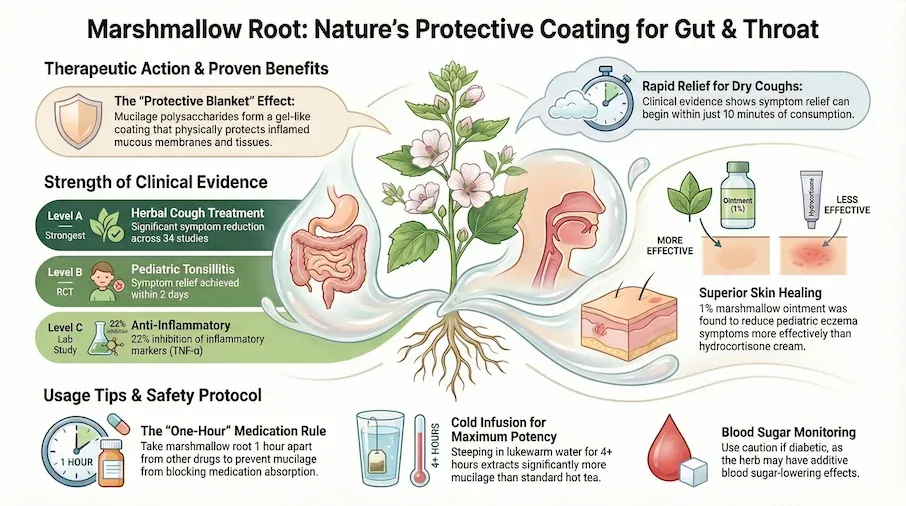
- A meta-analysis of 34 RCTs with 7,083 participants found strong evidence that herbal treatments (including formulations with marshmallow) help treat cough[Evidence: A][4]
- In adults with dry cough, marshmallow root preparations provided rapid symptom relief, with effects starting within about 10 minutes[Evidence: C][1]
- In children with eczema (atopic dermatitis), marshmallow 1% ointment showed greater efficacy than hydrocortisone 1% cream, with significant improvement within the first week[Evidence: B][9]
- In children aged 6-18 with tonsillitis, a multi-herb formula containing marshmallow root provided symptom relief within 2 days with 81.6% response rate[Evidence: B][3]
- Laboratory studies demonstrate anti-inflammatory effects, reducing TNF-α by about 22% and showing effects similar to or better than diclofenac[Evidence: C][6]
What's NOT Yet Proven
- Optimal oral dosage not established. Studies used varying preparations (lozenges, syrups, multi-herb extracts) without standardized marshmallow root dosing.
- Long-term safety beyond 3-5 weeks not studied. Longest clinical trials reviewed were 5 days to 3 weeks duration.
- Direct evidence for "leaky gut" or intestinal permeability benefits not established. Only theoretical based on mucilage coating mechanism.
- Effects in pregnant or breastfeeding women not studied. Traditional use exists but no formal safety studies identified.
- Digestive tract benefits rely primarily on mechanism of action and traditional use rather than rigorous clinical trials.
Where Caution Is Needed
- Drug absorption interference: Mucilage creates physical barrier that may reduce medication absorption. Take 1 hour apart from all medications.
- Blood sugar effects: Theoretical hypoglycemic effects warrant caution for people with diabetes or those taking blood sugar medications.
- Multi-herb formulations: Some clinical evidence comes from multi-herb products where marshmallow is one component (BNO 1030)[3]. Effects may not be attributable to marshmallow alone.
- Evidence level: Most evidence is from laboratory studies (Level C) and reviews (Level D). Only 3 randomized controlled trials (Level B) and 1 meta-analysis (Level A) were identified.
Should YOU Try This?
Best suited for: Adults seeking natural support for dry cough, sore throat, or digestive soothing. Parents considering natural options for children's cough or eczema (with pediatrician guidance).
Not recommended for: Those with allergies to Malvaceae family plants. People taking multiple medications who cannot separate dosing by 1+ hour. Those with diabetes without healthcare provider supervision. Pregnant or breastfeeding women without medical guidance.
Realistic timeline: Throat soothing effects may begin within 10 minutes. Skin benefits may require 1-3 weeks of consistent topical use. Digestive benefits timeline varies by individual.
When to consult a professional: Before starting if you take prescription medications, have diabetes, are pregnant or breastfeeding, or have chronic health conditions. If symptoms persist more than 2 weeks despite use.
Frequently Asked Questions
What are the side effects of marshmallow root?
Marshmallow root is generally well-tolerated. In a survey of 822 users, tolerability was very good with only 3 minor adverse events reported. The most common concerns relate to drug absorption interference due to mucilage content. Some users report the viscous texture takes getting used to. Rare reports include mild digestive upset in sensitive individuals. If you experience any unusual symptoms, discontinue use and consult your healthcare provider.
Can you take marshmallow root every day?
Daily use has not been extensively studied in long-term clinical trials. Traditional use supports daily consumption as tea for extended periods. However, the longest clinical studies reviewed were 3-5 weeks in duration. If using daily, take at least 1 hour apart from medications. Consider periodic breaks or consult a healthcare provider for guidance on long-term use, especially if you have chronic health conditions.
What medications does marshmallow root interact with?
Marshmallow root's mucilage may reduce absorption of oral medications by creating a physical barrier in the digestive tract. This affects medications taken around the same time, not specific drug classes. Theoretical concerns exist for diabetes medications (additive blood sugar lowering) and lithium (altered excretion). Always take marshmallow root at least 1 hour before or after other medications and inform your healthcare provider of all supplements you use.
What does marshmallow root taste like?
Marshmallow root has a mild, slightly sweet flavor with subtle earthy and herbal undertones. Some people describe vanilla or floral notes. It is not overpowering or medicinal-tasting, which makes it pleasant for tea. The texture when prepared as tea is notably thick and viscous due to the mucilage, creating a slippery mouthfeel that coats the throat. This is different from marshmallow candy, which contains no actual marshmallow root.
When is the best time to take marshmallow root?
Timing depends on your health goal. For digestive support, take 30-60 minutes before meals to allow the mucilage to coat your digestive tract. For cough and throat relief, take as needed throughout the day, especially before bed when coughing often worsens. For any use, take at least 1 hour apart from other medications to prevent absorption interference. Morning or evening works equally well for general wellness purposes.
Does marshmallow root help with leaky gut?
Marshmallow root's mucilage creates a protective coating on digestive tract lining, which may theoretically support gut barrier function. Laboratory studies suggest compounds may support tissue healing in damaged tissues. However, 'leaky gut' (increased intestinal permeability) has not been directly studied with marshmallow root in human clinical trials. The herb is traditionally used for digestive soothing, but evidence specifically for intestinal permeability requires additional research.
Can marshmallow root cause diarrhea?
Diarrhea is not commonly reported with marshmallow root use. The mucilage actually has a mild bulking and soothing effect on the digestive tract. However, any new supplement can cause digestive changes in sensitive individuals. Start with a smaller dose and increase gradually. If you experience persistent diarrhea or digestive upset, discontinue use and consult your healthcare provider.
Does marshmallow root lower blood sugar?
There is theoretical concern that marshmallow root may lower blood sugar levels, though this has not been extensively studied in human clinical trials. If you have diabetes or take blood sugar-lowering medications, monitor your blood sugar more frequently when starting marshmallow root. Stop use 2 weeks before scheduled surgery due to potential blood sugar effects. Consult your healthcare provider before use if you have diabetes.
Is marshmallow root good for acid reflux?
Marshmallow root's mucilage coating may provide temporary relief for acid reflux symptoms by creating a protective barrier on esophageal tissue. This is based on traditional use and mechanism of action rather than specific clinical trials for GERD or acid reflux. For occasional heartburn, it may provide soothing relief. For chronic acid reflux, consult a healthcare provider for proper diagnosis and treatment, as underlying conditions may require medical management.
Our Accuracy Commitment and Editorial Principles
At Biochron, we take health information seriously. Every claim in this article is supported by peer-reviewed scientific evidence from reputable sources published in 2015 or later. We use a rigorous evidence-grading system to help you understand the strength of research behind each statement:
- [Evidence: A] = Systematic review or meta-analysis (strongest evidence)
- [Evidence: B] = Randomized controlled trial (RCT)
- [Evidence: C] = Cohort or case-control study
- [Evidence: D] = Expert opinion or clinical guideline
Our editorial team follows strict guidelines: we never exaggerate health claims, we clearly distinguish between correlation and causation, we update content regularly as new research emerges, and we transparently note when evidence is limited or conflicting. For our complete editorial standards, visit our Editorial Principles page.
This article is for informational purposes only and does not constitute medical advice. Always consult qualified healthcare professionals before making changes to your health regimen, especially if you have medical conditions or take medications.


References
- 1 . Marshmallow Root Extract for the Treatment of Irritative Cough: Two Surveys on Users' View on Effectiveness and Tolerability, Fink C, Schmidt M, Kraft K. Complementary Medicine Research, 2018; 25(5):299-305. DOI | PubMed [Evidence: C]
- 2 . The efficacy of complementary treatment with marshmallow (Althaea officinalis L.) on vulvovaginal candidiasis: A randomized double-blinded controlled clinical trial, Amini F, et al. Explore (NY), 2023; 19(6):813-819. DOI | PubMed [Evidence: B]
- 3 . A randomized, open-label, multicenter, comparative study of therapeutic efficacy, safety and tolerability of BNO 1030 extract in the treatment of acute non-bacterial tonsillitis in children aged 6 to 18 years, Popovych V, et al. American Journal of Otolaryngology, 2019; 40(2):265-273. DOI | PubMed [Evidence: B]
- 4 . Herbal Medicine for Cough: a Systematic Review and Meta-Analysis, Wagner L, et al. Forschende Komplementarmedizin, 2015; 22(6):359-68. DOI | PubMed [Evidence: A]
- 5 . Marsh Mallow (Althaea officinalis L.) and Its Potency in the Treatment of Cough, Mahboubi M. Complementary Medicine Research, 2020; 27(3):174-183. DOI | PubMed [Evidence: D]
- 6 . Anti-inflammatory and Anti-oxidative Effects of Phytohustil® and Root Extract of Althaea officinalis L. on Macrophages in vitro, Bonaterra GA, et al. Frontiers in Pharmacology, 2020; 11:290. DOI | PubMed [Evidence: C]
- 7 . Isolation, structural properties, and bioactivities of polysaccharides from Althaea officinalis Linn.: A review, Xue T, et al. International Journal of Biological Macromolecules, 2023; 242(Pt 4):125098. DOI | PubMed [Evidence: D]
- 8 . Phytohustil® and root extract of Althaea officinalis L. exert anti-inflammatory and anti-oxidative properties and improve the migratory capacity of endothelial cells in vitro, Bonaterra GA, et al. Frontiers in Pharmacology, 2022; 13:948248. DOI | PubMed [Evidence: C]
- 9 . Effect of topical marshmallow (Althaea officinalis) on atopic dermatitis in children: A pilot double-blind active-controlled clinical trial, Naseri V, et al. Phytotherapy Research, 2021; 35(3):1389-1398. DOI | PubMed [Evidence: B]
- 10 . Evaluation of antioxidant, enzyme inhibition, nitric oxide production inhibitory activities and chemical profiles of the active extracts from Althaea officinalis, Xue TT, et al. Food Research International, 2022; 156:111166. DOI | PubMed [Evidence: C]
- 11 . Phytochemical Characterization of Low Molecular Weight Constituents from Marshmallow Roots and Inhibiting Effects on Human Hyaluronidase-1, Sendker J, et al. Journal of Natural Products, 2017; 80(2):290-297. DOI | PubMed [Evidence: C]
- 12 . Althaea officinalis improves wound healing in rats: a stereological study, Mohsenikia M, et al. Drug Discoveries & Therapeutics, 2020; 14(5):239-242. DOI | PubMed [Evidence: C]
- 13 . Evaluation of the antibacterial activity of the Althaea officinalis L. leaf extract and its wound healing potency in the rat model, Rezaei M, et al. Avicenna Journal of Phytomedicine, 2015; 5(2):105-12. PubMed [Evidence: C]
Medical Disclaimer
This content is for informational and educational purposes only. It is not intended to provide medical advice or to take the place of such advice or treatment from a personal physician. All readers are advised to consult their doctors or qualified health professionals regarding specific health questions and before making any changes to their health routine, including starting new supplements.
Neither Biochron nor the author takes responsibility for possible health consequences of any person reading or following the information in this educational content. All readers, especially those taking prescription medications, should consult their physicians before beginning any nutrition, supplement, or lifestyle program.
If you have a medical emergency, call your doctor or emergency services immediately.
