


💡 What You Need to Know Right Away
- CLA may modestly reduce body fat mass and increase fat-free mass, though effects are small and may not reach clinical significance based on 70 randomized controlled trials with 4,159 participants.[Evidence: A][1]
- CLA supplementation at 3,000 mg daily for 12 weeks reduced body fat percentage, trunk fat, fasting glucose, and insulin resistance (HOMA-IR) in obese adults.[Evidence: B][8]
- CLA significantly decreases inflammatory markers IL-6 and TNF-α, though it may slightly increase C-reactive protein (CRP).[Evidence: A][2]
- CLA does not negatively impact liver function (ALT and AST enzymes unchanged) and may reduce oxidative stress marker MDA (p=0.003).[Evidence: A][4]
Conjugated linoleic acid (CLA) has become one of the most researched fatty acids in nutrition science, with the global CLA market projected to reach $10.34 billion by 2030. If you've heard promises about CLA's weight loss potential, you're likely wondering what the science actually shows—and whether it's worth your attention.
The truth? Research reveals CLA offers measurable benefits for body composition, but the effects are more modest than supplement marketing suggests. This guide cuts through the hype to deliver what 12 peer-reviewed studies—including 10 meta-analyses analyzing thousands of participants—actually found about CLA's effects on your body, the right dosage, and important safety considerations you need to know.
❓ Quick Answers
What is CLA (conjugated linoleic acid)?
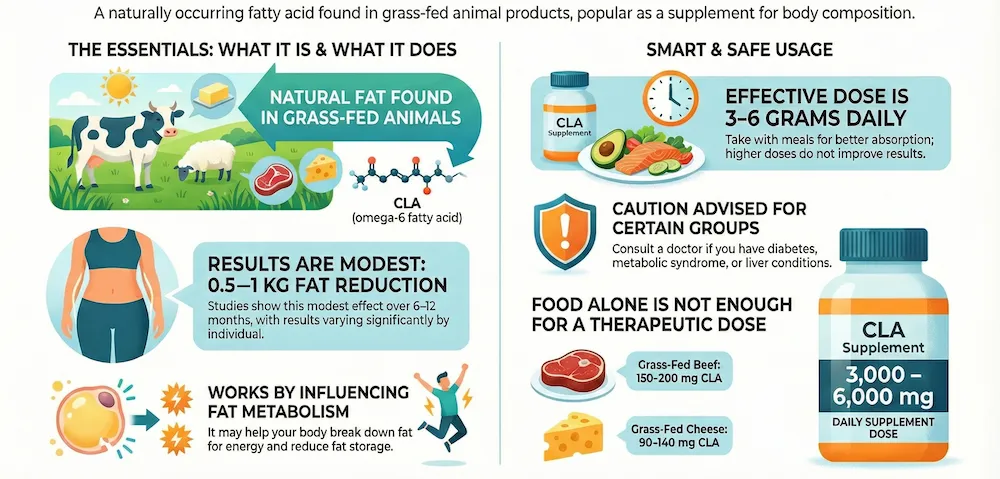
CLA is a naturally occurring omega-6 fatty acid found primarily in meat and dairy products from ruminant animals like cattle and sheep. It exists as multiple isomers, with cis-9, trans-11 (rumenic acid) being the most abundant in food sources. CLA supplements are typically produced from safflower or sunflower oil and contain a 50:50 blend of c9t11 and t10c12 isomers.[Evidence: A][7]
Does CLA help with weight loss?
Research suggests CLA may produce modest improvements in body composition. A meta-analysis of 70 randomized controlled trials with 4,159 participants found CLA significantly reduced body mass, BMI, waist circumference, and fat mass while increasing fat-free mass. However, researchers note these weight-loss properties are small and may not reach clinical importance.[Evidence: A][1]
What is the recommended dosage of CLA?
Clinical studies have used CLA doses ranging from 3,000 mg to 6,000 mg daily. A 12-week trial demonstrated that 3,000 mg daily effectively reduced body fat mass in obese adults.[Evidence: B][8] However, doses at or above 3,500 mg daily for 6 months or longer have been associated with elevated lipoprotein(a), a cardiovascular risk marker.[Evidence: A][11]
What are the side effects of CLA?
CLA may cause digestive discomfort and has shown mixed effects on inflammatory markers—decreasing IL-6 and TNF-α while increasing CRP by 0.89 mg/L.[Evidence: A][3] At higher doses (≥3.5 g/day) for extended periods (≥6 months), CLA significantly increased circulating lipoprotein(a) by 16.68 mg/L, an adverse cardiovascular marker.[Evidence: A][11]
Is CLA safe to take?
CLA appears safe for short-term use at moderate doses. A meta-analysis of 22 RCTs found CLA does not negatively impact liver function, with ALT and AST enzymes unchanged.[Evidence: A][4] When combined with exercise, CLA showed no higher risk of adverse events (RR 1.32, p>0.05) across 20 RCTs.[Evidence: A][12] Long-term safety requires caution regarding cardiovascular markers.
🔬 How Does CLA Work in Your Body?
Think of CLA as a metabolic dial-turner rather than an on-off switch. Unlike stimulant-based weight loss compounds that rev up your entire system, CLA works more subtly—adjusting how your body partitions energy between fat storage and lean tissue building. It's like having a skilled accountant who gradually redirects small amounts from your "fat savings account" into your "muscle investment fund."
At the molecular level, CLA influences several pathways simultaneously. Research indicates CLA significantly reduces inflammatory cytokines IL-6 and TNF-α,[Evidence: A][2] which are associated with obesity-related inflammation. This anti-inflammatory effect appears to work in tandem with CLA's impact on lipid metabolism.
CLA also demonstrates beneficial effects on vascular health. Studies show CLA reduces intercellular adhesion molecule (ICAM), a marker of endothelial function, though it does not significantly impact systolic or diastolic blood pressure.[Evidence: A][5]
The antioxidant properties of CLA add another layer to its mechanism. Meta-analysis of 22 randomized controlled trials found CLA may significantly reduce malondialdehyde (MDA), a marker of oxidative stress (p=0.003).[Evidence: A][4] This suggests CLA helps protect cells from oxidative damage.
In patients at cardiovascular risk, CLA led to significant reductions in body weight and body fat percentage without adversely affecting lipid profile or blood pressure markers.[Evidence: A][9] However, effects remain modest—imagine turning down your fat-storage thermostat by just one degree rather than a dramatic overhaul.
📊 Dosage and How to Use CLA
Clinical evidence provides specific dosage guidance based on your goals and health status. The following table summarizes dosages studied in peer-reviewed research:
| Purpose/Population | Dosage | Duration | Evidence |
|---|---|---|---|
| Body fat reduction in obese adults | 3,000 mg/day | 12 weeks | [B][8] |
| Cognitive function in older adults (mean age 72) | 6,000 mg/day | 8 weeks | [B][10] |
| Adverse effect threshold (Lp(a) elevation) | ≥3,500 mg/day | ≥24 weeks | [A][11] |
Timing and Administration
For optimal absorption, take CLA with meals containing dietary fat. Research protocols typically divided daily doses across 2-3 servings. In the 12-week obesity trial, participants took 3,000 mg daily with meals and experienced reductions in body fat mass, body fat percentage, and trunk fat, along with decreased fasting glucose and HOMA-IR (insulin resistance marker).[Evidence: B][8]
Recommended Maximum Intake
Based on available evidence, a conservative maximum of 3,000 mg daily is suggested. This dosage demonstrated efficacy in a 12-week RCT without reported adverse effects.[Evidence: B][8] Importantly, doses at or above 3,500 mg/day for 6 months or longer significantly elevated lipoprotein(a) by 26.13 mg/L—a dose-dependent cardiovascular risk.[Evidence: A][11]
⚠️ Risks, Side Effects, and Warnings
Inflammatory Marker Complexity
CLA demonstrates both pro-inflammatory and anti-inflammatory roles depending on the marker examined. A GRADE-assessed meta-analysis of 42 RCTs with 1,109 participants found IL-6 and TNF-α significantly decreased, while CRP slightly increased. Adiponectin and leptin remained unchanged in the overall population, though reductions appeared in women subgroups.[Evidence: A][2]
Liver Safety Profile
Reassuringly, CLA does not appear to harm liver function. Analysis of 22 randomized controlled trials found ALT and AST enzyme levels did not change after CLA supplementation.[Evidence: A][4]
Safety with Exercise
For those combining CLA with exercise programs, research provides reassurance. A meta-analysis of 20 RCTs found CLA combined with exercise showed no higher risk of adverse events (RR 1.32, p>0.05). However, this combination was ineffective for additional weight loss or exercise performance enhancement.[Evidence: A][12]
Cardiovascular Considerations
In patients at cardiovascular disease risk, CLA did not adversely affect lipid profile or blood pressure across 14 RCTs. Researchers concluded CLA may not have adverse effects on CVD risk markers, though effects on body composition remained modest and may not reach clinical importance.[Evidence: A][9]
🥗 Practical Ways to Use CLA
1. Prioritize Natural Food Sources
Systematic evaluation of CLA research recommends a balanced diet rich in natural CLA sources over supplementation.[Evidence: A][7] Grass-fed beef and dairy products contain significantly higher CLA concentrations than grain-fed alternatives. Focus on:
- Grass-fed beef (highest natural CLA content)
- Grass-fed butter and ghee
- Full-fat dairy from pasture-raised animals
- Lamb and goat products
2. If Supplementing, Start Conservative
Based on clinical evidence, begin with 3,000 mg daily divided across meals containing fat. This dosage showed efficacy for body fat reduction over 12 weeks in obese adults without significant adverse effects.[Evidence: B][8] Monitor your response before considering dose adjustments.
3. Limit Duration at Higher Doses
If using doses approaching 3,500 mg daily, limit continuous use to less than 6 months. Research shows lipoprotein(a) elevation becomes more significant at doses ≥3.5 g/day for durations ≥6 months.[Evidence: A][11] Consider cycling protocols with breaks between supplementation periods.
4. Combine with Balanced Lifestyle
While CLA combined with exercise was found safe (no increased adverse events), it did not enhance weight loss or exercise performance beyond exercise alone.[Evidence: A][12] View CLA as one component of a comprehensive approach rather than a standalone solution.
5. Choose Quality Supplements
Look for supplements that disclose their isomer ratio (c9t11 vs t10c12), provide third-party testing verification (USP, NSF, or Informed-Choice certification), and source CLA from safflower or sunflower oil. Avoid proprietary blends that hide ingredient amounts.
⚖️ CLA vs. Other Body Composition Supplements
Understanding how CLA compares to other popular supplements helps you make informed decisions. The following comparison is based on the mechanism and evidence profile of CLA versus common alternatives:
| Feature | CLA | Omega-3 Fatty Acids |
|---|---|---|
| Primary Mechanism | Lipid metabolism modulation, anti-inflammatory | Anti-inflammatory, cardiovascular support |
| Body Composition Effect | Modest fat reduction, increased lean mass[1] | Limited direct effect on body composition |
| Inflammatory Markers | Decreases IL-6, TNF-α; increases CRP[2][3] | Generally anti-inflammatory across markers |
| Cardiovascular Profile | No effect on lipids/BP; may increase Lp(a)[9][11] | Generally cardioprotective |
| Natural Sources | Grass-fed beef and dairy | Fatty fish, flaxseed, walnuts |
| Evidence Strength | 10 meta-analyses, modest effects | Extensive research, well-established benefits |
Unlike CLA, omega-3 fatty acids have a more consistent anti-inflammatory profile without the mixed effects on CRP and lipoprotein(a) observed with CLA. However, CLA has demonstrated more direct effects on body fat reduction and lean mass preservation,[Evidence: A][1] albeit modest in magnitude.
For those seeking body composition changes, CLA may offer slight advantages. For overall cardiovascular and anti-inflammatory support without body composition goals, omega-3s present a more favorable profile. Some individuals choose to use both, though combination research specific to CLA and omega-3 together is limited.
Frequently Asked Questions
Can CLA cause insulin resistance?
The relationship between CLA and insulin resistance depends significantly on the isomer form. Research indicates the t10c12 isomer found in supplements may have different metabolic effects than the naturally occurring c9t11 isomer (rumenic acid). However, a 12-week clinical trial in obese adults found that 3,000 mg daily CLA actually reduced HOMA-IR (a measure of insulin resistance) and decreased fasting glucose levels.[Evidence: B][8] The key appears to be dosage, duration, and individual metabolic status. Those with existing insulin resistance or diabetes should consult their healthcare provider before supplementation.
What are the different CLA isomers (c9t11 vs t10c12)?
CLA exists in multiple isomeric forms, with two being most significant. Cis-9, trans-11 CLA (rumenic acid) comprises approximately 80-90% of CLA in natural food sources like grass-fed beef and dairy. This isomer is associated with anti-inflammatory properties. Trans-10, cis-12 CLA is less common in foods but typically comprises 50% of commercial supplements made from safflower oil. This isomer is linked to the fat-reducing effects but may also be associated with some adverse metabolic effects. Research on older adults using rumenic acid-enriched CLA (predominantly c9t11) at 6 g/day for 8 weeks showed minimal effects on cognitive measures, with memory benefits observed only in male participants.[Evidence: B][10]
Does CLA affect liver function?
Evidence suggests CLA is safe for the liver. A comprehensive GRADE-assessed systematic review and meta-analysis of 22 randomized controlled trials specifically examined liver function enzymes after CLA supplementation. Results showed ALT (alanine aminotransferase) and AST (aspartate aminotransferase) levels did not change after CLA supplementation.[Evidence: A][4] Additionally, CLA may significantly reduce malondialdehyde (MDA), a marker of oxidative stress that can damage liver cells (p=0.003). This provides reassurance that CLA does not negatively impact liver function within studied dosage ranges and durations.
Is CLA safe for long-term use?
Long-term CLA safety requires careful consideration of dosage and duration. While short-term use at 3,000 mg daily for 12 weeks showed no significant adverse effects,[Evidence: B][8] meta-analysis revealed dose- and duration-dependent concerns. CLA supplementation at doses ≥3.5 g/day for ≥6 months significantly elevated circulating lipoprotein(a) by 26.13 mg/L—an adverse cardiovascular marker.[Evidence: A][11] Systematic evaluation recommends a balanced diet rich in natural CLA sources over long-term supplementation.[Evidence: A][7] If supplementing long-term, consider periodic breaks and cardiovascular marker monitoring.
Can CLA be safely combined with exercise?
Yes, combining CLA with exercise appears safe. A meta-analysis of 20 randomized controlled trials specifically examined CLA combined with exercise and found no higher risk of adverse events (relative risk 1.32, p>0.05).[Evidence: A][12] However, this same analysis found the combination was ineffective for enhancing weight loss or exercise performance beyond what exercise alone provides. The practical takeaway: CLA won't harm your exercise routine, but don't expect it to amplify your results. Focus on consistent exercise as your primary intervention and view CLA as a potential modest complement rather than a performance enhancer.
What are the cardiovascular effects of CLA?
CLA's cardiovascular profile is nuanced. A meta-analysis of 14 RCTs in patients at cardiovascular disease risk found CLA had no significant effect on lipid profile (cholesterol, triglycerides) or blood pressure, concluding CLA may not adversely affect CVD risk markers in this population.[Evidence: A][9] CLA also reduces ICAM, a marker of endothelial function.[Evidence: A][5] However, a separate meta-analysis of 6 RCTs with 752 subjects found CLA significantly increased lipoprotein(a) by 16.68 mg/L—a known cardiovascular risk marker. This elevation was dose- and duration-dependent.[Evidence: A][11] Individuals with cardiovascular concerns should discuss CLA use with their healthcare provider.
Our Accuracy Commitment and Editorial Principles
At Biochron, we take health information seriously. Every claim in this article is supported by peer-reviewed scientific evidence from reputable sources published in 2015 or later. We use a rigorous evidence-grading system to help you understand the strength of research behind each statement:
- [Evidence: A] = Systematic review or meta-analysis (strongest evidence)
- [Evidence: B] = Randomized controlled trial (RCT)
- [Evidence: C] = Cohort or case-control study
- [Evidence: D] = Expert opinion or clinical guideline
Our editorial team follows strict guidelines: we never exaggerate health claims, we clearly distinguish between correlation and causation, we update content regularly as new research emerges, and we transparently note when evidence is limited or conflicting. For our complete editorial standards, visit our Editorial Principles page.
This article is for informational purposes only and does not constitute medical advice. Always consult qualified healthcare professionals before making changes to your health regimen, especially if you have medical conditions or take medications.


References
- 1 . The effects of conjugated linoleic acid supplementation on anthropometrics and body composition indices in adults: a systematic review and dose-response meta-analysis. Asbaghi O, Shimi G, Hosseini Oskouie F, et al. British Journal of Nutrition, 2024. PubMed | DOI [Evidence: A]
- 2 . The effects of conjugated linoleic acid supplementation on inflammatory cytokines and adipokines in adults: A GRADE-assessed systematic review and dose-response meta-analysis. Rastgoo S, Shimi G, Shiraseb F, et al. Frontiers in Immunology, 2023. PubMed | DOI [Evidence: A]
- 3 . Effect of conjugated linoleic acid on blood inflammatory markers: a systematic review and meta-analysis on randomized controlled trials. Haghighatdoost F, Nobakht M Gh BF. European Journal of Clinical Nutrition, 2018. PubMed | DOI [Evidence: A]
- 4 . The effects of conjugated linoleic acid supplementation on liver function enzymes and malondialdehyde in adults: A GRADE-assessed systematic review and dose-response meta-analysis. Haghighat N, Shimi G, Shiraseb F, et al. Pharmacological Research, 2022. PubMed | DOI [Evidence: A]
- 5 . The effects of conjugated linoleic acid supplementation on blood pressure and endothelial function in adults: A systematic review and dose-response meta-analysis. Asbaghi O, Shimi G, Naseri K, et al. European Journal of Pharmacology, 2022. PubMed | DOI [Evidence: A]
- 6 . The effect of Conjugated Linoleic Acid intake on oxidative stress parameters and antioxidant enzymes: A systematic review and meta-analysis of randomized clinical trials. Morvaridzadeh M, Estêvão MD, Morvaridi M, et al. Prostaglandins & Other Lipid Mediators, 2022. PubMed | DOI [Evidence: A]
- 7 . Systematic evaluation on the effectiveness of conjugated linoleic acid in human health. Fuke G, Nornberg JL. Critical Reviews in Food Science and Nutrition, 2017. PubMed | DOI [Evidence: A]
- 8 . The Effect of Conjugated Linoleic Acid Supplementation on Body Composition, Serum Insulin and Leptin in Obese Adults. Esmaeili Shahmirzadi F, Ghavamzadeh S, Zamani T. Archives of Iranian Medicine, 2019. PubMed [Evidence: B]
- 9 . The effects of conjugated linoleic acid supplementation on cardiovascular risk factors in patients at risk of cardiovascular disease: A GRADE-assessed systematic review and dose-response meta-analysis. Esmaeilnejad M, Rasaei N, Goudarzi K, et al. British Journal of Nutrition, 2024. PubMed | DOI [Evidence: A]
- 10 . Effects of rumenic acid rich conjugated linoleic acid supplementation on cognitive function and handgrip performance in older men and women. Jenkins NDM, Housh TJ, Miramonti AA, et al. Experimental Gerontology, 2016. PubMed | DOI [Evidence: B]
- 11 . Adverse effects of conjugated linoleic acids supplementation on circulating lipoprotein (a) levels in overweight and obese individuals: results of a systematic review and meta-analysis of randomized controlled trials. Leilami K, Kohansal A, Mohammadi Sartang M, et al. American Journal of Cardiovascular Diseases, 2021. PubMed [Evidence: A]
- 12 . Effects of conjugated linoleic acid and exercise on body composition and obesity: a systematic review and meta-analysis. Liang CW, Cheng HY, Lee YH, et al. Nutrition Reviews, 2023. PubMed | DOI [Evidence: A]
Medical Disclaimer
This content is for informational and educational purposes only. It is not intended to provide medical advice or to take the place of such advice or treatment from a personal physician. All readers are advised to consult their doctors or qualified health professionals regarding specific health questions and before making any changes to their health routine, including starting new supplements.
Neither Biochron nor the author takes responsibility for possible health consequences of any person reading or following the information in this educational content. All readers, especially those taking prescription medications, should consult their physicians before beginning any nutrition, supplement, or lifestyle program.
If you have a medical emergency, call your doctor or emergency services immediately.
