


💡 What You Need to Know Right Away
- Sea buckthorn oil significantly reduces triglycerides (SMD -0.722, p<0.001) and total cholesterol (SMD -0.345, p=0.021) according to a meta-analysis of randomized controlled trials[Evidence: A][1]
- Taking 0.75 ml daily for 30 days normalized blood pressure in hypertensive subjects and enhanced antioxidant status[Evidence: B][2]
- Sea buckthorn cream accelerated wound healing with significantly shorter healing periods (p<0.001) compared to standard silver sulfadiazine treatment in burn patients[Evidence: B][5]
- Oral palmitoleic acid (500 mg/day for 12 weeks) significantly improved skin hydration and reduced transepidermal water loss[Evidence: B][19]
Are you looking for a natural supplement that supports heart health, improves your skin, and delivers nutrients you can't easily find elsewhere? Sea buckthorn oil (Hippophae rhamnoides) might be exactly what you're searching for.
This bright orange oil comes from the berries and seeds of a hardy shrub native to the mountainous regions of Europe and Asia. What makes it truly special is its remarkable nutritional profile—sea buckthorn is one of the only plant sources containing all four omega fatty acids (3, 6, 7, and 9), with particularly high concentrations of the rare omega-7 palmitoleic acid.[Evidence: D][17]
With over 200 documented bioactive properties and growing scientific research, sea buckthorn oil has earned attention from health researchers worldwide.[Evidence: D][17] In this comprehensive guide, you'll discover what the clinical evidence actually shows about its benefits, learn safe dosage ranges, and understand who should exercise caution. Let's explore the science behind this ancient remedy.
❓ Quick Answers
What is sea buckthorn oil good for?
Sea buckthorn oil is used primarily for cardiovascular support and skin health. Clinical research demonstrates it reduces triglycerides and cholesterol levels in people with abnormal lipid metabolism.[Evidence: A][1] Studies also show it accelerates wound healing, with burn patients experiencing significantly faster recovery compared to conventional treatments.[Evidence: B][5]
Does sea buckthorn oil have omega-7?
Yes, sea buckthorn oil is one of the richest natural sources of omega-7 palmitoleic acid. This unique monounsaturated fatty acid is rare in the plant kingdom and gives sea buckthorn its distinctive benefits.[Evidence: D][17] Higher palmitoleic acid levels correlate with improved insulin sensitivity and better lipid profiles in humans.[Evidence: D][8]
Is it safe to take sea buckthorn oil every day?
Research suggests daily use is safe for most adults. A 90-day toxicity study found no adverse outcomes at doses up to 10 mL/kg in animal models.[Evidence: D][12] Human clinical trials lasting up to 90 days with 111 participants reported no serious adverse events.[Evidence: B][3] However, consult your healthcare provider before starting any new supplement.
What does sea buckthorn oil do for your skin?
Sea buckthorn oil supports skin health through multiple mechanisms. Oral supplementation with 500 mg/day palmitoleic acid for 12 weeks significantly improved skin hydration and reduced transepidermal water loss.[Evidence: B][19] Topical application improved psoriasis symptoms (PASI scores) at 4 and 8 weeks in clinical trials.[Evidence: B][16]
How much sea buckthorn oil should I take daily?
Clinical studies have used various dosages depending on health goals. For cardiovascular health, 0.75 ml daily showed benefits in 30 days.[Evidence: B][2] For skin hydration, 500 mg/day palmitoleic acid for 12 weeks proved effective.[Evidence: B][19] Specific recommendations depend on your health objectives.
🔬 How Does Sea Buckthorn Oil Work?
Think of sea buckthorn oil as a master key that unlocks multiple health pathways simultaneously. Just as a Swiss Army knife contains many specialized tools, sea buckthorn oil delivers over 95 distinct flavonoids, unique fatty acids, and bioactive compounds that work together through complementary mechanisms.[Evidence: D][7]
Anti-Inflammatory Pathways
Sea buckthorn oil contains four major flavonoid components—taxifolin, isoquercitrin, narcissoside, and quercetin—that suppress nitric oxide production and reduce inflammatory protein expression including TNF and various interleukins.[Evidence: D][6] The oil inhibits key inflammatory signaling cascades: NF-κB, JAK2/STAT1, and p38-MAPK pathways.[Evidence: C][4]
In patients with ulcerative colitis, 720 mg/day of cis-palmitoleic acid for 8 weeks produced significant reductions in high-sensitivity C-reactive protein (hsCRP, p=0.04) and erythrocyte sedimentation rate (ESR, p<0.05).[Evidence: B][20]
Cardiovascular Protection
Imagine your blood vessels as highways—sea buckthorn oil helps keep these pathways clear and flexible. The oil works through multiple cardiovascular mechanisms: antioxidant activity, vascular function enhancement, and reduced cell death in heart tissue.[Evidence: A][15]
A meta-analysis of randomized controlled trials found sea buckthorn reduced triglycerides (SMD -0.722, p<0.001) and total cholesterol (SMD -0.345, p=0.021), while reducing LDL-C and increasing HDL-C.[Evidence: A][1] In animal studies, sea buckthorn seed oil reduced blood total cholesterol by 20-22%, enhanced cholesterol excretion, and modified beneficial bacterial communities in the gut.[Evidence: C][11]
Blood Pressure Regulation
Palmitoleic acid appears to protect against hypertension by inhibiting NF-κB-mediated inflammation. A case-control study found hypertensive subjects had lower erythrocyte phospholipid palmitoleic acid levels, and high levels were inversely associated with hypertension.[Evidence: C][9]
Skin and Tissue Repair
Sea buckthorn oil improves blood circulation and oxygenation of the skin.[Evidence: D][17] In dry eye models, sea buckthorn pulp oil restored aqueous tear secretion and reduced inflammatory responses in the lacrimal gland.[Evidence: C][10]
Metabolic Regulation
Research indicates potential synergistic interactions between sea buckthorn's fatty acids that may enhance overall metabolic benefits, though further research is needed to fully characterize these effects.[Evidence: D][18]
📊 Dosage and How to Use
Clinical studies provide specific dosage guidance for sea buckthorn oil, though optimal amounts vary by health goal. The following table summarizes evidence-based recommendations from published research.
| Purpose/Condition | Dosage | Duration | Evidence |
|---|---|---|---|
| Cardiovascular health (hypertension, cholesterol) | 0.75 ml/day sea buckthorn seed oil | 30 days | [B][2] |
| Cardiovascular/anti-inflammatory (hypercholesterolemia) | 90 ml/day sea buckthorn puree | 90 days | [B][3] |
| Skin barrier improvement/hydration | 500 mg/day palmitoleic acid | 12 weeks | [B][19] |
| Anti-inflammatory (ulcerative colitis) | 720 mg/day cis-palmitoleic acid | 8 weeks | [B][20] |
| Inflammatory markers (note: no benefit observed) | 688 mg/day palmitoleate | 3 weeks | [B][14] |
Important Dosage Notes
- Oil vs. Purified Palmitoleic Acid: Some studies use whole sea buckthorn oil while others use purified palmitoleic acid supplements. The whole oil contains additional beneficial compounds.
- Duration Matters: One study found that 688 mg/day for only 3 weeks failed to reduce inflammatory biomarkers, suggesting longer dosing periods may be necessary.[Evidence: B][14]
- Individual Variation: Benefits for lipid metabolism were observed primarily in people with abnormal lipid levels—those with normal levels may see less effect.[Evidence: A][1]
Forms of Sea Buckthorn Oil
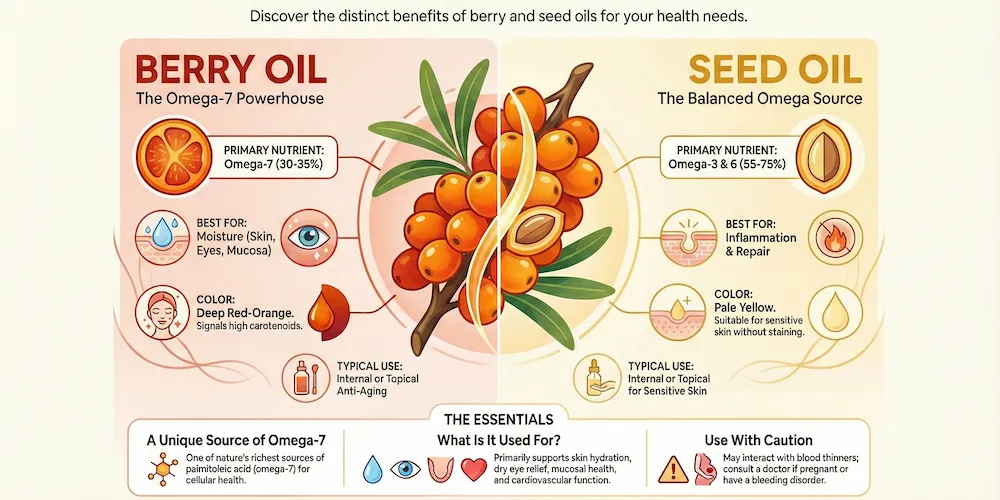
- Seed Oil: Higher in omega-3 and omega-6 fatty acids; lighter in color
- Fruit/Pulp Oil: Higher in omega-7 palmitoleic acid; bright orange color
- Capsules: Convenient for oral supplementation; typical doses 500-1000 mg
- Topical: Applied directly to skin for wound healing or dermatological conditions
🥗 Practical Ways to Use Sea Buckthorn Oil
1. Oral Supplementation
For cardiovascular and systemic benefits, take sea buckthorn oil capsules or liquid with meals. Based on clinical evidence, start with lower doses (0.75 ml or 500 mg palmitoleic acid) and use consistently for at least 4-12 weeks to assess benefits.[Evidence: B][2]
2. Topical Application for Skin Conditions
For psoriasis and inflammatory skin conditions, apply sea buckthorn extract topically to affected areas. Clinical trials showed improvement in PASI and DLQI scores at 4 and 8 weeks, while placebo-treated lesions worsened.[Evidence: B][16] For atopic dermatitis-like conditions, topical application reduced skin lesion severity scores and prevented mast cell infiltration.[Evidence: C][4]
3. Wound Care
Sea buckthorn cream has shown superiority to 1% silver sulfadiazine for second-degree burns, with significantly shorter healing periods (p<0.001).[Evidence: B][5] Apply to clean wounds under healthcare supervision.
4. Quality Selection Tips
- Check Omega-7 Content: Look for products listing palmitoleic acid percentage (quality products typically contain 30%+ in fruit oil)
- Extraction Method: Supercritical CO2 extraction preserves more bioactive compounds
- Organic Certification: USDA organic certification ensures no synthetic pesticides
- Avoid Blends: Pure sea buckthorn oil delivers documented benefits; avoid products diluted with cheaper oils
5. Storage and Shelf Life
- Store in a cool, dark place away from direct sunlight
- Refrigerate after opening to extend freshness
- Typical shelf life: 12-18 months unopened; 6 months after opening
- Signs of spoilage: rancid smell, color changes, or unusual texture
⚖️ Sea Buckthorn Oil vs. Other Oils
Sea buckthorn oil has a unique composition that sets it apart from other popular supplemental oils. Research indicates most studies examine isolated fatty acids rather than complete sea buckthorn extracts, and the potential synergistic interactions between fatty acids have not been fully characterized.[Evidence: D][18]
| Feature | Sea Buckthorn Oil | Fish Oil | Flaxseed Oil |
|---|---|---|---|
| Omega-7 (Palmitoleic Acid) | High (unique feature) | Low/trace | None |
| Omega-3 Fatty Acids | Moderate (ALA) | High (EPA, DHA) | High (ALA) |
| Omega-6 Fatty Acids | Present | Low | Present |
| Plant-Based | Yes | No | Yes |
| Cardiovascular Evidence | Reduces TG (SMD -0.722), TC (SMD -0.345)[1] | Well-established | Moderate |
| Skin Benefits | Hydration, wound healing[19][5] | Limited | Limited |
| Antioxidant Content | High (95+ flavonoids, carotenoids)[7] | Low (requires added vitamin E) | Moderate |
When to Choose Sea Buckthorn Oil
- Omega-7 Focus: If you specifically want palmitoleic acid benefits for skin or metabolic health
- Plant-Based Diet: Vegetarians and vegans seeking omega fatty acid supplementation
- Skin Conditions: When targeting skin hydration, wound healing, or inflammatory skin conditions
- Antioxidant Support: The 95+ flavonoids provide broad antioxidant coverage[Evidence: D][7]
When Fish Oil May Be Better
- EPA/DHA Focus: Fish oil provides preformed EPA and DHA, which are more efficiently used by the body than plant-based ALA
- Established Cardiovascular Protocols: Fish oil has more extensive clinical trial data for heart health
- Cognitive Health: DHA is particularly important for brain function
Frequently Asked Questions
Is sea buckthorn better than fish oil?
Sea buckthorn and fish oil offer different benefits and aren't directly comparable. Sea buckthorn oil is unique for its high omega-7 palmitoleic acid content, which is rare in other sources. A meta-analysis found it reduces triglycerides (SMD -0.722, p<0.001) and total cholesterol (SMD -0.345, p=0.021).[Evidence: A][1] Fish oil provides EPA and DHA omega-3s, which have extensive evidence for cardiovascular and cognitive health. For skin benefits and plant-based nutrition, sea buckthorn may be preferable. For maximum EPA/DHA intake, fish oil is superior. Many people benefit from using both oils for complementary effects.
Can sea buckthorn oil help with dry eyes?
Research suggests sea buckthorn oil may support eye health, particularly for dry eye syndrome. In a murine dry eye model, sea buckthorn pulp oil restored aqueous tear secretion and reduced inflammatory responses in the lacrimal gland.[Evidence: C][10] Palmitoleate (the primary omega-7 fatty acid) demonstrated comparable effectiveness to the whole oil in this study. The mechanism appears to involve supporting mucous membrane hydration throughout the body. However, human clinical trials with specific dosing protocols for dry eye are currently limited. If you experience chronic dry eyes, consult an eye care professional for comprehensive treatment options.
Does sea buckthorn oil help with menopause?
Sea buckthorn oil has shown promise for certain menopause-related symptoms, particularly vaginal dryness. The oil's omega-7 palmitoleic acid supports mucous membrane health throughout the body, which may provide relief from dryness affecting vaginal tissues. While specific menopause-focused clinical trials are limited in post-2015 literature, the oil's documented effects on skin hydration (significant improvement with 500 mg/day palmitoleic acid over 12 weeks)[Evidence: B][19] and mucous membrane support suggest potential benefits. The anti-inflammatory properties may also help with other menopausal discomforts. Consult your healthcare provider for personalized recommendations.
Is sea buckthorn oil good for heart health?
Yes, clinical evidence supports sea buckthorn oil's cardiovascular benefits. A comprehensive meta-analysis of randomized controlled trials found significant reductions in triglycerides (SMD -0.722, p<0.001) and total cholesterol (SMD -0.345, p=0.021), along with reduced LDL-C and increased HDL-C.[Evidence: A][1] In hypertensive subjects, 0.75 ml daily for 30 days normalized blood pressure and reduced cholesterol and triglycerides.[Evidence: B][2] The oil works through multiple mechanisms: anti-inflammatory, antioxidant, and vascular function enhancement.[Evidence: A][15] Benefits were most pronounced in people with abnormal lipid metabolism rather than those with normal levels.
What is the difference between seed oil and fruit oil?
Sea buckthorn produces two distinct oils with different compositions and uses. Seed oil is extracted from the seeds and is lighter in color, higher in omega-3 (alpha-linolenic acid) and omega-6 (linoleic acid) fatty acids, and has a more balanced fatty acid profile. It's often preferred for general nutritional supplementation. Fruit/pulp oil is extracted from the orange berry flesh, has a bright orange-red color due to high carotenoid content, and contains significantly more omega-7 palmitoleic acid. It's particularly valued for skin health and mucous membrane support. A clinical study using sea buckthorn seed oil (0.75 ml daily) showed cardiovascular benefits,[Evidence: B][2] while skin benefits are often attributed to the omega-7-rich fruit oil.
Is sea buckthorn oil safe during pregnancy?
Current evidence is limited for human pregnancy safety. Animal teratogenicity studies showed no maternal or embryo toxicity in rats, and no mutagenic effects were observed in comprehensive genotoxicity testing.[Evidence: D][13] However, no human pregnancy studies have been conducted with sea buckthorn oil specifically. Given this gap in human data, pregnant women should consult their healthcare provider before using sea buckthorn oil supplements. The general recommendation is to exercise caution with any supplement during pregnancy unless specifically approved by a qualified healthcare professional. If considering topical use for skin conditions during pregnancy, discuss with your dermatologist or obstetrician first.
Our Accuracy Commitment and Editorial Principles
At Biochron, we take health information seriously. Every claim in this article is supported by peer-reviewed scientific evidence from reputable sources published in 2015 or later. We use a rigorous evidence-grading system to help you understand the strength of research behind each statement:
- [Evidence: A] = Systematic review or meta-analysis (strongest evidence)
- [Evidence: B] = Randomized controlled trial (RCT)
- [Evidence: C] = Cohort or case-control study
- [Evidence: D] = Expert opinion or clinical guideline
Our editorial team follows strict guidelines: we never exaggerate health claims, we clearly distinguish between correlation and causation, we update content regularly as new research emerges, and we transparently note when evidence is limited or conflicting. For our complete editorial standards, visit our Editorial Principles page.
This article is for informational purposes only and does not constitute medical advice. Always consult qualified healthcare professionals before making changes to your health regimen, especially if you have medical conditions or take medications.


References
- 1 . Effects of sea buckthorn (Hippophae rhamnoides L.) on factors related to metabolic syndrome: A systematic review and meta-analysis of randomized controlled trial, Geng Y et al., Phytotherapy Research, 2022, PubMed, DOI [Evidence: A]
- 2 . Effect of seabuckthorn seed oil in reducing cardiovascular risk factors: A longitudinal controlled trial on hypertensive subjects, Vashishtha V et al., Clinical Nutrition, 2017, PubMed, DOI [Evidence: B]
- 3 . Effects of sea buckthorn puree on risk factors of cardiovascular disease in hypercholesterolemia population: a double-blind, randomized, placebo-controlled trial, Zhou F et al., Animal Biotechnology, 2022, PubMed, DOI [Evidence: B]
- 4 . Sea Buckthorn (Hippophaë rhamnoides L.) Oil Improves Atopic Dermatitis-Like Skin Lesions via Inhibition of NF-κB and STAT1 Activation, Hou DD et al., Skin Pharmacology and Physiology, 2017, PubMed, DOI [Evidence: C]
- 5 . To compare the effect of sea buckthorn and silver sulfadiazine dressing on period of wound healing in patients with second-degree burns: A randomized triple-blind clinical trial, Abdullahzadeh M et al., Wound Repair and Regeneration, 2021, PubMed, DOI [Evidence: B]
- 6 . Sea buckthorn flavonoids: Purification, identification, and in vitro anti-inflammatory effects, Yang Z et al., Journal of Chromatography A, 2025, PubMed, DOI [Evidence: D]
- 7 . Flavonoids from sea buckthorn: A review on phytochemistry, pharmacokinetics and role in metabolic diseases, Liu S et al., Journal of Food Biochemistry, 2021, PubMed, DOI [Evidence: D]
- 8 . Protocol for a randomized placebo-controlled clinical trial using pure palmitoleic acid to ameliorate insulin resistance and lipogenesis in overweight and obese subjects with prediabetes, Cetin E et al., Frontiers in Endocrinology, 2024, PubMed, DOI [Evidence: D]
- 9 . Palmitoleic Acid Protects against Hypertension by Inhibiting NF-κB-Mediated Inflammation, Tang J et al., Molecular Nutrition & Food Research, 2021, PubMed, DOI [Evidence: C]
- 10 . Restoration of Tear Secretion in a Murine Dry Eye Model by Oral Administration of Palmitoleic Acid, Kimura Y et al., Nutrients, 2017, PubMed, DOI [Evidence: C]
- 11 . Sea buckthorn seed oil reduces blood cholesterol and modulates gut microbiota, Hao W et al., Food & Function, 2019, PubMed, DOI [Evidence: C]
- 12 . Acute and subchronic toxicity studies of seabuckthorn (Hippophae rhamnoides L.) oil in rodents, Zhao P et al., Regulatory Toxicology and Pharmacology, 2017, PubMed, DOI [Evidence: D]
- 13 . Genotoxicity and teratogenicity of seabuckthorn (Hippophae rhamnoides L.) berry oil, Wen P et al., Drug and Chemical Toxicology, 2020, PubMed, DOI [Evidence: D]
- 14 . Omega-7 Mixed Fatty Acid Supplementation Fails to Reduce Serum Inflammatory Biomarkers: A Placebo-Controlled, Double-Blind Randomized Crossover Trial, Sasagawa M et al., Nutrients, 2021, PubMed, DOI [Evidence: B]
- 15 . Research progress of sea buckthorn (Hippophae rhamnoides L.) in prevention and treatment of cardiovascular disease, Chen Y et al., Frontiers in Cardiovascular Medicine, 2024, PubMed, DOI [Evidence: A]
- 16 . Sea buckthorn extract in the treatment of psoriasis, Boca AN et al., Experimental and Therapeutic Medicine, 2019
- 17 . Abundance of active ingredients in sea-buckthorn oil, Zielińska A et al., Lipids in Health and Disease, 2017
- 18 . The impact of sea buckthorn oil fatty acids on human health, Solà Marsiñach M et al., Lipids in Health and Disease, 2019
- 19 . Efficacy and safety of oral palmitoleic acid supplementation for skin barrier improvement: A 12-week, randomized, double-blinded, placebo-controlled study, Koh YG et al., Heliyon, 2023
- 20 . Effect of Cis-palmitoleic acid supplementation on inflammation and expression of HNF4γ, HNF4α and IL6 in patients with ulcerative colitis, Bueno-Hernández N et al., Minerva Gastroenterologica e Dietologica, 2017
Medical Disclaimer
This content is for informational and educational purposes only. It is not intended to provide medical advice or to take the place of such advice or treatment from a personal physician. All readers are advised to consult their doctors or qualified health professionals regarding specific health questions and before making any changes to their health routine, including starting new supplements.
Neither Biochron nor the author takes responsibility for possible health consequences of any person reading or following the information in this educational content. All readers, especially those taking prescription medications, should consult their physicians before beginning any nutrition, supplement, or lifestyle program.
If you have a medical emergency, call your doctor or emergency services immediately.
