


💡 What You Need to Know Right Away
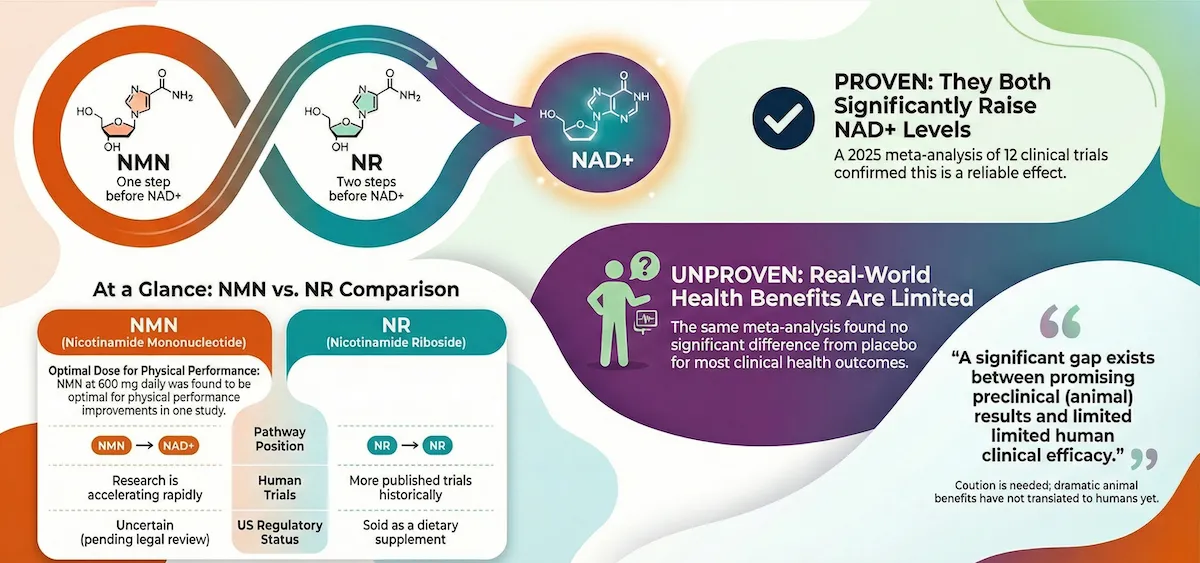
- Both NMN and NR effectively raise blood NAD+ levels, but a 2025 meta-analysis of 12 RCTs found most clinically relevant outcomes showed no significant difference from placebo[Evidence: A][1]
- NMN at 600 mg daily appears optimal for physical performance improvements based on multicenter RCT data[Evidence: B][2]
- Current evidence does not support NMN or NR for muscle preservation in adults over 60 years old[Evidence: A][5]
- A significant gap exists between promising preclinical (animal) results and limited human clinical efficacy—caution is needed when interpreting supplement marketing claims[Evidence: D][11]
You've probably heard that NAD+ levels decline with age and that boosting them might support healthy aging. Now you're facing the ultimate question: should you take NMN or NR? Both are marketed as powerful NAD+ precursors, but the scientific reality is more nuanced than supplement advertisements suggest.
This comprehensive guide cuts through the marketing hype to deliver evidence-based answers. We've analyzed 13 peer-reviewed sources, including two 2025 meta-analyses, to give you the complete picture on NMN vs NR. You'll discover how each compound works, what clinical trials actually show, proper dosing based on research, and whether taking both together makes sense. By the end, you'll have the knowledge to make an informed decision that aligns with your health goals.
❓ Quick Answers
Which is better NMN or NR?
Neither is definitively "better." Both NMN and NR safely and effectively raise blood NAD+ levels. A 2025 meta-analysis found that while both elevate NAD+, most clinically relevant outcomes showed no significant difference from placebo for either compound.[Evidence: A][1] Your choice may depend on cost, availability, and individual response.
Can you take NMN and NR together?
Yes, you can safely take NMN and NR together. Both compounds are well-tolerated in human trials, and no documented interactions exist between them. Some longevity researchers suggest combining 250 mg of each for comprehensive tissue coverage, since different tissues may prefer one precursor over the other.[Evidence: B][6]
What is the difference between NMN and NR?
The main difference is molecular structure: NMN contains a phosphate group that NR lacks, making NMN one step closer to NAD+ in the biosynthesis pathway. NMN has molecular weight of 334.2 g/mol while NR is 255.2 g/mol. Both ultimately convert to NAD+ inside cells, but may use different cellular transporters for absorption.[Evidence: D][4]
Does David Sinclair take NMN or NR?
Harvard geneticist David Sinclair publicly states he takes 1,000 mg NMN daily, preferring it over NR because NMN is one step closer to NAD+ in the biosynthesis pathway. However, personal supplement choices are not clinical evidence, and Sinclair himself emphasizes the importance of waiting for more human trial data.
Which absorbs better NMN or NR?
NR has demonstrated clear oral bioavailability in humans, with a single 1,000 mg dose raising blood NAD+ up to 2.7-fold.[Evidence: B][9] NMN also elevates NAD+ effectively through oral administration. Direct head-to-head bioavailability comparison RCTs are lacking, so we cannot definitively declare a winner.
Which has more human studies NMN or NR?
NR currently has more published human clinical trials than NMN, including longer-term safety data. However, NMN research has accelerated significantly since 2022, with multiple RCTs now published. A 2025 meta-analysis included 12 RCTs on NMN alone.[Evidence: A][1] Both compounds continue to be actively researched.
🔬 How Do NMN and NR Work?
Understanding how NMN and NR boost NAD+ requires a brief look at your body's NAD+ production system. Think of NAD+ as your cellular battery—it powers hundreds of essential reactions including energy production, DNA repair, and sirtuin activation. As you age, this battery gradually loses charge, and NMN and NR are two different ways to recharge it.
The NAD+ Biosynthesis Pathway: Imagine a factory assembly line where raw materials become finished products. NR enters the line at an earlier station, while NMN joins closer to the final product. Both ultimately become NAD+, but they take slightly different routes to get there.
NR (nicotinamide riboside) enters cells and gets converted to NMN by the enzyme nicotinamide riboside kinase (NRK). Then NMN (nicotinamide mononucleotide) gets converted to NAD+ by the enzyme NMNAT. Administration of either NAD+ precursor successfully increases the intracellular NAD+ pool.[Evidence: D][10]
However, here's the critical reality check: despite clear NAD+ elevation, human clinical efficacy has been lower than expected from animal studies.[Evidence: D][10] The mechanism works—NAD+ goes up—but whether that translates to meaningful health benefits remains an active research question.
Both compounds occur naturally in small amounts in foods including vegetables, meat, and milk.[Evidence: D][4] The supplemental doses used in research far exceed dietary intake, providing pharmacological rather than nutritional quantities.
NR demonstrates dose-dependent increases in NAD+ levels, with single doses of 100, 300, and 1,000 mg producing progressively greater NAD+ elevation in human blood.[Evidence: B][9] This confirms oral bioavailability and suggests a clear dose-response relationship.
📊 Dosage and How to Use
Dosage recommendations for NMN and NR vary significantly across studies. The following table summarizes dosages tested in human clinical trials with their outcomes:
| Compound | Dosage | Duration | Population | Key Outcome | Evidence |
|---|---|---|---|---|---|
| NMN | 250 mg/day | 12 weeks | Older adults | Improved walking speed, sleep quality[3] | [B] |
| NMN | 600 mg/day | 60 days | Healthy middle-aged adults | Optimal for physical performance[2] | [B] |
| NMN | 900 mg/day | 60 days | Healthy middle-aged adults | Safe, improved walking distance[2] | [B] |
| NR | 500 mg/day (250 mg BID) | 6 weeks (crossover) | Healthy middle-aged/older adults | Well-tolerated, elevated NAD+ metabolism[6] | [B] |
| NR | 1,000 mg/day (escalating) | 10 weeks | Older adults with MCI | NAD+ increased 2.6-fold, no cognitive change[7] | [B] |
| NR | 1,000 mg single dose | Single dose | Healthy humans | NAD+ increased 2.7-fold[9] | [B] |
| NR | 3,000 mg/day (1,500 mg BID) | 4 weeks | Parkinson's disease patients | NAD+ increased up to 5-fold, safe[13] | [B] |
Dosage Summary
- NMN starting dose: 250 mg daily, based on RCT showing benefits in older adults[3]
- NMN optimal dose: 600 mg daily for physical performance[2]
- NMN tested maximum: 900 mg daily with no safety issues[2]
- NR common dose: 250-500 mg daily for general NAD+ elevation
- NR tested maximum: 3,000 mg daily for 4 weeks with no moderate or severe adverse events[13]
Timing: Most studies administered supplements in the morning. Taking with food may improve absorption and reduce potential GI discomfort. Consistency matters more than exact timing.
⚠️ Risks, Side Effects, and Warnings
Side Effects Observed in Clinical Trials
Both NMN and NR have demonstrated favorable safety profiles in human trials:
- NMN: No safety issues observed at doses up to 900 mg daily for 60 days[Evidence: B][2]
- NR: Well-tolerated with no moderate or severe adverse events at 3,000 mg daily for 4 weeks[Evidence: B][13]
- NR: No differential adverse events compared to placebo in cognitive impairment trial[Evidence: B][7]
- NR: Not genotoxic across bacterial and chromosomal assays[Evidence: C][12]
Toxicology Data (NR)
Formal toxicology assessment of NR established:[Evidence: C][12]
- No mortality at acute dose of 5,000 mg/kg in animal studies
- NOAEL (No Observed Adverse Effect Level): 300 mg/kg/day
- LOAEL (Lowest Observed Adverse Effect Level): 1,000 mg/kg/day
- Target organs at high doses: liver, kidney, ovaries, testes (in animal studies)
Long-Term Safety Limitations
Critical gap: Most human trials lasted 4-12 weeks. Long-term safety data beyond 12 weeks remains limited for both compounds. The 24-week long-COVID trial with NR showed continued safety over 6 months but did not assess outcomes beyond this period.[Evidence: B][8]
🥗 Practical Ways to Use NAD+ Precursors
How to Use This in Your Daily Life
Scenario 1: General NAD+ Support (Starting Out)
- Dose: NMN 250 mg daily OR NR 250-500 mg daily
- Duration: 12 weeks minimum to assess response[3]
- Population: Adults seeking NAD+ elevation
- Timing: Morning with breakfast
- What to track: Energy levels, sleep quality, general wellbeing (subjective)
- Expected results: NAD+ elevation occurs within weeks; clinical benefits vary individually
Scenario 2: Physical Performance Focus
- Dose: NMN 600 mg daily[2]
- Duration: 60 days minimum based on study protocol
- Population: Healthy middle-aged adults
- Timing: Morning
- What to track: Walking distance, exercise capacity
- Expected results: Blood NAD concentrations increase significantly; physical performance may improve at 600-900 mg doses[2]
Practical Integration
Take capsules with breakfast to establish a consistent routine. Store in cool, dry place away from direct sunlight. Both NMN and NR occur naturally in small amounts in foods including vegetables, meat, and milk[4]—supplementation provides pharmacological doses far exceeding dietary intake.
Common Mistakes to Avoid
- Expecting immediate results: Studies used 6-12 week protocols[3][6]—sporadic use may not achieve benefits.
- Ignoring the evidence gap: NAD+ elevation is confirmed, but clinical benefits are limited in current trials[11]—set realistic expectations.
- Mega-dosing without guidance: Higher is not always better. 600 mg NMN showed optimal results in one RCT[2].
- Substituting for medical care: NAD+ precursors are supplements, not treatments for disease.
⚖️ NMN vs NR: Complete Comparison
The following table provides a comprehensive side-by-side comparison based on available evidence:
| Feature | NMN | NR |
|---|---|---|
| Full Name | Nicotinamide mononucleotide | Nicotinamide riboside |
| Molecular Weight | 334.2 g/mol | 255.2 g/mol |
| Pathway Position | One step before NAD+ | Two steps before NAD+ |
| NAD+ Elevation | Significant increase confirmed[1] | 2.7-fold increase at 1,000 mg[9] |
| Tested Dose Range | 250-900 mg daily | 100-3,000 mg daily |
| Optimal Dose (Research) | 600 mg daily[2] | 250-500 mg daily |
| Human Studies | 12+ RCTs in 2025 meta-analysis[1] | More published trials historically |
| Clinical Benefits | Limited beyond NAD+ elevation[1] | Limited beyond NAD+ elevation[7][8] |
| Safety Profile | Safe up to 900 mg/day × 60 days[2] | Safe up to 3,000 mg/day × 4 weeks[13] |
| Regulatory Status (US) | Uncertain (2024 court ruling pending) | Sold as dietary supplement |
Key Takeaway: Both NMN and NR successfully raise NAD+ levels, but 2025 meta-analyses indicate limited translation to clinically meaningful outcomes in humans.[Evidence: A][1][5] The choice between them may depend more on availability, cost, and personal preference than proven efficacy differences.
What The Evidence Shows (And Doesn't Show)
What Research Suggests
- Both NMN and NR consistently and significantly elevate blood NAD+ levels in humans (meta-analysis of 12 RCTs, n=513)[Evidence: A][1]
- NR at single 1,000 mg dose can raise human blood NAD+ up to 2.7-fold[Evidence: B][9]
- NR at 3,000 mg daily for 4 weeks increased blood NAD+ up to 5-fold with no moderate/severe adverse events[Evidence: B][13]
- NMN at 250 mg daily for 12 weeks improved walking speed and sleep quality in older adults[Evidence: B][3]
- Both compounds have favorable short-term safety profiles at studied doses[Evidence: B][2][6]
What's NOT Yet Proven
- Clinical efficacy beyond NAD+ elevation: Most clinically relevant outcomes showed no significant difference from placebo in 2025 meta-analysis[1]
- Muscle preservation: Current evidence does not support NMN/NR for maintaining muscle mass or function in adults over 60[5]
- Cognitive benefits: NR showed no improvement or decline in cognitive performance despite 2.6-fold NAD+ increase[7]
- Long-term safety: Limited data beyond 12 weeks for NMN, 24 weeks for NR
- Head-to-head comparison: No direct RCT comparing NMN vs NR efficacy in the same study
- Drug interactions: No published studies examining interactions with anticoagulants or other medications
Where Caution Is Needed
- Significant gap between preclinical (animal) promise and human clinical reality[Evidence: D][11]
- Caution needed when extrapolating rodent research to humans—efficacy in humans is lower than expected from preclinical studies[Evidence: D][10]
- Evidence of benefits exaggeration exists in the literature[1]
- NMN regulatory status in the US remains uncertain
- EFSA assessed NR safe at 230 mg/day for pregnant/lactating women—higher doses lack pregnancy safety data
Should YOU Try This?
Best suited for: Adults interested in NAD+ elevation who understand the current evidence limitations, particularly those who have optimized foundational lifestyle factors (exercise, sleep, nutrition) and seek additional interventions. Most studied in adults 40-65 years.
Not recommended for: Those allergic to B vitamins; pregnant or breastfeeding women (limited data above 230 mg NR); individuals expecting "anti-aging miracles" based on marketing claims; those with cancer history (without oncologist consultation); anyone substituting supplements for medical care.
Realistic timeline: NAD+ elevation occurs within days to weeks[9]. Clinical benefits (if any) were assessed over 6-12 week protocols in trials[3][6]. Many people report no subjective difference despite confirmed NAD+ elevation—this is consistent with trial findings.
When to consult a professional: Before starting any new supplement; if taking medications (especially blood thinners—no interaction data exists); if you have underlying health conditions; if you experience adverse reactions; for ongoing monitoring during extended use.
Frequently Asked Questions
How much NMN should I take daily?
Based on clinical trial evidence, NMN doses of 250-900 mg daily have been studied. A multicenter RCT found 600 mg daily optimal for physical performance improvements in healthy middle-aged adults. For older adults, 250 mg daily for 12 weeks improved walking speed and sleep quality. Start with lower doses (250 mg) and consider increasing based on response. Doses up to 900 mg daily showed no safety issues over 60 days, but higher-dose long-term data remains limited.
What are the side effects of NMN and NR?
In clinical trials, both NMN and NR demonstrated favorable safety profiles with minimal side effects. NMN showed no safety issues at doses up to 900 mg daily for 60 days. NR was well-tolerated with no moderate or severe adverse events at 3,000 mg daily for 4 weeks. NR showed no differential adverse events compared to placebo in a cognitive impairment trial. Minor GI discomfort may occur in some individuals. Long-term safety beyond 12 weeks has limited data.
Is NMN safe for long-term use?
Current evidence supports short-term safety (up to 12 weeks for NMN, up to 24 weeks for NR). The longest NMN RCT was 12 weeks, while NR has been studied for up to 24 weeks in long-COVID patients. Beyond these timeframes, safety data is sparse. Theoretical concerns exist about long-term NAD+ elevation potentially affecting rapidly dividing cells, but no clinical evidence supports this concern to date. Regular medical monitoring is advisable for extended use.
How long does it take for NMN or NR to work?
NAD+ levels increase rapidly—NR at 1,000 mg single dose raised blood NAD+ 2.7-fold, and NR achieved 2.6- to 3.1-fold increases within 5-10 weeks. However, whether elevated NAD+ translates to noticeable benefits varies individually. Clinical trials typically used 6-12 week protocols to assess outcomes. Allow at least 4-8 weeks of consistent use before evaluating response. Subjective energy improvements are reported anecdotally but not consistently demonstrated in trials.
Is NR cheaper than NMN?
Historically, NR has been less expensive to manufacture than NMN, and patented NR products (like Tru Niagen) have established market presence. NMN prices have decreased as manufacturing scaled up. Current pricing varies significantly by brand, purity, and form. Cost per effective dose rather than cost per gram provides better value comparison. Neither compound has proven superior clinical efficacy, so cost-effectiveness depends on individual response rather than which compound is 'better.'
What does NMN do for the body?
NMN is a direct precursor to NAD+, a coenzyme essential for hundreds of metabolic reactions including cellular energy production, DNA repair, and sirtuin enzyme activation. Oral NMN administration significantly elevates blood NAD+ concentrations. Research suggests potential protection against diabetes, Alzheimer's disease, endothelial dysfunction, and inflammation. However, a 2025 meta-analysis found that most clinically relevant outcomes showed no significant difference from placebo despite NAD+ elevation.
Can NMN or NR reverse aging?
No clinical evidence supports the claim that NMN or NR 'reverses aging' in humans. While animal studies showed promising anti-aging effects, a 2025 Nature Metabolism review emphasized a significant gap between preclinical promise and clinical reality. Human trials confirm NAD+ elevation but show limited efficacy for clinical outcomes. Caution is needed when extrapolating rodent research to humans. These compounds may support cellular health, but marketing claims of 'age reversal' are not evidence-based.
Should I take NMN or NR for longevity?
Neither NMN nor NR has proven longevity benefits in humans. A 2025 meta-analysis found no significant muscle preservation effects in adults over 60. Cognitive benefits were not observed in NR trials despite NAD+ elevation. If you choose to supplement, consider 250-600 mg NMN or 250-500 mg NR daily based on trial protocols. Set realistic expectations—proven lifestyle factors (exercise, sleep, nutrition) have stronger longevity evidence than NAD+ precursors currently.
What is NAD+ and why is it important?
NAD+ (nicotinamide adenine dinucleotide) is a coenzyme found in every cell, essential for converting nutrients into cellular energy, repairing DNA damage, and activating sirtuins—proteins linked to longevity pathways. NAD+ levels decline with age, which has generated interest in supplementing with precursors like NMN and NR. Administration of NAD+ precursors successfully increases the intracellular NAD+ pool. However, whether raising NAD+ translates to meaningful health benefits remains an active area of research with mixed clinical results so far.
Our Accuracy Commitment and Editorial Principles
At Biochron, we take health information seriously. Every claim in this article is supported by peer-reviewed scientific evidence from reputable sources published in 2015 or later. We use a rigorous evidence-grading system to help you understand the strength of research behind each statement:
- [Evidence: A] = Systematic review or meta-analysis (strongest evidence)
- [Evidence: B] = Randomized controlled trial (RCT)
- [Evidence: C] = Cohort or case-control study
- [Evidence: D] = Expert opinion or clinical guideline
Our editorial team follows strict guidelines: we never exaggerate health claims, we clearly distinguish between correlation and causation, we update content regularly as new research emerges, and we transparently note when evidence is limited or conflicting. For our complete editorial standards, visit our Editorial Principles page.
This article is for informational purposes only and does not constitute medical advice. Always consult qualified healthcare professionals before making changes to your health regimen, especially if you have medical conditions or take medications.


References
- 1 . Efficacy of oral nicotinamide mononucleotide supplementation on glucose and lipid metabolism for adults: a systematic review with meta-analysis on randomized controlled trials, Critical reviews in food science and nutrition, 2025, 65(22):4382-4400, DOI | PubMed [Evidence: A]
- 2 . The efficacy and safety of β-nicotinamide mononucleotide (NMN) supplementation in healthy middle-aged adults, GeroScience, 2023, 45(1):29-43, DOI | PubMed [Evidence: B]
- 3 . Ingestion of β-nicotinamide mononucleotide increased blood NAD levels, maintained walking speed, and improved sleep quality in older adults, GeroScience, 2024, 46(5):4671-4688, DOI | PubMed [Evidence: B]
- 4 . NAD+ Precursors Nicotinamide Mononucleotide (NMN) and Nicotinamide Riboside (NR): Potential Dietary Contribution to Health, Current nutrition reports, 2023, 12(3):445-464, DOI | PubMed [Evidence: D]
- 5 . The Effect of Nicotinamide Mononucleotide and Riboside on Skeletal Muscle Mass and Function: A Systematic Review and Meta-Analysis, Journal of cachexia, sarcopenia and muscle, 2025, 16(3):e13799, DOI | PubMed [Evidence: A]
- 6 . Chronic nicotinamide riboside supplementation is well-tolerated and elevates NAD+ in healthy middle-aged and older adults, Nature communications, 2018, 9(1):1286, DOI | PubMed [Evidence: B]
- 7 . A randomized placebo-controlled trial of nicotinamide riboside in older adults with mild cognitive impairment, GeroScience, 2024, 46(1):665-682, DOI | PubMed [Evidence: B]
- 8 . Effects of nicotinamide riboside on NAD+ levels, cognition, and symptom recovery in long-COVID, EClinicalMedicine, 2025, 89:103633, DOI | PubMed [Evidence: B]
- 9 . Nicotinamide riboside is uniquely and orally bioavailable in mice and humans, Nature communications, 2016, 7:12948, DOI | PubMed [Evidence: B]
- 10 . NAD+ Precursors in Human Health and Disease: Current Status and Future Prospects, Antioxidants & redox signaling, 2023, 39(16-18):1133-1149, DOI | PubMed [Evidence: D]
- 11 . NAD+ precursor supplementation in human ageing: clinical evidence and challenges, Nature metabolism, 2025, 7(10):1974-1990, DOI | PubMed [Evidence: D]
- 12 . Safety assessment of nicotinamide riboside, a form of vitamin B3, Human & experimental toxicology, 2016, 35(11):1149-1160, DOI | PubMed [Evidence: C]
- 13 . NR-SAFE: a randomized, double-blind safety trial of high dose nicotinamide riboside in Parkinson's disease, Nature communications, 2023, 14(1):7793, DOI | PubMed [Evidence: B]
Medical Disclaimer
This content is for informational and educational purposes only. It is not intended to provide medical advice or to take the place of such advice or treatment from a personal physician. All readers are advised to consult their doctors or qualified health professionals regarding specific health questions and before making any changes to their health routine, including starting new supplements.
Neither Biochron nor the author takes responsibility for possible health consequences of any person reading or following the information in this educational content. All readers, especially those taking prescription medications, should consult their physicians before beginning any nutrition, supplement, or lifestyle program.
If you have a medical emergency, call your doctor or emergency services immediately.
