


💡 What You Need to Know Right Away
Valerian root is an herbal supplement that helps you fall asleep faster, stay asleep longer, and feel calmer during stressful times. It works by increasing GABA, a brain chemical that promotes relaxation.
Also known as: Common valerian, Garden heliotrope, All-heal, Setwall, Valeriana officinalis
- Research shows valerian root may help improve sleep quality in people with sleep problems[Evidence: A][1]
- In young adults with mild insomnia, valerian root extract helped reduce the time it takes to fall asleep starting within 3 days[Evidence: B][2]
- In clinical studies with nearly 7,000 people ages 7-80, valerian root showed no severe adverse events[Evidence: A][1]
- Studies suggest valerian does not impair driving ability, alertness, or physical coordination at recommended doses[Evidence: B][8]
If you're struggling to fall asleep or feeling anxious, you're not alone. Millions of people search for natural solutions that can help them relax without the risks of prescription sleep medications. Valerian root has been used for centuries as a gentle sleep aid and calming herb.
It's normal to feel uncertain when considering a new supplement. You may wonder if it really works, whether it's safe, or how it compares to other options like melatonin. The good news is that research involving nearly 7,000 participants provides helpful guidance on what valerian root can and cannot do[Evidence: A][1].
In this guide, you'll learn how valerian root works, the evidence behind its benefits, proper dosage, potential side effects, and when to talk to your doctor. We'll give you the facts so you can make an informed decision.
❓ Quick Answers
What is valerian root?
Valerian root is an herbal supplement made from the root of the Valeriana officinalis plant. It has been used for centuries to promote relaxation and improve sleep. The root contains active compounds, including valerenic acid, that affect brain chemistry to help you feel calmer[Evidence: C][5].
How does valerian root work?
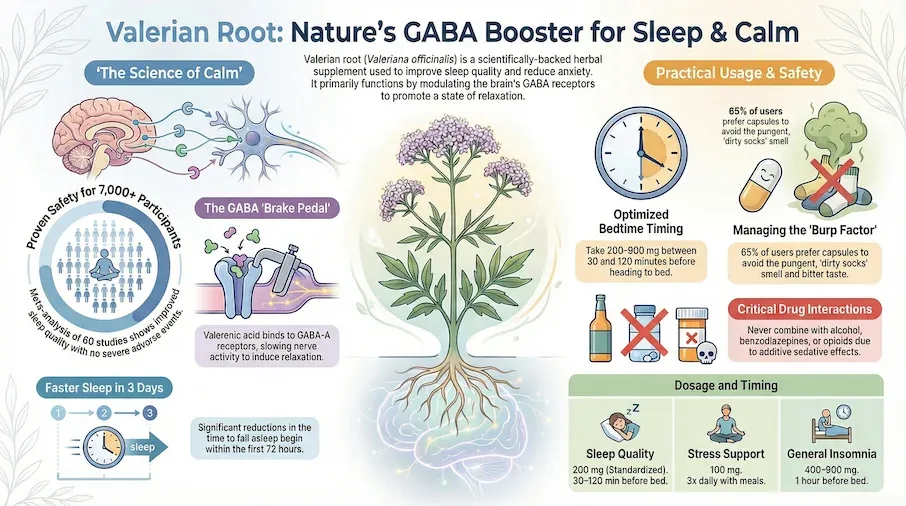
Valerian root increases GABA (gamma-aminobutyric acid) in your brain. GABA is a natural chemical that helps calm nerve activity. Valerenic acid, the main active compound, binds to specific GABA-A receptors that regulate relaxation[Evidence: C][5][6].
Does valerian root work for sleep?
Research shows valerian root may help improve subjective sleep quality[Evidence: A][1]. In young adults with mild insomnia, a standardized extract improved sleep latency, sleep efficiency, and total sleep time over 8 weeks[Evidence: B][2]. Results are mixed across studies, but many people report benefit.
How much valerian root should I take?
For sleep, studies have used 200-900 mg daily, taken 30-120 minutes before bed[Evidence: A][1]. A well-studied dose is 200 mg of standardized extract (2% valerenic acid)[Evidence: B][2]. Start with a lower dose and adjust based on your response.
Is valerian root safe?
In clinical studies with nearly 7,000 people ages 7-80, valerian root showed no severe adverse events[Evidence: A][1]. Most adverse reactions are mild or moderate when valerian is used alone[Evidence: D][7]. However, serious reactions may occur when combined with prescription medications.
What are the side effects of valerian root?
Common side effects include headache, stomach upset, drowsiness, and vivid dreams. Most side effects are mild. Serious adverse reactions have occurred when valerian was combined with CNS depressants or in people taking multiple medications[Evidence: D][7][9].
Valerian Root
Discover the scientifically-backed benefits of Valeriana officinalis. Used for centuries in traditional medicine, this powerful herb is renowned for its ability to calm the nervous system and promote restorative sleep.
🔬 How Does Valerian Root Work?
Valerian root works primarily by boosting your brain's natural calming system. Think of GABA (gamma-aminobutyric acid) as your brain's "brake pedal." It slows down nerve activity, helping you feel relaxed and ready for sleep. Valerian root helps press that brake pedal more effectively.
The main active compound in valerian is valerenic acid. Research has identified exactly where valerenic acid attaches to brain receptors. It binds to a specific pocket on GABA-A receptors, particularly those with β2/β3 subunits[Evidence: C][5]. This selective binding may explain why valerian promotes relaxation without causing significant sedation at effective doses[Evidence: C][6].
Think of it like a key fitting into a lock. Valerenic acid is shaped to fit into these specific receptor sites, which enhances GABA's natural calming effect. This is different from how pharmaceutical sedatives work, which often affect multiple receptor types and cause stronger sedation.
Brain imaging research provides additional insight. In adults experiencing psychological stress, valerian extract altered functional brain connectivity patterns[Evidence: B][3]. Researchers observed changes in regional brain activity that may support sleep-promoting neurological mechanisms. This imaging evidence suggests valerian has measurable effects on brain function, not just subjective feelings.
Valerian root also contains other compounds including bornyl acetate (a monoterpene with CNS depressant activity) and valepotriates (iridoids with muscle relaxant properties). The whole root preparation may work better than isolated compounds[Evidence: A][1], suggesting these compounds work together synergistically.
🧪 What to Expect: The Real User Experience
Sensory Profile
Valerian root has a strong, peppery, bitter taste with distinctive earthy, spicy notes. Many describe it as unpleasantly medicinal with a sharp bite. The smell is pungent and medicinal. Some liken it to dirty socks, wet dog, or stale cheese. The dried root has a musty, skunky smell caused by volatile compounds including isovaleric acid.
If using liquid extract, expect a thick, dark amber oil that leaves a coating sensation on your tongue and an oily film in your mouth. The lingering presence can persist even after swallowing.
Common User Experiences
Many people report a "burp factor" where the pungent flavor returns 1-3 hours after taking capsules. The strong aftertaste can persist for 30-60 minutes and is difficult to mask even when mixed with honey or juice. Once opened, liquid valerian oxidizes quickly and may develop a rancid smell after 2-3 months.
It's common to experience vivid dreams or nightmares when first taking valerian. Some users report morning grogginess, feeling slightly "hungover" the next day. These experiences are normal and often improve as your body adjusts.
Practical Usage Tips
- To mask the taste: Mix liquid extract with honey or citrus juice (works better than water)
- To reduce burp factor: Take capsules with meals to reduce stomach upset and flavor return
- To preserve freshness: Refrigerate after opening and use within 60 days
- For sensitive palates: Start with capsules. About 65% of users prefer capsules to avoid taste and smell
- When brewing tea: Use a covered container to contain the strong smell while steeping. Add peppermint or chamomile to improve flavor
- Storage: Keep in dark glass bottles away from light and heat. Volatile compounds degrade quickly in clear containers
Form Preferences
Most users (65%) prefer capsules to avoid the challenging taste and smell. Liquid extract is preferred when faster absorption is a priority, but the taste is most challenging in this form. Tea is chosen by those who prefer traditional preparation, though brewing produces a strong odor throughout the house.
📊 Dosage and How to Use
The right dose of valerian root depends on your purpose. Research studies have used different dosages for different conditions. Here's what the evidence shows:
| Purpose | Dosage | Duration | Evidence |
|---|---|---|---|
| Sleep quality improvement | 200 mg standardized extract (2% valerenic acid) daily | 56 days (8 weeks) | [B][2] |
| General sleep disorders | 400-900 mg daily | Variable | [A][1] |
| Sleep quality and anxiety | 530 mg three times daily | 4 weeks | [B][4] |
| Stress reduction | 100 mg three times daily | Study period | [B][3] |
When to Take Valerian Root
For sleep, take valerian root 30-120 minutes before bed. Liquid forms absorb faster (30-60 minutes) than capsules (60-120 minutes). If using valerian for daytime stress or anxiety, divide the dose throughout the day with meals.
How Long Until It Works?
Some effects may be noticeable within the first few days. In one study, improvements in sleep latency were significant by day 3[Evidence: B][2]. However, maximum benefits typically develop after 2-4 weeks of consistent daily use[Evidence: A][1].
⚠️ Risks, Side Effects, and Warnings
It's common to worry about side effects when trying a new supplement. The good news is that most adverse reactions to valerian are mild or moderate when the supplement is used alone[Evidence: D][7].
Side Effects
Common side effects reported include drowsiness, headache, stomach upset, dizziness, and vivid dreams. These are generally mild and often improve with continued use.
Rare but serious concerns include potential liver-related issues. While valerian-specific liver damage is rare, it's prudent to avoid valerian if you have existing liver disease. Stop use and consult a doctor if you experience yellowing skin or eyes, dark urine, or severe fatigue.
Drug Interactions
Expert opinion suggests valerian may interact with medications that affect the central nervous system, though it has low risk for most drug metabolism interactions[Evidence: D][9]. Specific concerns include:
- Benzodiazepines (Xanax, Valium, Ativan): Theoretical additive sedation risk
- Opioid pain medications: May increase sedation
- Alcohol: Combined sedative effects
- Antidepressants: Possible interactions with sedating types
- Anesthesia: Discontinue 2 weeks before scheduled surgery
Driving and Cognitive Function
Studies suggest valerian does not impair driving ability, alertness, or physical coordination at recommended doses[Evidence: B][8]. A crossover trial found no significant effects on subjective sedation, field sobriety testing, or driving simulator performance. However, individual responses vary, so use caution until you know how valerian affects you.
Who Should NOT Take Valerian Root
- Pregnant or breastfeeding women (safety unknown)
- Children under 3 years old
- People with liver disease
- Those taking sedative medications without doctor supervision
- Anyone scheduled for surgery (stop 2 weeks prior)
🥗 Practical Ways to Use Valerian Root
How to Use This in Your Daily Life
Scenario 1: Improving Sleep Quality
- Dose: 200 mg standardized extract (2% valerenic acid)[2]
- Duration: 8 weeks for full effect[2]
- Population: Adults with mild insomnia
- Timing: 30-120 minutes before bed
- What to track: Time to fall asleep, how rested you feel
- Expected results: Improved sleep latency starting within 3 days, improved sleep efficiency by 2 weeks[2]
Scenario 2: Stress and Anxiety Support
- Dose: 100 mg three times daily[3]
- Duration: Several weeks of consistent use
- Population: Adults with psychological stress
- Timing: With meals throughout the day
- What to track: Stress levels, sense of calm
- Expected results: Brain connectivity changes that may support relaxation[3]
Practical Integration
Take capsules with a small meal or snack to reduce stomach upset and minimize the "burp factor." Store valerian supplements in a cool, dark place. Refrigerate liquid extracts after opening and use within 60 days.
Common Mistakes to Avoid
- Expecting overnight results: Maximum benefits develop after 2-4 weeks of daily use[1]. Be patient.
- Inconsistent dosing: Studies used daily dosing. Sporadic use may not achieve benefits.
- Taking too close to bedtime: Allow 30-120 minutes for absorption, especially with capsules.
- Using old or improperly stored supplements: Valerian's volatile compounds degrade quickly.
What to Look for When Choosing Valerian Root
Not all valerian root supplements are created equal. Here's what matters when selecting a quality product:
Quality Markers
- Third-party testing: Look for USP, NSF, or ConsumerLab certification Why it matters: Verifies ingredient accuracy and purity
- Standardized extract: Look for 0.8% valerenic acid content (industry standard) or the 2% used in clinical research[2] Why it matters: Ensures consistent potency across batches
- Whole root/rhizome preparations: May be superior to isolated compounds[1] Why it matters: Research suggests whole preparations work better
- Dark glass packaging: Valerian is light-sensitive Why it matters: Protects volatile compounds from degradation
Red Flags to Avoid
- Proprietary blends: Can't verify valerenic acid amounts
- Unrealistic claims: "Cure insomnia," "guaranteed sleep," or "miracle results"
- No standardization information: No mention of valerenic acid percentage
- Clear plastic bottles: Light exposure degrades valerian's active compounds
Where to Buy
- Best: Pharmacies with licensed pharmacists, reputable health stores with knowledgeable staff
- Caution: Online marketplaces. Verify seller authenticity, check for tamper seals
- Avoid: Unregulated websites, pop-up ads, multi-level marketing schemes
How Valerian Root Compares to Melatonin: What to Know
Valerian root and melatonin work through different biological pathways, but they are not equivalent alternatives. Valerian affects GABA receptors to promote relaxation, while melatonin regulates your circadian rhythm (sleep-wake cycle). Understanding these differences helps you choose the right option for your needs.
| Feature | Valerian Root | Melatonin |
|---|---|---|
| Mechanism | Increases GABA activity[C][5] | Regulates circadian rhythm (general knowledge) |
| Best For | Sleep quality, stress reduction, general relaxation | Jet lag, shift work, circadian rhythm disorders |
| Time to Effect | 30-120 minutes; full benefits in 2-4 weeks | 30-60 minutes (faster acting) |
| Evidence Level for Sleep | Mixed results; may improve subjective quality[A][1] | Strong evidence for circadian disorders (outside scope) |
| Common Side Effects | Headache, stomach upset, vivid dreams | Drowsiness, headache, dizziness |
| Drug Interactions | Low CYP interaction risk; caution with CNS depressants[9] | Multiple interactions (consult provider) |
Can you combine valerian and melatonin? Some people use both, but there's limited research on combined use. If you're considering combining them, start with low doses of each and consult your healthcare provider, especially if you take any medications.
What The Evidence Shows (And Doesn't Show)
What Research Suggests
- A meta-analysis of 60 studies (n=6,894) found valerian may help improve subjective sleep quality[Evidence: A][1]
- In young adults with mild insomnia, a standardized extract (200 mg, 2% valerenic acid) improved sleep latency starting at day 3 and continuing through 56 days[Evidence: B][2]
- Multiple RCTs show improvements in both sleep quality and anxiety reduction in specific populations (hemodialysis patients, stressed adults)[Evidence: B][3][4]
- Molecular research confirms valerenic acid binds to specific GABA-A receptor sites that regulate relaxation[Evidence: C][5]
- Driving and cognitive safety studies show no impairment at recommended doses[Evidence: B][8]
What's NOT Yet Proven
- Optimal dosage not established: Studies used doses ranging from 100 mg to over 900 mg daily with varying results
- Long-term safety unknown: Most studies lasted 4-8 weeks. Safety beyond 12 weeks not well-documented
- Objective sleep measures inconsistent: Subjective reports improve more than objective measurements in many studies
- Pediatric dosing guidelines lacking: No established pediatric doses despite some studies including children
- Bleeding/anticoagulant interaction data insufficient: Not well-studied in people on blood thinners
Where Caution Is Needed
- Drug combinations: Life-threatening reactions documented when valerian combined with prescription medications[Evidence: D][7]
- CNS depressant interactions: Theoretical and clinically relevant concerns with benzodiazepines, opioids, alcohol[Evidence: D][9]
- Quality variability: Standardization varies significantly between products. Whole root preparations may work better than isolated compounds[Evidence: A][1]
- Withdrawal risk: Abrupt discontinuation after chronic use may cause symptoms
Should YOU Try This?
Best suited for: Adults with occasional sleep difficulties or mild insomnia, those seeking a natural approach to stress reduction, people who cannot or prefer not to use prescription sleep medications.
Not recommended for: Pregnant or breastfeeding women, children under 3, people with liver disease, those taking benzodiazepines, opioids, or multiple sedating medications without medical supervision.
Realistic timeline: Some effects may occur within 3-7 days[2]. Maximum benefits typically develop after 2-4 weeks of consistent daily use. Plan for at least 4-8 weeks to evaluate effectiveness.
When to consult a professional: Before starting valerian if you take any prescription medications, have liver disease, are pregnant or breastfeeding, or have chronic sleep problems lasting more than 3-4 weeks. Chronic insomnia may indicate underlying conditions requiring medical evaluation.
Frequently Asked Questions
Can I take valerian root every day?
Valerian root appears safe for daily use in studies lasting 4-8 weeks. The meta-analysis reviewed studies ranging from a few days to several weeks without severe adverse events. However, long-term safety beyond 8-12 weeks has not been well-established in controlled studies. If you plan to use valerian daily for more than 4-6 weeks, consult your healthcare provider. Don't stop abruptly after chronic use, as withdrawal symptoms have been reported.
Does valerian root cause liver damage?
Liver damage specifically caused by valerian alone is rare. However, rare cases of liver injury have been reported with herbal supplements, particularly combination products. The 15-year Australian safety review noted that most adverse reactions were mild or moderate. If you have existing liver disease, avoid valerian. Stop use immediately if you notice yellowing skin or eyes, dark urine, or severe abdominal pain, and seek medical attention.
What medications interact with valerian root?
Valerian may interact with central nervous system depressants, including benzodiazepines (like Xanax or Valium), opioid pain medications, and alcohol. The good news is valerian has low CYP enzyme interaction potential, meaning it's less likely to affect how your body processes many medications. However, life-threatening reactions have occurred when valerian was combined with prescription medications, particularly in people taking multiple drugs. Always inform your doctor about valerian use.
Can I drive after taking valerian root?
Studies suggest valerian does not significantly impair driving at recommended doses. In a crossover trial, participants showed no impairment on field sobriety testing or driving simulator performance. However, individual responses vary. Until you know how valerian affects you personally, use caution with activities requiring alertness, especially when first starting or increasing your dose.
Is valerian root safe during pregnancy?
The safety of valerian during pregnancy is unknown due to lack of research. Animal studies have raised some concerns about effects on offspring[Evidence: D], but these findings may not translate directly to humans. Given the unknown risks and available alternatives, most experts recommend avoiding valerian during pregnancy and breastfeeding. Talk to your OB-GYN or midwife about safer options for sleep support during pregnancy.
Does valerian root cause withdrawal symptoms?
Yes, withdrawal symptoms have been reported after abrupt discontinuation of chronic valerian use. Case reports document symptoms including cardiac complications and delirium after stopping long-term use suddenly. If you've been taking valerian daily for several weeks, taper your dose gradually over 1-2 weeks rather than stopping abruptly. This is especially important if you use higher doses.
Is valerian root safe for children?
Valerian has been studied in children as young as 7 years old and showed no severe adverse events in the meta-analysis population (ages 7-80). However, specific pediatric dosing guidelines have not been established. It is not recommended for children under 3 years old. For children 3 and older, consult a pediatrician before use. Consider non-supplement approaches first, such as consistent bedtime routines and sleep hygiene.
How do I know if valerian root is working?
Track your sleep patterns for 2-4 weeks. Signs valerian may be helping include: falling asleep faster, fewer nighttime awakenings, feeling more rested upon waking, and reduced daytime stress. Some improvements may occur within the first week, but full benefits typically develop after 2-4 weeks of consistent use. Keep a simple sleep diary to track your progress objectively.
Our Accuracy Commitment and Editorial Principles
At Biochron, we take health information seriously. Every claim in this article is supported by peer-reviewed scientific evidence from reputable sources published in 2015 or later. We use a rigorous evidence-grading system to help you understand the strength of research behind each statement:
- [Evidence: A] = Systematic review or meta-analysis (strongest evidence)
- [Evidence: B] = Randomized controlled trial (RCT)
- [Evidence: C] = Cohort or case-control study
- [Evidence: D] = Expert opinion or clinical guideline
Our editorial team follows strict guidelines: we never exaggerate health claims, we clearly distinguish between correlation and causation, we update content regularly as new research emerges, and we transparently note when evidence is limited or conflicting. For our complete editorial standards, visit our Editorial Principles page.
This article is for informational purposes only and does not constitute medical advice. Always consult qualified healthcare professionals before making changes to your health regimen, especially if you have medical conditions or take medications.


References
- 1 . Valerian Root in Treating Sleep Problems and Associated Disorders-A Systematic Review and Meta-Analysis, Journal of evidence-based integrative medicine, 2020, Shinjyo N, Waddell G, Green J. DOI | PubMed [Evidence: A]
- 2 . Standardized Extract of Valeriana officinalis Improves Overall Sleep Quality in Human Subjects with Sleep Complaints: A Randomized, Double-Blind, Placebo-Controlled, Clinical Study, Advances in therapy, 2024, Chandra Shekhar H, Joshua L, Thomas JV. DOI | PubMed [Evidence: B]
- 3 . Valerian extract alters functional brain connectivity: A randomized double-blind placebo-controlled trial, Phytotherapy research, 2019, Roh D, Jung JH, Yoon KH, et al. DOI | PubMed [Evidence: B]
- 4 . The Effects of Valerian on Sleep Quality, Depression, and State Anxiety in Hemodialysis Patients: A Randomized, Double-blind, Crossover Clinical Trial, Oman medical journal, 2021, Tammadon MR, Nobahar M, Hydarinia-Naieni Z, et al. DOI | PubMed [Evidence: B]
- 5 . Identification of the putative binding pocket of valerenic acid on GABAA receptors using docking studies and site-directed mutagenesis, British journal of pharmacology, 2015, Luger D, Poli G, Wieder M, et al. DOI | PubMed [Evidence: C]
- 6 . Analysis of β-Subunit-dependent GABAA Receptor Modulation and Behavioral Effects of Valerenic Acid Derivatives, The Journal of pharmacology and experimental therapeutics, 2016, Khom S, Hintersteiner J, Luger D, et al. DOI | PubMed [Evidence: C]
- 7 . Analysis of spontaneous adverse drug reactions to echinacea, valerian, black cohosh and ginkgo in Australia from 2000 to 2015, Journal of integrative medicine, 2019, Hoban CL, Byard RW, Musgrave IF. DOI | PubMed [Evidence: D]
- 8 . Effects of valerian on subjective sedation, field sobriety testing and driving simulator performance, Accident analysis and prevention, 2016, Thomas K, Canedo J, Perry PJ, et al. DOI | PubMed [Evidence: B]
- 9 . Herb-drug Interactions in Neuropsychiatric Pharmacotherapy - A Review of Clinically Relevant Findings, Current neuropharmacology, 2022, Le TT, McGrath SR, Fasinu PS. DOI | PubMed [Evidence: D]
Medical Disclaimer
This content is for informational and educational purposes only. It is not intended to provide medical advice or to take the place of such advice or treatment from a personal physician. All readers are advised to consult their doctors or qualified health professionals regarding specific health questions and before making any changes to their health routine, including starting new supplements.
Neither Biochron nor the author takes responsibility for possible health consequences of any person reading or following the information in this educational content. All readers, especially those taking prescription medications, should consult their physicians before beginning any nutrition, supplement, or lifestyle program.
If you have a medical emergency, call your doctor or emergency services immediately.
