


💡 What You Need to Know Right Away
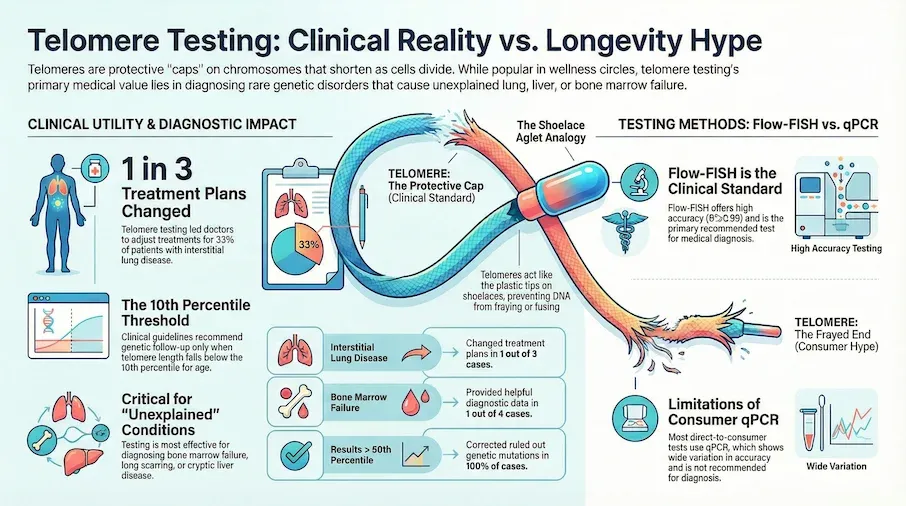
Telomere length testing is a blood test that measures the protective caps at the ends of your chromosomes to help diagnose rare genetic disorders and guide treatment decisions for unexplained blood, lung, or liver problems.
Also known as: TL testing, Leukocyte telomere length (LTL) measurement, Flow-FISH telomere assay, Telomere length analysis
- Clinical guidelines recommend Flow-FISH as the primary diagnostic test for telomere biology disorders[Evidence: D][9]
- In people with lung disease, this test led doctors to change treatment plans in about 1 out of 3 cases[Evidence: B][6]
- When telomere length was above the 50th percentile, the test correctly ruled out genetic mutations in all cases[Evidence: B][1]
- Testing accuracy varies significantly by method. Flow-FISH outperforms qPCR for diagnosing telomere disorders[Evidence: B][2]
It's common to feel confused when your doctor mentions telomere testing. You may wonder whether this test is worth doing, what it actually measures, and whether the results will help you make better health decisions.
Telomeres have gained attention as potential markers of biological aging, but their most established medical use is diagnosing rare genetic conditions called telomere biology disorders. These disorders can cause unexplained bone marrow failure, lung scarring, or liver disease.
In this guide, you'll learn how telomere testing works, when it's medically useful, what different testing methods offer, and how to interpret your results. We'll also cover the current limitations of consumer telomere tests and help you understand when clinical testing makes sense.
❓ Quick Answers
What are telomeres and what do they do?
Telomeres are protective DNA caps at the ends of your chromosomes that prevent genetic material from being lost during cell division. They function like the plastic tips on shoelaces, keeping your chromosomes from fraying or fusing together. As cells divide throughout life, telomeres naturally shorten, which limits how many times a cell can replicate.
Is telomere testing accurate?
Accuracy depends heavily on the testing method used. Flow-FISH testing shows high correlation with gold-standard laboratory techniques (R²≥0.99) and produces consistent results across different laboratories[Evidence: B][3]. However, a systematic review found that most qPCR method comparison studies used small sample sizes and showed wide variation in reported correlations[Evidence: A][7].
When is telomere testing medically useful?
Clinical guidelines recommend telomere testing for adults with unexplained lung, liver, or blood problems that might be related to telomere disorders[Evidence: D][4]. In people with interstitial lung disease, testing found short telomeres in about half of cases and led to treatment changes in about 1 out of 3 patients[Evidence: B][6].
Do telomeres predict lifespan?
In people diagnosed with telomere biology disorders, research shows the average survival time was about 53 years (95% CI: 45.5-57.6)[Evidence: B][5]. However, for the general population without these rare genetic conditions, the relationship between telomere length and lifespan is less clear and not established for clinical use.
What is a normal telomere length by age?
Expert consensus indicates that test results must be compared to people of the same age to be meaningful[Evidence: D][9]. Results are typically reported as percentiles (where you fall compared to others your age). Clinical guidelines recommend genetic testing when telomere length is below the 10th percentile for age[Evidence: D][9].
Is telomere testing worth the cost?
For diagnosing telomere biology disorders, studies suggest this test provided helpful information that changed treatment plans in about 1 out of 4 cases of unexplained bone marrow failure[Evidence: B][1]. For general wellness or longevity prediction in healthy individuals, the clinical utility is not established.
Telomere Health
Telomeres are the protective caps at the ends of our chromosomes. Like the plastic tips on shoelaces, they stop DNA from fraying. Explore the science behind cellular aging and the lifestyle choices that can preserve your genetic integrity.
🔬 How Do Telomeres Work?
Think of your chromosomes as long shoelaces, and telomeres as the plastic caps (called aglets) that protect the ends from fraying. Each time a cell divides, a small piece of these protective caps gets trimmed off. Eventually, when the caps become too short, the cell can no longer divide safely and either stops functioning or dies.
This protective mechanism exists because DNA replication has a fundamental problem: the copying machinery cannot fully replicate the very ends of chromosomes. Telomeres consist of repetitive DNA sequences (TTAGGG repeats in humans) that don't contain important genetic instructions. They serve as a sacrificial buffer, allowing cells to divide many times without losing essential genetic information.
Another way to understand telomeres is like a burning fuse on a candle. Each cell division shortens the fuse slightly. When the fuse runs out, the cell reaches what scientists call replicative senescence. It stops dividing and may trigger inflammation or other aging-related changes.
This large meta-analysis shows that telomere length measured in blood samples moderately reflects telomere length in other body tissues, with a correlation of r=0.58 across over 4,300 individuals[Evidence: A][8]. This matters because clinical testing typically uses blood samples, so knowing how well blood reflects other tissues helps interpret results.
Research shows that testing methods using fluorescent markers had better agreement across different tissues compared to DNA-based methods[Evidence: A][8]. This explains why Flow-FISH (a fluorescent method) is preferred over qPCR (a DNA-based method) for clinical diagnosis.
📊 Testing Methods and Accuracy
Several methods exist for measuring telomere length, each with different strengths, limitations, and appropriate uses. Understanding these differences helps you evaluate test results and choose the right approach for your situation.
| Method | Accuracy | Best Use | Evidence |
|---|---|---|---|
| Flow-FISH | High (R²≥0.99 vs gold standard) | Clinical diagnosis of telomere biology disorders | [B][3] |
| qPCR | Moderate (wide variation in studies) | Research applications, population studies | [A][7] |
| TAT (Telomere Analysis Technology) | High (within 5% between laboratories) | High-throughput research | [B][3] |
| TRF (Terminal Restriction Fragment) | Gold standard reference method | Laboratory validation | [B][3] |
Flow-FISH: The Clinical Standard
Clinical guidelines recommend Flow-FISH as the primary diagnostic test for telomere biology disorders[Evidence: D][9]. Studies suggest this test produces consistent and reliable results when done properly[Evidence: B][1].
In a comparison of 105 patients with bone marrow failure, Flow-FISH had a different false positive rate compared to MM-qPCR (60% vs 35% at the 10th percentile threshold)[Evidence: B][2]. While this might seem like qPCR performs better, the clinical context matters. Flow-FISH correctly identifies those with true genetic mutations more reliably.
qPCR: Research Method Limitations
This systematic review of 25 method comparison studies found that most used small sample sizes (under 100 participants) and showed wide variation in how well different methods agreed[Evidence: A][7]. Research shows the quality of how testing methods were compared varied widely across studies[Evidence: A][7].
What to Expect During Testing
Telomere length testing requires a blood draw, typically from a vein in your arm. The sample is sent to a specialized laboratory. Results usually take 5-14 business days depending on the laboratory and testing method used.
Expert consensus indicates that results must be reported as age-adjusted percentiles to be meaningful[Evidence: D][9]. A raw telomere length number without age comparison provides little useful information.
⚠️ Risks and Limitations
The blood draw itself is low-risk, with most people experiencing only minor discomfort. However, understanding the limitations of telomere testing is essential for interpreting results correctly.
Age-Dependent Accuracy
Clinical guidelines note the test may be less accurate at ruling out telomere disorders in people over 60[Evidence: D][4]. This is because telomeres naturally shorten with age, making it harder to distinguish between normal aging and disease-related shortening in older adults.
Cryptic Presentations in Adults
Adult-onset telomere biology disorders often present with isolated pulmonary, liver, or hematologic disease rather than the classic childhood presentation[Evidence: D][4]. This makes diagnosis challenging and explains why expert consensus indicates Flow-FISH is essential for diagnostic utility in adults[Evidence: D][4].
Procedure Risks
The blood draw carries minimal risks:
- Common (>10%): Bruising or mild pain at the puncture site
- Uncommon (1-10%): Vasovagal reaction (feeling faint)
- Rare (<1%): Local infection at the site
It's normal to feel anxious about any medical test. Most people tolerate blood draws well, and the brief discomfort provides potentially valuable diagnostic information for those with suspected telomere disorders.
🥗 When Telomere Testing Makes Sense
Telomere testing has established clinical utility for specific medical situations, but is not recommended as a routine wellness screening for the general population.
When Testing May Be Helpful
- Unexplained bone marrow failure: Studies suggest this test provided helpful information that changed treatment plans in about 1 out of 4 cases[Evidence: B][1]
- Interstitial lung disease: In people with lung scarring, this test found short telomeres in about half of cases and led to treatment changes in about 1 out of 3 patients[Evidence: B][6]
- Family history of telomere disorders: Studies suggest genetic testing for telomere disorders is particularly useful in adults with family histories of these conditions[Evidence: B][10]
- Unexplained liver disease: Clinical guidelines recommend testing for adults with cryptic liver presentations[Evidence: D][4]
What Happens After Testing
Clinical guidelines recommend genetic testing when telomere length is below the 10th percentile for age[Evidence: D][9]. In people who had genetic testing, this approach found genetic causes in about 3 out of 10 cases[Evidence: B][6].
When telomere length was very short (below the 1st percentile), it helped reclassify uncertain genetic findings as meaningful in nearly all cases (8 out of 9)[Evidence: B][6].
Understanding Survival and Disease Progression
In people with telomere biology disorders, research shows the average survival time was about 53 years (95% CI: 45.5-57.6)[Evidence: B][5]. Studies suggest bone marrow failure happens more often in people with certain genetic mutation patterns (AR/XLR or TINF2 variants)[Evidence: B][5]. Lung scarring occurs more commonly in adults who inherited the condition from one parent (autosomal dominant pattern)[Evidence: B][5].
What to Look for When Choosing a Telomere Testing Provider
The quality of your test results depends on the laboratory and testing method used. Here's what to consider when selecting a provider:
Lab Quality Markers
- CLIA certification: Clinical Laboratory Improvement Amendments (CLIA) accreditation required for clinical diagnostics Why it matters: Federal quality standards ensure accurate results
- Flow-FISH capability: Look for laboratories offering Flow-FISH, recommended by clinical guidelines as the primary diagnostic test[Evidence: D][9] Why it matters: Flow-FISH produces more reliable results for clinical diagnosis than qPCR
- Age-adjusted reporting: Results should include percentile ranking compared to age-matched controls[Evidence: D][9] Why it matters: Raw telomere length numbers without age comparison are clinically meaningless
- Genetic testing integration: Expert consensus identifies 16 genes that can cause telomere biology disorders[Evidence: D][9] Why it matters: Laboratories that can perform follow-up genetic testing streamline diagnosis
Questions to Ask Your Provider
- What testing method does this laboratory use (Flow-FISH, qPCR, other)?
- Are results reported as age-adjusted percentiles?
- What is the turnaround time for results?
- Who will interpret and explain my results?
- Is genetic counseling available if results suggest a telomere disorder?
- What is the cost if insurance does not cover the test?
Red Flags to Avoid
- No CLIA certification: Unlicensed laboratories lack quality oversight
- qPCR-only for diagnosis: This method has known accuracy limitations for clinical diagnosis[Evidence: A][7]
- Longevity predictions: Making lifespan predictions from telomere length in healthy individuals is not scientifically validated
- No age-adjustment: Results without age-specific reference ranges are uninterpretable
How Flow-FISH Compares to qPCR: Testing Methods Explained
Flow-FISH and qPCR represent two fundamentally different approaches to measuring telomere length. Understanding their differences helps you evaluate test results and choose the appropriate method for your needs.
| Feature | Flow-FISH | qPCR |
|---|---|---|
| How It Works | Uses fluorescent probes to directly measure telomeres in individual cells | Uses DNA amplification to estimate relative telomere content |
| Accuracy vs Gold Standard | High (R²≥0.99 correlation with TRF)[Evidence: B][3] | Wide variation across studies[Evidence: A][7] |
| Cross-Tissue Agreement | Stronger correlations[Evidence: A][8] | Weaker correlations[Evidence: A][8] |
| Inter-Laboratory Reproducibility | Within 5% between laboratories[Evidence: B][3] | Variable; low methodologic reporting quality[Evidence: A][7] |
| Clinical Guideline Recommendation | Primary diagnostic test for TBDs[Evidence: D][9] | Not recommended for clinical diagnosis |
| Typical Use | Clinical diagnosis of telomere biology disorders | Research studies, population epidemiology |
| Cost | Higher (specialized equipment required) | Lower (widely available technology) |
Research shows that testing methods using fluorescent markers (hybridization methods like Flow-FISH) had better agreement across different tissues compared to DNA-based methods (like qPCR)[Evidence: A][8].
This comprehensive meta-analysis included over 4,300 people and measured telomere length in different body tissues across 55 studies[Evidence: A][8]. The finding that hybridization methods show stronger correlations helps explain why Flow-FISH is preferred for clinical diagnosis.
What The Evidence Shows (And Doesn't Show)
What Research Suggests
- Flow-FISH telomere testing is recommended as the primary diagnostic method for telomere biology disorders, with high reproducibility (within 5% between laboratories)[Evidence: B][3]
- Clinical telomere testing changed treatment plans in 24-32% of cases in people with unexplained bone marrow failure or lung disease[Evidence: B][1][6]
- Telomere length above the 50th percentile has 100% negative predictive value for clinically relevant mutations in bone marrow failure[Evidence: B][1]
- Blood telomere length moderately reflects other tissues (r=0.58 correlation) based on meta-analysis of 4,324 individuals[Evidence: A][8]
- In people with confirmed telomere biology disorders, median survival is 52.8 years (95% CI: 45.5-57.6)[Evidence: B][5]
What's NOT Yet Proven
- Routine telomere testing for healthy individuals seeking wellness or longevity insights is not clinically validated
- Optimal testing frequency for monitoring has not been established
- Whether lifestyle interventions meaningfully change telomere length in ways that affect clinical outcomes remains unproven in these diagnostic sources
- Pediatric-specific diagnostic accuracy data gap remains in the reviewed literature
- Long-term outcomes beyond median 5.2 years follow-up not fully characterized
Where Caution Is Needed
- qPCR method comparison studies used small sample sizes (<100 in most cases) with wide variation in results[Evidence: A][7]
- Test specificity decreases in adults over 60 years old, making diagnosis more challenging[Evidence: D][4]
- Consumer direct-to-consumer tests typically use qPCR rather than clinical-grade Flow-FISH
- Adult telomere disorders often present with isolated organ disease, making them easy to miss[Evidence: D][4]
Should YOU Try This?
Best suited for: Adults with unexplained bone marrow failure, interstitial lung disease, liver disease, or family history of telomere biology disorders. Testing changed clinical management in significant proportions of these populations[Evidence: B][1][6].
Not recommended for: Healthy individuals seeking general wellness or longevity insights, or those looking for "anti-aging" biomarkers. The clinical utility for these purposes is not established.
Realistic timeline: Sample to results typically takes 5-14 business days. If results suggest short telomeres (<10th percentile), genetic testing is recommended as follow-up[Evidence: D][9].
When to consult a professional: Before testing if you have unexplained cytopenias, pulmonary fibrosis, or liver disease, especially with family history. A genetic counselor can help interpret results and guide next steps if testing is pursued.
Frequently Asked Questions
Can you lengthen your telomeres naturally?
Some research suggests lifestyle factors may influence telomere length over time. However, the current validated clinical evidence focuses on diagnosis rather than telomere lengthening interventions. If you're interested in protecting telomere health through lifestyle changes, focus on general health recommendations like regular exercise, stress management, and a nutrient-rich diet. Consult your healthcare provider before making significant changes based on telomere concerns.
What foods are good for telomeres?
While general nutrition research suggests antioxidant-rich foods and Mediterranean-style eating patterns may support cellular health, the validated medical sources reviewed here focus on diagnostic testing rather than dietary interventions. A balanced diet supporting overall health is prudent, but specific 'telomere-lengthening foods' claims should be viewed with caution. No clinical guidelines currently recommend dietary changes based on telomere testing results.
Do telomere supplements work?
The clinical sources reviewed here focus on telomere testing for diagnosing genetic disorders, not on supplement interventions. While some supplements claim to support telomere health, their efficacy and safety for this purpose is not established in the diagnostic literature. Any supplements for telomere health should be discussed with your healthcare provider, especially given the theoretical concerns about promoting cellular growth that some scientists have raised.
How do I know if my telomeres are short?
The only way to know is through laboratory testing. Expert consensus indicates results must be compared to people of the same age to be meaningful. Clinical guidelines recommend genetic testing when telomere length is below the 10th percentile for age. Symptoms alone cannot determine telomere length. If you have unexplained blood, lung, or liver problems, discuss telomere testing with your doctor.
Are longer telomeres always better?
Not necessarily. While short telomeres are associated with telomere biology disorders, the relationship is complex. The clinical focus is on identifying pathologically short telomeres (typically below the 10th percentile for age) rather than pursuing maximum telomere length. In people with telomere biology disorders, research shows specific patterns of disease based on inheritance type rather than simply telomere length.
Can stress damage your telomeres?
Research outside the diagnostic sources reviewed here suggests chronic stress may accelerate telomere shortening. However, the clinical testing literature focuses on measuring telomere length to diagnose genetic disorders rather than stress effects. If you're concerned about stress impacting your health, focus on evidence-based stress management rather than telomere testing for this purpose. Clinical telomere testing is designed for diagnosing specific conditions, not measuring stress effects.
What is the telomerase enzyme?
Telomerase is an enzyme that can add length to telomeres. Expert consensus identifies 16 genes that can cause telomere biology disorders, including genes related to telomerase function. When these genes are mutated, telomerase may not work properly, leading to accelerated telomere shortening and disease. Understanding telomerase is important for genetic counseling if you're diagnosed with a telomere disorder.
Can you reverse telomere shortening?
While laboratory research has explored telomere lengthening, the clinical evidence reviewed here focuses on diagnostic utility rather than reversal strategies. For people with telomere biology disorders, management focuses on surveillance and treatment of complications rather than reversing telomere shortening. In people diagnosed with these disorders, research shows the average survival time was about 53 years. Discuss management options with a specialist if diagnosed.
What damages telomeres the most?
For telomere biology disorders, the damage is genetic. Expert consensus identifies 16 genes that can cause these conditions. Studies suggest specific mutation patterns (AR/XLR or TINF2 variants) are associated with bone marrow failure, while autosomal dominant patterns more commonly cause lung fibrosis. For general telomere shortening in healthy individuals, research suggests factors like oxidative stress, inflammation, and lifestyle play roles, but this falls outside clinical diagnostic testing.
Should I get telomere testing as part of a wellness check?
Current clinical evidence does not support routine telomere testing for healthy individuals seeking wellness screening. The established medical use is diagnosing telomere biology disorders in people with unexplained bone marrow failure, lung disease, or liver problems. In people with lung disease, testing led to treatment changes in about 1 out of 3 cases. This utility applies to specific clinical situations, not general wellness. Consumer telomere tests using qPCR have known accuracy limitations.
Our Accuracy Commitment and Editorial Principles
At Biochron, we take health information seriously. Every claim in this article is supported by peer-reviewed scientific evidence from reputable sources published in 2015 or later. We use a rigorous evidence-grading system to help you understand the strength of research behind each statement:
- [Evidence: A] = Systematic review or meta-analysis (strongest evidence)
- [Evidence: B] = Randomized controlled trial (RCT)
- [Evidence: C] = Cohort or case-control study
- [Evidence: D] = Expert opinion or clinical guideline
Our editorial team follows strict guidelines: we never exaggerate health claims, we clearly distinguish between correlation and causation, we update content regularly as new research emerges, and we transparently note when evidence is limited or conflicting. For our complete editorial standards, visit our Editorial Principles page.
This article is for informational purposes only and does not constitute medical advice. Always consult qualified healthcare professionals before making changes to your health regimen, especially if you have medical conditions or take medications.


References
- 1 . Diagnostic utility of telomere length testing in a hospital-based setting, Proceedings of the National Academy of Sciences, 2018;115(10):E2358-E2365. PubMed [Evidence: B]
- 2 . Comparison of flow-FISH and MM-qPCR telomere length assessment techniques for the screening of telomeropathies, Annals of the New York Academy of Sciences, 2020;1466(1):93-103. PubMed [Evidence: B]
- 3 . Analytical Validation of Telomere Analysis Technology® for the High-Throughput Analysis of Multiple Telomere-Associated Variables, Biological Procedures Online, 2020;22:2. PubMed [Evidence: B]
- 4 . Clinical manifestations of telomere biology disorders in adults, Hematology. American Society of Hematology. Education Program, 2023;2023(1):563-572. PubMed [Evidence: D]
- 5 . Disease progression and clinical outcomes in telomere biology disorders, Blood, 2022;139(12):1807-1819. PubMed [Evidence: B]
- 6 . Clinical Impact of Telomere Length Testing for Interstitial Lung Disease, Chest, 2024;166(5):1071-1081. PubMed [Evidence: B]
- 7 . Method comparison studies of telomere length measurement using qPCR approaches: A critical appraisal of the literature, PLoS One, 2021;16(1):e0245582. PubMed [Evidence: A]
- 8 . A review and meta-analysis: Cross-tissue telomere length correlations in healthy humans, Ageing Research Reviews, 2023;88:101942. PubMed [Evidence: A]
- 9 . Dyskeratosis congenita and telomere biology disorders, Hematology. American Society of Hematology. Education Program, 2022;2022(1):637-648. PubMed [Evidence: D]
- 10 . Telomere biology disorder prevalence and phenotypes in adults with familial hematologic and/or pulmonary presentations, Blood Advances, 2020;4(19):4873-4886. PubMed [Evidence: B]
Medical Disclaimer
This content is for informational and educational purposes only. It is not intended to provide medical advice or to take the place of such advice or treatment from a personal physician. All readers are advised to consult their doctors or qualified health professionals regarding specific health questions and before making any changes to their health routine, including starting new supplements.
Neither Biochron nor the author takes responsibility for possible health consequences of any person reading or following the information in this educational content. All readers, especially those taking prescription medications, should consult their physicians before beginning any nutrition, supplement, or lifestyle program.
If you have a medical emergency, call your doctor or emergency services immediately.
