


💡 What You Need to Know Right Away
- Royal jelly demonstrates significant antioxidant effects, reducing oxidative stress marker MDA and increasing total antioxidant capacity (TAC) in meta-analysis of 6 randomized controlled trials[Evidence: A][2]
- A 12-week RCT found royal jelly improved cognitive function and increased brain-derived neurotrophic factor (BDNF) in stroke patients[Evidence: B][7]
- Royal jelly significantly improved vascular endothelial function in 100 healthy volunteers after just 4 weeks of supplementation[Evidence: B][10]
- Systematic review confirms royal jelly exhibits anti-inflammatory, antioxidant, antimicrobial, and anti-aging effects through multiple biological pathways[Evidence: A][1]
Have you been curious about royal jelly and whether it truly delivers on its health promises? You're not alone. This remarkable bee-produced substance has captured the attention of researchers worldwide, with scientific publications more than doubling from 81 in 2014 to 173 in 2024.
Royal jelly is the exclusive food that transforms ordinary bee larvae into queen bees, giving them 40 times the lifespan of worker bees. This biological phenomenon has sparked decades of research into whether these benefits might extend to humans.
In this comprehensive guide, we analyze 14 peer-reviewed studies—including 4 meta-analyses and 7 randomized controlled trials—to separate evidence-based benefits from marketing hype. You'll discover what royal jelly can realistically do for your health, the optimal dosages studied in clinical trials, and critical safety information you need to know before trying it.
❓ Quick Answers
What are the benefits of royal jelly?
Royal jelly offers multiple evidence-based health benefits including antioxidant protection, anti-inflammatory effects, blood sugar support, cardiovascular health, and cognitive function improvement. A 2024 systematic review confirmed its pharmacological activities through NF-κB, MAPK, and AMPK pathways.[Evidence: A][1] Most benefits require consistent supplementation for 4-12 weeks.
Is royal jelly safe?
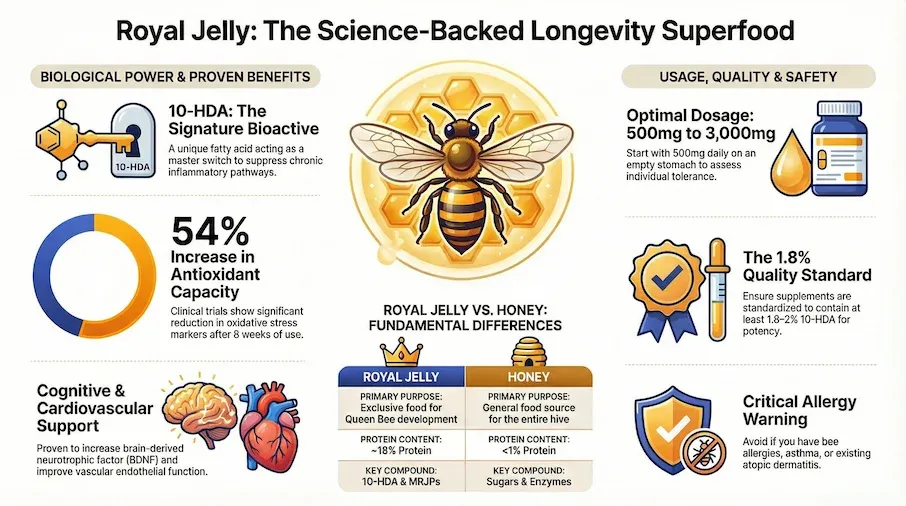
Royal jelly is generally safe for most adults when taken up to 3,000 mg daily for up to 6 months, based on clinical trial data.[Evidence: B][8] However, people with bee allergies, asthma, or atopic dermatitis face higher risk of allergic reactions—even without prior royal jelly exposure.[Evidence: C][11]
How much royal jelly should I take?
Clinical studies used dosages ranging from 500 mg to 3,000 mg daily. For general health, 690-1,000 mg daily shows benefits in 4-12 weeks.[Evidence: B][10] Higher doses (3,000 mg) were used in bone health studies lasting 6 months.[Evidence: B][8]
What is 10-HDA in royal jelly?
10-Hydroxy-2-decenoic acid (10-HDA) is a unique fatty acid found only in royal jelly. It's responsible for many of royal jelly's biological activities, including antimicrobial, anti-inflammatory, and immunomodulatory effects. Quality supplements list their 10-HDA content as a potency indicator—look for products with at least 1.8-2% 10-HDA.
Royal Jelly
Benefits
Discover the incredible health and wellness benefits of royal jelly, the nutrient-rich, golden secretion fed exclusively to queen bees.
🔬 How Does Royal Jelly Work?
Think of royal jelly as nature's biological programming tool. Just as software code instructs a computer what to do, royal jelly contains compounds that influence how cells behave—switching on protective genes while dialing down inflammatory responses. This is why the same bee larva becomes either a short-lived worker or a long-lived queen depending solely on its royal jelly diet.
The key bioactive compounds in royal jelly work through several well-documented pathways:
10-HDA (10-Hydroxy-2-decenoic acid) is royal jelly's signature compound, found nowhere else in nature. Research shows it acts like a master switch for inflammation, suppressing the NF-κB and MAPK signaling pathways that drive chronic inflammatory conditions.[Evidence: A][1]
Major Royal Jelly Proteins (MRJPs) support immune function and have demonstrated antioxidant activity. A meta-analysis of randomized controlled trials found royal jelly significantly reduced malondialdehyde (MDA)—a marker of oxidative damage—while increasing total antioxidant capacity (TAC).[Evidence: A][2]
Cardiovascular Effects: Royal jelly promotes blood vessel relaxation through the nitric oxide (NO) pathway. Animal studies demonstrate it activates acetylcholine/muscarinic receptors, triggering NO release that relaxes blood vessel walls and improves circulation—without affecting heart rate.[Evidence: C][9] This mechanism was confirmed in hypertensive models, where royal jelly significantly reduced both systolic and diastolic blood pressure via the NO/cGMP pathway.[Evidence: C][13]
Metabolic Effects: Royal jelly influences lipid metabolism and insulin sensitivity. An 8-week RCT in overweight adults showed royal jelly reduced total cholesterol by 6.7%, decreased CRP (an inflammatory marker) by 19%, and increased adiponectin by 34%—a hormone that improves insulin sensitivity.[Evidence: B][14]
🏆 11 Evidence-Based Royal Jelly Benefits
1. Antioxidant Protection
A meta-analysis of 6 randomized controlled trials found royal jelly significantly reduced malondialdehyde (MDA)—a key marker of oxidative stress—and increased total antioxidant capacity (TAC).[Evidence: A][2] An 8-week study showed TAC increased by 54% in participants taking royal jelly compared to placebo.[Evidence: B][14]
2. Anti-Inflammatory Effects
In patients with multiple sclerosis, 500 mg daily royal jelly for 2 months significantly decreased inflammatory markers including IL-1β, TNF-α, and IFN-γ, while improving disability scores.[Evidence: B][6] Systematic review confirms these effects operate through NF-κB and MAPK pathway suppression.[Evidence: A][1]
3. Cardiovascular and Vascular Health
A double-blind RCT with 100 healthy volunteers found 690 mg daily royal jelly significantly improved vascular endothelial function (measured by RH-PAT index) after just 4 weeks.[Evidence: B][10] Another RCT showed significant improvement in diastolic blood pressure (p=0.032) with 1,200 mg daily protease-treated royal jelly.[Evidence: B][12]
4. Cognitive Function and Brain Health
A triple-blind, placebo-controlled RCT in 64 ischemic stroke patients found 1,000 mg daily royal jelly for 12 weeks improved cognitive function and increased brain-derived neurotrophic factor (BDNF)—a protein essential for brain plasticity and memory.[Evidence: B][7]
5. Blood Sugar Management
A meta-analysis of randomized clinical trials found royal jelly significantly reduced fasting blood glucose when taken for 8 weeks or longer in populations with metabolic concerns.[Evidence: A][3] While overall glycemic effects were modest, the subgroup with longer duration showed meaningful improvements.
6. Bone Health Support
A 6-month double-blind RCT in 72 postmenopausal women (ages 45-60) found that while the placebo group lost bone mineral density, the royal jelly group maintained their femoral BMD—demonstrating a protective effect against age-related bone loss.[Evidence: B][8]
7. Lipid Profile Improvement
An 8-week RCT in 60 overweight adults showed royal jelly reduced total cholesterol by 6.7% and increased adiponectin—a beneficial adipokine—by 34%.[Evidence: B][14] The study also showed improved satiety and reduced inflammatory markers.
8. Antimicrobial Properties
A single-blind RCT comparing vaginal royal jelly (1,000 mg) to clotrimazole cream 2% in 90 women with vulvovaginal candidiasis found both treatments equally effective in reducing Candida cultures and relieving symptoms.[Evidence: B][5] This suggests potential as a natural antimicrobial alternative.
9. Weight Management Support
A GRADE-assessed meta-analysis of 10 RCTs (512 participants) found royal jelly at dosages below 3,000 mg/day significantly reduced body weight and BMI.[Evidence: A][4] Effects were dose-dependent, with lower doses showing more consistent results.
10. Immune System Modulation
A double-blind RCT in 90 healthy subjects found 1,200 mg daily protease-treated royal jelly for 4 weeks significantly increased hematopoietic stem cell populations in peripheral blood—cells essential for immune system renewal and regeneration.[Evidence: B][12]
11. Anti-Aging Effects
A 2024 systematic review spanning 2000-2024 confirmed royal jelly's anti-aging properties through its combined antioxidant, anti-inflammatory, and cell-protective mechanisms. The unique 10-HDA compound and MRJP proteins work synergistically to protect against cellular aging through the AMPK pathway.[Evidence: A][1]
📊 Dosage and How to Use
Clinical trials have used varying doses of royal jelly depending on the health outcome studied. Here's a comprehensive guide based on actual research protocols:
| Purpose/Condition | Dosage | Duration | Evidence |
|---|---|---|---|
| General vascular health | 690 mg/day | 4 weeks | [B][10] |
| Anti-inflammatory (MS patients) | 500 mg/day | 2 months | [B][6] |
| Cognitive function (post-stroke) | 1,000 mg/day | 12 weeks | [B][7] |
| Blood pressure / stem cells | 1,200 mg/day | 4 weeks | [B][12] |
| Bone health (postmenopausal) | 3,000 mg/day | 6 months | [B][8] |
| Blood sugar management | Variable | ≥8 weeks | [A][3] |
| Weight management | <3,000 mg/day | Variable | [A][4] |
General Recommendations
- Starting dose: Begin with 500-1,000 mg daily to assess tolerance
- Timing: Take in the morning on an empty stomach for optimal absorption
- Method: For fresh or liquid royal jelly, sublingual absorption (under the tongue for 2-3 minutes) may enhance bioavailability
- Duration: Most studies showing benefits lasted 4-12 weeks; some bone health studies extended to 6 months
- Maximum studied: Up to 3,000 mg daily has been safely used in 6-month trials[B][8]
⚠️ Risks, Side Effects, and Warnings
Who Should Avoid Royal Jelly
| Population | Risk Level | Recommendation |
|---|---|---|
| Bee allergy sufferers | High | Avoid completely |
| Asthma patients | Moderate-High | Avoid or consult allergist first |
| Atopic dermatitis patients | Moderate | Caution due to cross-reactive allergens[11] |
| Pregnant/breastfeeding | Insufficient data | Avoid until more research available |
| Hormone-sensitive cancers | Moderate | Avoid due to estrogenic activity |
| Those on warfarin | Moderate | Consult physician; monitor INR |
Emergency warning: Seek immediate medical attention if you experience difficulty breathing, swelling of face/throat, severe hives, or dizziness after taking royal jelly—these may indicate anaphylaxis.
🥗 Practical Ways to Use Royal Jelly
1. Morning Sublingual Dose
Place fresh or liquid royal jelly (approximately 1/4 teaspoon or 1,000 mg) under your tongue upon waking. Hold for 2-3 minutes before swallowing. Wait 15-20 minutes before eating breakfast. This method may enhance absorption and is the traditional way royal jelly has been consumed in Asia for centuries.
2. Capsule Convenience
Freeze-dried royal jelly capsules offer consistent dosing and longer shelf life. Take with a glass of water in the morning on an empty stomach. Look for capsules standardized to contain at least 1.8-2% 10-HDA for quality assurance.
3. Honey Blend
Some products combine royal jelly with raw honey for improved taste and stability. Stir one teaspoon into warm (not hot) tea or water. Avoid temperatures above 40°C (104°F) which may degrade active compounds.
Storage Tips
- Fresh royal jelly: Must be refrigerated; use within 3-6 months
- Freeze-dried: Store in cool, dry place; stable for 1-2 years
- Honey-preserved: Room temperature okay; check expiration date
- Never freeze fresh royal jelly as this may damage active proteins
Quality Selection Checklist
- ✓ 10-HDA content listed (aim for ≥1.8%)
- ✓ Third-party tested for purity
- ✓ Source country and production date disclosed
- ✓ Free from fillers and artificial additives
- ✓ Proper cold-chain handling for fresh products
⚖️ Royal Jelly vs Honey: What's the Difference?
While both come from bees, royal jelly and honey are fundamentally different substances with distinct compositions, production methods, and health applications.
| Aspect | Royal Jelly | Honey |
|---|---|---|
| Source | Secreted from worker bee glands | Made from flower nectar |
| Purpose in hive | Exclusive queen bee food; determines queen development | General food source for all bees |
| Key compounds | 10-HDA, MRJPs, acetylcholine, B vitamins | Sugars, enzymes, antioxidants |
| Protein content | ~18% protein | <1% protein |
| Sugar content | ~15% carbohydrates | ~80% sugars |
| Primary benefits | Anti-inflammatory, antioxidant, cardiovascular, cognitive | Wound healing, cough relief, antimicrobial |
| Shelf life | 3-6 months (fresh, refrigerated); 1-2 years (freeze-dried) | Indefinite if properly stored |
| Price range | $30-100+ per 100g (premium product) | $5-30 per 500g |
Bottom line: Royal jelly is a specialized supplement with documented pharmacological effects, while honey is primarily a natural sweetener with some therapeutic properties. They serve different purposes and can be used complementarily. For targeted health benefits like cardiovascular or cognitive support, royal jelly has stronger research backing.[Evidence: A][1]
Frequently Asked Questions
What's the difference between royal jelly and honey?
Royal jelly and honey differ fundamentally in composition and production. Royal jelly is a protein-rich (18%) secretion from worker bee glands that exclusively feeds queen bees, while honey is a sugar-rich (80%) product made from flower nectar that feeds all bees. Royal jelly contains unique compounds like 10-HDA and major royal jelly proteins (MRJPs) not found in honey. These differences explain why royal jelly has distinct pharmacological effects—including anti-inflammatory, cardiovascular, and cognitive benefits documented in clinical trials while honey is primarily valued as a natural sweetener with wound-healing properties.
Does royal jelly help with menopause symptoms?
Royal jelly contains compounds with estrogenic activity that may provide relief for some menopause symptoms. A 6-month study in postmenopausal women (ages 45-60) found royal jelly protected against bone mineral density loss—the placebo group lost BMD while the royal jelly group maintained their femoral bone density. However, research specifically on hot flashes and vaginal dryness remains limited. Women considering royal jelly for menopause should consult their healthcare provider, especially if they have hormone-sensitive conditions, as the estrogenic effects could be either beneficial or contraindicated depending on individual circumstances.
Can royal jelly improve fertility?
Royal jelly's effects on human fertility have limited clinical evidence. While the substance contains compounds that influence hormonal pathways—and has shown promising results in animal models—human studies specifically designed to evaluate fertility outcomes are scarce. The hormonal effects of royal jelly, including its estrogenic activity, suggest potential mechanisms for supporting reproductive health. However, couples trying to conceive should rely on established fertility treatments and consult reproductive specialists rather than depending on royal jelly supplementation. More human clinical trials are needed before fertility claims can be substantiated.
Does royal jelly boost the immune system?
Evidence suggests royal jelly modulates immune function through several mechanisms. A double-blind RCT found that 1,200 mg daily protease-treated royal jelly for 4 weeks significantly increased hematopoietic stem cell populations in peripheral blood—these cells are essential for immune system renewal and regeneration. Additionally, royal jelly's anti-inflammatory effects—reducing markers like IL-1β, TNF-α, and IFN-γ indicate immunomodulatory properties. However, 'immune boosting' is an oversimplification; royal jelly appears to help balance immune responses rather than simply amplify them.
How to choose quality royal jelly supplements?
Quality royal jelly supplements should meet several criteria: First, look for products that specify 10-HDA content—the unique bioactive fatty acid that drives many benefits. Quality products contain at least 1.8-2% 10-HDA. Second, verify third-party testing certificates for purity and potency. Third, check whether the product is fresh (requires refrigeration), freeze-dried (most stable), or honey-preserved (convenient but variable potency). Fourth, transparent labeling should disclose source country, production date, and processing method. Finally, reputable brands provide batch-specific certificates of analysis. Avoid products with fillers, artificial preservatives, or those that don't disclose their 10-HDA content.
Can royal jelly cause allergic reactions?
Yes, royal jelly can cause allergic reactions ranging from mild skin rashes to severe anaphylaxis. Importantly, a study found IgE antibodies against royal jelly allergens in 10 of 30 atopic dermatitis patients who had never even been exposed to royal jelly, identifying 6 cross-reactive allergens shared with dust mites, shellfish (crabs), cockroaches, and bee venom. This means people with existing allergies to these substances may react to royal jelly upon first exposure. People with bee allergies, asthma, or atopic conditions should avoid royal jelly entirely. Anyone trying royal jelly for the first time should start with a very small amount and be prepared to seek emergency care if respiratory symptoms develop.
Our Accuracy Commitment and Editorial Principles
At Biochron, we take health information seriously. Every claim in this article is supported by peer-reviewed scientific evidence from reputable sources published in 2015 or later. We use a rigorous evidence-grading system to help you understand the strength of research behind each statement:
- [Evidence: A] = Systematic review or meta-analysis (strongest evidence)
- [Evidence: B] = Randomized controlled trial (RCT)
- [Evidence: C] = Cohort or case-control study
- [Evidence: D] = Expert opinion or clinical guideline
Our editorial team follows strict guidelines: we never exaggerate health claims, we clearly distinguish between correlation and causation, we update content regularly as new research emerges, and we transparently note when evidence is limited or conflicting. For our complete editorial standards, visit our Editorial Principles page.
This article is for informational purposes only and does not constitute medical advice. Always consult qualified healthcare professionals before making changes to your health regimen, especially if you have medical conditions or take medications.


References
- 1 . Royal jelly a promising therapeutic intervention and functional food supplement: A systematic review, Kumar R, Thakur A, Kumar S, Hajam YA. Heliyon, 2024. PubMed | DOI [Evidence: A]
- 2 . Effects of royal jelly consumption on inflammation and oxidative stress: A systematic review and meta-analysis of randomized controlled trials, Taheri S, et al. Avicenna Journal of Phytomedicine, 2025. PubMed | DOI [Evidence: A]
- 3 . The effect of Royal jelly on liver enzymes and glycemic indices: A systematic review and meta-analysis of randomized clinical trials, Bahari H, et al. Complementary Therapies in Medicine, 2023. PubMed | DOI [Evidence: A]
- 4 . The effects of royal jelly supplementation on anthropometric indices: a GRADE-assessed systematic review and dose-response meta-analysis of randomized controlled trials, Vajdi M, et al. Frontiers in Nutrition, 2023. PubMed | DOI [Evidence: A]
- 5 . Vaginal Royal Jelly for Vulvovaginal Candidiasis Treatment: A Randomized Clinical Trial, Chaleshtori MR, et al. Advanced Biomedical Research, 2025. PubMed | DOI [Evidence: B]
- 6 . Anti-inflammatory potential of royal jelly in multiple sclerosis disease: a double randomized clinical trial, Sabbagh S, et al. Annals of Medicine and Surgery, 2025. PubMed | DOI [Evidence: B]
- 7 . Effects of the royal jelly consumption on post-stroke complications in patients with ischemic stroke: results of a randomized controlled trial, Karimi E, et al. Frontiers in Nutrition, 2024. PubMed | DOI [Evidence: B]
- 8 . Effects of royal jelly on bone metabolism in postmenopausal women: a randomized, controlled study, Matsushita H, et al. Climacteric, 2021. PubMed | DOI [Evidence: B]
- 9 . Royal jelly increases peripheral circulation by inducing vasorelaxation through nitric oxide production under healthy conditions, Liang Y, et al. Biomedicine & Pharmacotherapy, 2018. PubMed | DOI [Evidence: C]
- 10 . A Randomized, Double-Blind Comparison Study of Royal Jelly to Augment Vascular Endothelial Function in Healthy Volunteers, Fujisue K, et al. Journal of Atherosclerosis and Thrombosis, 2022. PubMed | DOI [Evidence: B]
- 11 . Studies of royal jelly and associated cross-reactive allergens in atopic dermatitis patients, Hata T, et al. PLoS One, 2020. PubMed | DOI [Evidence: C]
- 12 . Royal Jelly Increases Hematopoietic Stem Cells in Peripheral Blood: A Double-Blind, Placebo-Controlled, Randomized Trial in Healthy Subjects, Okamoto H, et al. Evidence-Based Complementary and Alternative Medicine, 2023. PubMed | DOI [Evidence: B]
- 13 . Royal jelly causes hypotension and vasodilation induced by increasing nitric oxide production, Pan Y, et al. Food Science & Nutrition, 2019. PubMed | DOI [Evidence: C]
- 14 . Effects of Royal Jelly Administration on Lipid Profile, Satiety, Inflammation, and Antioxidant Capacity in Asymptomatic Overweight Adults, Petelin A, et al. Evidence-Based Complementary and Alternative Medicine, 2019. PubMed | DOI [Evidence: B]
Medical Disclaimer
This content is for informational and educational purposes only. It is not intended to provide medical advice or to take the place of such advice or treatment from a personal physician. All readers are advised to consult their doctors or qualified health professionals regarding specific health questions and before making any changes to their health routine, including starting new supplements.
Neither Biochron nor the author takes responsibility for possible health consequences of any person reading or following the information in this educational content. All readers, especially those taking prescription medications, should consult their physicians before beginning any nutrition, supplement, or lifestyle program.
If you have a medical emergency, call your doctor or emergency services immediately.
