


💡 What You Need to Know Right Away
- Raw honey reduces upper respiratory infection symptoms with a mean difference of -3.96 on symptom scores and decreases cough frequency and severity [Evidence: A][2]
- A meta-analysis of 18 controlled trials found raw honey reduced fasting glucose by 1.05 mmol/L and total cholesterol by 0.61 mmol/L [Evidence: A][4]
- Burn wounds treated with honey dressings healed approximately 20 fewer days compared to silver dressings [Evidence: A][9]
- Cochrane review of 899 children found honey probably reduces cough frequency better than placebo and may outperform diphenhydramine [Evidence: A][5]
You've likely heard that raw honey is nature's golden remedy—but which claims actually hold up to scientific scrutiny? With the global honey market valued at USD 9.2 billion and raw honey sales growing at 6.0% annually, consumers are increasingly turning to this unprocessed sweetener for its potential health benefits.
Unlike regular honey that undergoes pasteurization and filtration, raw honey preserves its natural enzymes, pollen, and bioactive compounds. A comprehensive review analyzing 48 clinical trials with 3,655 participants found documented benefits for cardiovascular health, metabolic function, wound healing, and respiratory symptoms [Evidence: D][3].
In this guide, you'll discover what the research actually shows about raw honey's health effects, proper dosage based on clinical studies, critical safety warnings (especially for infants), and how to identify authentic raw honey. Every claim is backed by peer-reviewed evidence—no hype, just science.
❓ Quick Answers
What is the difference between raw honey and regular honey?
Raw honey is unpasteurized and minimally filtered, preserving natural enzymes, pollen, propolis, and antioxidants. Regular honey undergoes pasteurization (heating to 160°F) and fine filtration, which extends shelf life but reduces beneficial bioactive compounds including phenolic compounds with antioxidant, anti-inflammatory, and antimicrobial properties [Evidence: D][3].
What is raw honey good for?
Research supports raw honey for cough relief, wound healing, and cardiometabolic health. A meta-analysis found honey improved upper respiratory infection symptoms (MD -3.96) and reduced cough frequency (SMD -0.36) [Evidence: A][2]. Clinical evidence also supports honey for blood glucose management, with raw honey reducing fasting glucose by 1.05 mmol/L [Evidence: A][4].
How much raw honey should I consume daily?
Clinical studies used a median dose of 40 grams per day (approximately 2 tablespoons) over 8 weeks for cardiometabolic benefits [Evidence: A][4]. For cough relief in children, the benefit was most pronounced within the first 3 days of use [Evidence: A][5]. General guidance: 1-2 tablespoons daily for adults.
Why can't babies have honey?
Honey should NEVER be given to infants under 12 months due to botulism risk. Approximately 10% of honey specimens contain Clostridium botulinum spores, which can germinate in an infant's immature digestive system and produce life-threatening toxins. This is a critical safety warning recognized by the CDC and AAP—no exceptions, regardless of honey type or source.
Benefits of Raw Honey
Unpasteurized and unfiltered, raw honey has been used for millennia as both an exceptional food and natural medicine. Discover 10 remarkable benefits hidden in every golden drop.
🔬 How Does Raw Honey Work?
Think of raw honey as nature's medicine cabinet, packed with compounds that work like a well-coordinated defense team protecting your body. At its core, honey contains phenolic compounds including quercetin (Wikidata Q409478, PubChem CID 5280343) and other flavonoids that act as powerful antioxidants [Evidence: D][3].
The antimicrobial action of honey works through multiple mechanisms. Glucose oxidase in raw honey enzymatically produces hydrogen peroxide (Wikidata Q171877, PubChem CID 784), creating an environment hostile to harmful bacteria. This explains why burn wounds treated with honey dressings healed approximately 20 fewer days compared to silver dressings (pooled RD -20, 95% CI -0.29 to -0.11, p<0.001), with researchers noting that honey has more antibacterial qualities than silver while avoiding silver's toxic effects on skin tissue [Evidence: A][9].
For respiratory symptoms, honey acts like a soothing blanket coating inflamed throat tissues while its anti-inflammatory compounds reduce irritation. A systematic review of 14 studies found honey improved combined symptom scores (mean difference -3.96), reduced cough frequency (SMD -0.36), and decreased cough severity (SMD -0.44) [Evidence: A][2]. Another analysis confirmed honey probably decreases severity and frequency of cough while improving quality of sleep for both patients and parents [Evidence: C][7].
Manuka honey contains an additional compound: methylglyoxal (MGO, Wikidata Q903881, PubChem CID 880, ChEBI:17158), which provides enhanced antibacterial activity. In cancer patients undergoing treatment, a network meta-analysis of 17 RCTs with 1,265 patients found that honey significantly increased therapeutic effect for moderate-severe oral mucositis, with pure natural honey showing superior effectiveness [Evidence: A][8].
Regarding wound healing beyond burns, clinical evidence shows honey promotes tissue repair across multiple wound types. A study of 150 breastfeeding women found honey produced significant fissure reduction (p<0.001), with effectiveness comparable to breast milk for nipple fissure healing [Evidence: C][11]. For surgical wounds, an RCT with 52 patients and 72 incisions found honey dressing resulted in scars of 3.64±0.83mm at 3 months and 3.49±0.87mm at 6 months, compared to control scars of 5.43±0.05mm at 3 months and 5.30±1.35mm at 6 months (p<0.001), demonstrating honey improves both the healing process and final aesthetic result [Evidence: B][12].
Important clarification on lipid effects: While some claims suggest honey improves cholesterol, a meta-analysis of 23 controlled trials found honey had no significant effects on total cholesterol, triglycerides, LDL-cholesterol, or HDL-cholesterol overall, with substantial heterogeneity across studies [Evidence: A][1]. However, a separate meta-analysis focusing specifically on raw honey found it reduced total cholesterol by 0.61 mmol/L and increased HDL-C with high certainty evidence when consumed at 40g/day [Evidence: A][4].
📊 Dosage and How to Use
Clinical research provides specific dosage guidance for different health applications. The table below summarizes dosages used in peer-reviewed studies.
| Purpose/Condition | Dosage | Duration | Evidence |
|---|---|---|---|
| Cardiometabolic health (blood glucose, cholesterol) | 40g/day (median) | 8 weeks (median) | [A][4] |
| Upper respiratory infection symptoms | Variable (symptomatic use) | 1-2 weeks | [A][2] |
| Cough relief in children (ages 1-18) | Single or few doses | Benefit within first 3 days | [A][5] |
| Constipation and insomnia (pregnancy) | 1 tablespoon with warm water | 6 days, twice daily | [C][10] |
| Wound healing (burns, surgical) | Topical dressing (thin layer) | Continuous until healed | [A][9] |
| Oral mucositis (chemo/radiotherapy) | Topical application to oral mucosa | During treatment course | [A][8] |
General Guidelines: For adults without specific health conditions, 1-2 tablespoons (approximately 20-40 grams) daily is commonly recommended. Clinical trials used a median of 40g/day with a median trial length of 8 weeks for cardiometabolic outcomes [Evidence: A][4].
Important: Raw honey remains a sugar source (approximately 17g of carbohydrates per tablespoon). Consume in moderation as part of a balanced diet. These dosages are based on clinical research—consult your healthcare provider for personalized recommendations.
🥗 Practical Ways to Use Raw Honey
1. For Cough and Sore Throat Relief
Take 1-2 teaspoons of raw honey directly or dissolved in warm (not hot) water or herbal tea. Research shows benefit is most pronounced within the first 3 days of symptoms [Evidence: A][5]. For children over 12 months, honey represents a safe and effective alternative to over-the-counter cough suppressants—it may even outperform diphenhydramine with effects similar to dextromethorphan.
2. For Digestive Comfort During Pregnancy
A quasi-experimental study found that consuming 1 tablespoon of honey with warm water twice daily for 6 days produced statistically significant reduction in constipation and insomnia among third-trimester pregnant women (t=2.327, P<0.01) [Evidence: C][10]. Take in the morning and evening for best results.
3. For Wound Care (Topical Use)
Apply a thin layer of raw honey (preferably medical-grade or manuka honey for serious wounds) directly to clean wounds, burns, or skin irritations. Cover with a sterile bandage. Research shows honey dressings accelerate healing—burn wounds healed approximately 20 fewer days compared to silver dressings [Evidence: A][9]. For nipple fissures during breastfeeding, apply after nursing; results comparable to breast milk application [Evidence: C][11].
4. For Breastfeeding Support
Research indicates combining honey with fenugreek produced significant increases in Breastfeeding Success (BFS) scores, while fenugreek alone showed no significant improvement [Evidence: B][6]. Consult a lactation consultant for personalized guidance.
Storage and Handling Tips
- Store properly: Keep in a cool, dry place in a sealed container. Avoid refrigeration.
- Crystallization is normal: If honey crystallizes, gently warm the jar in warm water (not exceeding 95°F/35°C to preserve enzymes).
- Use appropriate utensils: Wooden or plastic utensils are preferred over metal for long-term storage.
- Avoid high heat: Never cook raw honey at high temperatures as this destroys beneficial enzymes.
- Shelf life: Properly stored raw honey has an indefinite shelf life.
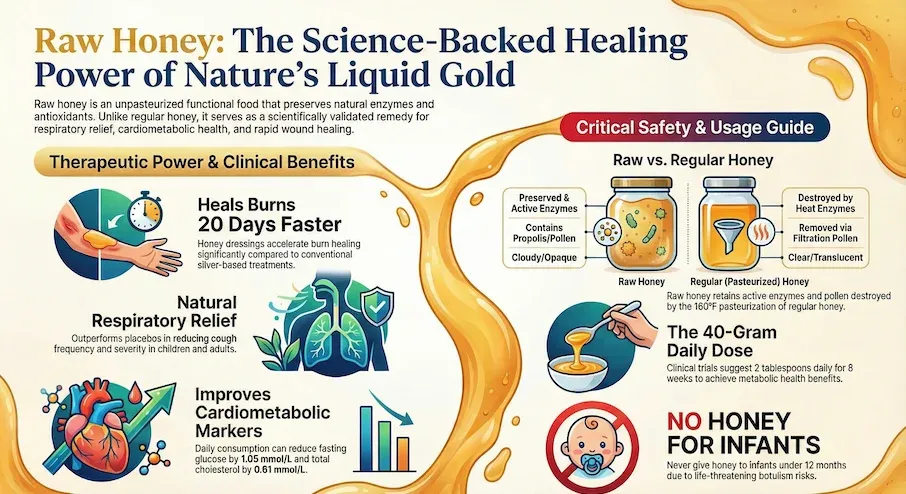
⚖️ Raw Honey vs. Regular Honey
Understanding the differences between raw and processed honey helps you make informed purchasing decisions. The key distinctions relate to processing methods and resulting nutrient content.
| Feature | Raw Honey | Regular (Pasteurized) Honey |
|---|---|---|
| Processing | Unpasteurized, minimally filtered | Heated to 160°F (71°C), fine-filtered |
| Enzymes | Preserved (glucose oxidase active) | Reduced or destroyed by heat |
| Pollen Content | Contains bee pollen and propolis | Removed during ultra-filtration |
| Appearance | Cloudy, opaque, may crystallize | Clear, translucent, shelf-stable |
| Bioactive Compounds | Phenolic compounds with antioxidant, anti-inflammatory, antimicrobial properties preserved [3] | Reduced bioactive content |
| Cardiometabolic Effects | Raw honey reduced fasting glucose by 1.05 mmol/L, total cholesterol by 0.61 mmol/L [4] | Less studied specifically |
| Price Range | $15-30 per pound (premium) | $5-12 per pound (standard) |
| Crystallization | Natural, indicates authenticity | Delayed or prevented by processing |
When to choose raw honey: If you're seeking maximum bioactive compounds for health benefits, particularly for wound healing, cough relief, or cardiometabolic support backed by clinical evidence.
When regular honey may suffice: For general cooking, baking at high temperatures (where enzymes would be destroyed anyway), or if you prefer a longer shelf life without crystallization.
Frequently Asked Questions
Is it safe to eat raw honey?
For adults and children over 12 months, raw honey is generally safe and supported by clinical evidence. A Cochrane review of 899 children found adverse events were mild, occurring in 12% of honey users versus 11% receiving placebo. However, specific populations require caution: infants under 12 months should NEVER consume honey due to botulism risk, those with pollen allergies may experience reactions, and immunocompromised individuals should consult healthcare providers. Diabetic patients should monitor blood glucose when consuming honey regularly.
Can raw honey help with weight loss?
Current evidence does not strongly support raw honey for weight loss. While honey has a lower glycemic index than refined sugar and may help reduce cravings when used as a sugar substitute, no high-quality human clinical trials demonstrate significant weight reduction from honey consumption. Animal studies show some anti-obesity effects, but these haven't been replicated in humans. If using honey for wellness, consume in moderation (1-2 tablespoons daily maximum) as it still contains approximately 64 calories and 17 grams of carbohydrates per tablespoon. Focus on overall dietary patterns rather than any single food for weight management.
Is raw honey good for your skin?
Clinical evidence supports topical honey for specific skin conditions. For wound healing, an RCT found honey dressings resulted in smaller scars (3.64±0.83mm) compared to control dressings (5.43±0.05mm) at 3 months (p<0.001), with researchers concluding honey improves the healing process and final aesthetic result. Honey's antimicrobial properties from hydrogen peroxide production make it effective for acne and minor skin infections. For facial use, apply a thin layer as a mask for 10-15 minutes, 2-3 times weekly, then rinse with warm water. Perform a patch test first if you have sensitive skin or pollen allergies.
Does raw honey expire?
Properly stored raw honey has an essentially indefinite shelf life. Honey's low moisture content (typically below 18%) and acidic pH (3.2-4.5) create an environment where bacteria cannot survive. Archaeological discoveries have found edible honey in Egyptian tombs thousands of years old. Crystallization—when honey becomes thick and grainy—is a natural process that indicates authenticity, not spoilage. To reliquify crystallized honey, place the jar in warm water (not exceeding 95°F/35°C) until it returns to liquid form. Store in a cool, dry place in a sealed container; avoid refrigeration as this accelerates crystallization.
Can diabetics eat raw honey?
Diabetic patients should approach honey with informed caution. A meta-analysis of 18 controlled trials found raw honey reduced fasting glucose by 1.05 mmol/L, which seems paradoxical for a sweetener. Researchers noted that robinia, clover, and raw honey specifically showed metabolic benefits. However, honey still raises blood glucose and contains significant carbohydrates (17g per tablespoon). If you have diabetes, consult your physician before regular use, monitor blood glucose carefully, limit intake to 1 tablespoon daily maximum if approved, and account for honey's carbohydrates in your meal planning.
How should raw honey be stored?
Store raw honey in a sealed glass or food-grade plastic container at room temperature (50-70°F/10-21°C) in a cool, dry place away from direct sunlight. Avoid refrigeration, which accelerates crystallization. Keep the lid tightly sealed to prevent moisture absorption, as honey is hygroscopic and absorbs water from the air—excess moisture can lead to fermentation. Use clean, dry utensils (wooden or plastic preferred over metal) to prevent introducing contaminants. If crystallization occurs, it's a sign of authentic raw honey; gently warm in a water bath below 95°F/35°C to preserve enzymes. Never microwave honey as this destroys beneficial compounds.
Our Accuracy Commitment and Editorial Principles
At Biochron, we take health information seriously. Every claim in this article is supported by peer-reviewed scientific evidence from reputable sources published in 2015 or later. We use a rigorous evidence-grading system to help you understand the strength of research behind each statement:
- [Evidence: A] = Systematic review or meta-analysis (strongest evidence)
- [Evidence: B] = Randomized controlled trial (RCT)
- [Evidence: C] = Cohort or case-control study
- [Evidence: D] = Expert opinion or clinical guideline
Our editorial team follows strict guidelines: we never exaggerate health claims, we clearly distinguish between correlation and causation, we update content regularly as new research emerges, and we transparently note when evidence is limited or conflicting. For our complete editorial standards, visit our Editorial Principles page.
This article is for informational purposes only and does not constitute medical advice. Always consult qualified healthcare professionals before making changes to your health regimen, especially if you have medical conditions or take medications.


References
- 1 . The effect of honey on lipid profiles: a systematic review and meta-analysis of controlled clinical trials. Gholami Z, Sohrabi Z, Zare M, Pourrajab B, Nasimi N. British Journal of Nutrition, 2022. PubMed | DOI [Evidence: A]
- 2 . Effectiveness of honey for symptomatic relief in upper respiratory tract infections: a systematic review and meta-analysis. Abuelgasim H, Albury C, Lee J. BMJ Evidence-Based Medicine, 2021. PubMed | DOI [Evidence: A]
- 3 . A Comprehensive Review of the Effect of Honey on Human Health. Palma-Morales M, Huertas JR, Rodríguez-Pérez C. Nutrients, 2023. PubMed | DOI [Evidence: D]
- 4 . Effect of honey on cardiometabolic risk factors: a systematic review and meta-analysis. Ahmed A, Tul-Noor Z, Lee D, et al. Nutrition Reviews, 2023. PubMed | DOI [Evidence: A]
- 5 . Honey for acute cough in children. Oduwole O, Udoh EE, Oyo-Ita A, Meremikwu MM. Cochrane Database of Systematic Reviews, 2018. PubMed | DOI [Evidence: A]
- 6 . A Comparative Study on the Effects of 'Honey and Fenugreek' with 'Fenugreek' on the Breastfeeding Success: A Randomized Trial. Simbar M, Nazarpour S, Mojab F, et al. Evidence-Based Complementary and Alternative Medicine, 2022. PubMed | DOI [Evidence: B]
- 7 . Is honey an effective treatment for acute cough in children?. Nitsche MP, Carreño M. Medwave, 2016. PubMed | DOI [Evidence: C]
- 8 . Topical application of honey in the management of chemo/radiotherapy-induced oral mucositis: A systematic review and network meta-analysis. Yang C, Gong G, Jin E, et al. International Journal of Nursing Studies, 2019. PubMed | DOI [Evidence: A]
- 9 . A systematic review and meta-analysis of dressings used for wound healing: the efficiency of honey compared to silver on burns. Lindberg T, Andersson O, Palm M, Fagerström C. Contemporary Nurse, 2015. PubMed | DOI [Evidence: A]
- 10 . A Study to Assess the Effectiveness of Honey in the Reduction of Constipation and Insomnia among Antenatal Mothers during the Third Trimester of Pregnancy. Rajagopal H, Kumari R, Deenadayalan PP, Viyakappan B. Journal of Pharmacy and Bioallied Sciences, 2024. PubMed | DOI [Evidence: C]
- 11 . Comparing the Effects of Yarrow, Honey, and Breast Milk for Healing Nipple Fissure. Firouzabadi M, Pourramezani N, Balvardi M. Iranian Journal of Nursing and Midwifery Research, 2020. PubMed | DOI [Evidence: C]
- 12 . Topical Application of Honey on Surgical Wounds: A Randomized Clinical Trial. Goharshenasan P, Amini S, Atria A, Abtahi H, Khorasani G. Forschende Komplementärmedizin, 2016. PubMed | DOI [Evidence: B]
Medical Disclaimer
This content is for informational and educational purposes only. It is not intended to provide medical advice or to take the place of such advice or treatment from a personal physician. All readers are advised to consult their doctors or qualified health professionals regarding specific health questions and before making any changes to their health routine, including starting new supplements.
Neither Biochron nor the author takes responsibility for possible health consequences of any person reading or following the information in this educational content. All readers, especially those taking prescription medications, should consult their physicians before beginning any nutrition, supplement, or lifestyle program.
If you have a medical emergency, call your doctor or emergency services immediately.
