


💡 What You Need to Know Right Away
Nattokinase is a supplement that helps support heart health by breaking down blood clots, lowering blood pressure, and promoting healthy circulation.
Also known as: Subtilisin NAT, NK, Natto Extract, Orokinase
- A review of 6 clinical studies (546 adults) confirms nattokinase helps lower blood pressure in people with high blood pressure[Evidence: A][1]
- A single oral dose activates measurable clot-dissolving activity within 4 to 8 hours in healthy adults[Evidence: B][9]
- Safety has been confirmed for up to 3 years at 2,000 FU daily in a controlled study of 265 participants[Evidence: B][4]
- In over 1,000 participants, high-dose nattokinase (10,800 FU) improved cholesterol and reduced artery plaque after 12 months[Evidence: C][3]
If you have been researching natural ways to support your heart health, nattokinase has probably come up in your search. This enzyme, derived from the traditional Japanese fermented soybean food called natto, has gained significant attention as a dietary supplement for cardiovascular support.
It is common to feel overwhelmed by conflicting information about supplements, especially when it comes to something as important as your heart. Many people wonder whether nattokinase actually works, what dose to take, and whether it is safe to use alongside medications[Evidence: A][1].
This article breaks down the current evidence on nattokinase. You will learn how it works in your body, what clinical studies have found, safe dosage ranges, potential risks, and who should avoid it. Every claim is backed by peer-reviewed research so you can make informed decisions with your healthcare provider.
❓ Quick Answers
What is nattokinase used for?
Nattokinase is primarily used to support cardiovascular health. It helps break down blood clots[Evidence: B][9], may lower blood pressure[Evidence: A][1], and supports healthy circulation. People also use it for cholesterol management and as part of an overall heart health supplement routine. It is available as an over-the-counter dietary supplement.
How does nattokinase work in the body?
Nattokinase works by directly breaking down fibrin, the protein that forms the structure of blood clots[Evidence: B][9]. It also activates your body's natural clot-dissolving system and has anti-inflammatory and antioxidant effects[Evidence: D][11]. These multiple pathways work simultaneously to support cardiovascular health.
What is the difference between nattokinase and natto food?
Natto is a traditional Japanese fermented soybean food that naturally contains nattokinase along with vitamin K2, protein, and other nutrients. Nattokinase supplements are purified enzyme extracts with vitamin K2 removed, which is important for people taking blood-thinning medications. The supplement provides standardized dosing measured in fibrinolytic units (FU), while natto food has variable enzyme content.
Can nattokinase dissolve blood clots?
Nattokinase activates measurable clot-dissolving activity in the human body[Evidence: B][9]. A study in healthy adults showed that a single 2,000 FU dose significantly elevated D-dimer levels, a direct marker of active clot breakdown, within 6 to 8 hours[Evidence: B][9]. However, nattokinase is not a replacement for prescribed blood-thinning medications.
How much nattokinase should I take?
Clinical studies have used doses ranging from 2,000 FU to 10,800 FU daily[Evidence: B][4][Evidence: C][3]. Nattokinase potency is measured in fibrinolytic units (FU), not milligrams. A dose of 2,000 FU has been studied safely for up to 3 years[Evidence: B][4]. Your healthcare provider should guide your specific dosage.
Is nattokinase safe?
Nattokinase appears to be well tolerated in clinical research. A meta-analysis of 6 studies reported no notable adverse events[Evidence: A][1], and a 3-year controlled trial confirmed safety at 2,000 FU daily[Evidence: B][4]. Real-world data from 153 patients with vascular diseases also showed no adverse drug reactions[Evidence: D][7]. People on blood-thinning medications should consult their doctor first.
Can nattokinase lower blood pressure?
Research shows nattokinase helps lower blood pressure in people with high blood pressure[Evidence: A][1]. A meta-analysis of 6 clinical trials found it reduced systolic blood pressure by 3.45 mmHg and diastolic by 2.32 mmHg[Evidence: A][1]. One study showed stronger effects in men, with diastolic pressure dropping about 5 points[Evidence: B][2].
Nattokinase Benefits
Discover the powerful cardiovascular enzyme derived from traditional Japanese Natto.
🔬 How Does Nattokinase Work?
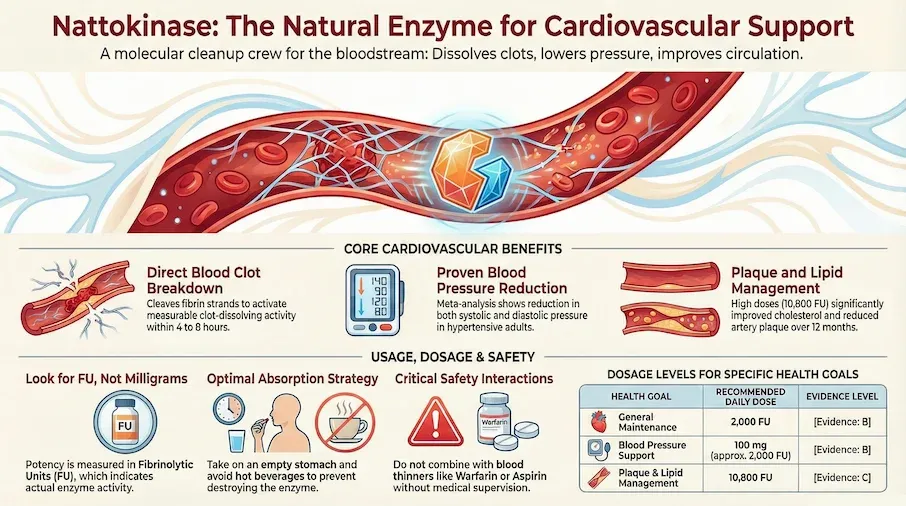
Think of nattokinase as a molecular cleanup crew that patrols your bloodstream. Just as a maintenance team clears away debris after a storm, nattokinase snips apart the web-like fibrin strands that form the backbone of blood clots.
Nattokinase is a serine protease enzyme produced by Bacillus subtilis var. natto during the fermentation of soybeans. When taken by mouth, it supports your cardiovascular system through several pathways at once.
Breaking down clots directly
Nattokinase cleaves fibrin, the protein that gives blood clots their structure[Evidence: B][9]. In healthy adults, a single 2,000 FU dose triggered measurable clot-dissolving activity within 4 hours. D-dimer, a marker confirming active clot breakdown, rose significantly by 6 to 8 hours after ingestion[Evidence: B][9]. Factor VIII, a key clotting protein, declined at the same time, while the body's natural blood-thinning activity (antithrombin) increased[Evidence: B][9]. All changes remained within normal physiological ranges[Evidence: B][9].
Activating your body's own clot-clearing system
Nattokinase also boosts your body's natural defenses against unwanted clots. It enhances tissue plasminogen activator (t-PA) activity while suppressing plasminogen activator inhibitor-1 (PAI-1), a protein that blocks clot removal[Evidence: D][11]. This dual action means nattokinase both adds its own clot-dissolving power and amplifies the system you already have.
Lowering blood pressure
A meta-analysis confirmed nattokinase reduces both systolic and diastolic blood pressure[Evidence: A][1]. One study found it increased plasma renin activity, suggesting it influences the body's blood pressure regulation system directly[Evidence: B][2].
Reducing inflammation and oxidative damage
A 2024 comprehensive review found nattokinase also acts as an anti-inflammatory and antioxidant, helping protect blood vessel walls from damage caused by oxidative stress[Evidence: D][11]. These additional protective mechanisms may contribute to its overall cardiovascular benefits.
🧪 What to Expect: The Real User Experience
Sensory Profile
Standard nattokinase capsules are tasteless and odorless when swallowed whole. Enteric-coated capsules, the most commonly recommended form, have no detectable smell or flavor. If you open a capsule or use the less common powder form, you may detect a faint fermented or "beany" smell, but nothing approaching the pungency of actual natto food. Natto itself has an intensely strong, ammonia-like odor and sticky, stringy texture that many Western consumers find challenging. The supplement form bypasses these sensory experiences entirely.
Common User Experiences
Many people notice no immediate effects from nattokinase, which is normal for a cardiovascular supplement. Some users report mild headaches within hours of the first dose, possibly related to blood pressure changes. A smaller number experience brief palpitations or light-headedness during the first week, which typically resolves as the body adjusts. At higher doses (above 10,000 FU), occasional digestive discomfort has been reported. If you notice no benefit after 2 to 3 months, product quality may be a factor, as some commercial products have been found to contain less active enzyme than their labels claim.
Practical Usage Tips
- Take on an empty stomach: 30 to 60 minutes before meals to reduce enzyme competition with food
- Choose enteric-coated capsules: These protect the enzyme from stomach acid, improving delivery to the intestine
- Avoid hot beverages: Heat above 60°C (140°F) can destroy enzyme activity
- Check the FU label: Always verify fibrinolytic units (FU) are listed, not just milligrams
- If you take warfarin: Use only purified supplement (vitamin K2 removed), never whole natto food
- Start low: Begin at 2,000 FU daily and increase only under physician guidance
Form Preferences
Most users prefer capsule form for convenience and standardized dosing. Enteric-coated capsules are strongly recommended over standard capsules for better acid stability and enzyme delivery. Powder forms are occasionally used in smoothies but can carry a faint fermented odor.
📊 Dosage and How to Use
Nattokinase potency is measured in fibrinolytic units (FU), not milligrams. This distinction matters because milligrams tell you how much powder is in a capsule, while FU tells you how active the enzyme actually is. Always look for FU on the label when choosing a product.
| Purpose/Condition | Dosage | Duration Studied | Evidence |
|---|---|---|---|
| Blood pressure support | 100 mg daily | 8 weeks | [Evidence: B][2] |
| Cardiovascular maintenance | 2,000 FU daily | Up to 3 years | [Evidence: B][4] |
| Cognitive support (arterial stenosis) | 8,000 FU daily | 6 months | [Evidence: B][12] |
| Plaque and lipid management | 10,800 FU daily | 12 months | [Evidence: C][3] |
| Combination therapy (NK + red yeast rice) | NK + red yeast rice daily | 90 days | [Evidence: B][8] |
What Is a Fibrinolytic Unit (FU)?
A fibrinolytic unit (FU) measures how effectively nattokinase dissolves fibrin, the protein mesh inside blood clots. One FU represents a standardized amount of clot-dissolving power. A capsule containing 100 mg of nattokinase powder could contain anywhere from 2,000 FU to over 10,000 FU depending on the enzyme's concentration and purity.
Important Dosage Notes
A 3-year controlled study confirmed safety at 2,000 FU daily in healthy adults[Evidence: B][4]. However, this same study found no cardiovascular benefit at this dose in people who were already healthy and at low risk for heart disease[Evidence: B][4].
A large clinical study of over 1,000 participants found that 3,600 FU daily was not effective for lipid and plaque outcomes, while 10,800 FU daily produced significant improvements[Evidence: C][3]. This suggests that higher doses may be necessary for cholesterol and plaque-related goals.
Your healthcare provider should guide your specific dosage, especially if you have existing health conditions or take medications.
⚠️ Risks, Side Effects, and Warnings
Nattokinase may enhance blood-thinning effects when combined with anticoagulant or antiplatelet medications. Do not combine nattokinase with warfarin, aspirin, clopidogrel, or direct oral anticoagulants (DOACs) without medical supervision. Stop taking nattokinase at least 2 weeks before any scheduled surgery.
It is common to have concerns about supplement safety, especially when heart health is involved. The overall clinical evidence suggests nattokinase is well tolerated, but certain groups need to exercise caution.
Side Effects
Clinical studies consistently report a favorable safety profile for nattokinase:
- A meta-analysis of 6 clinical trials reported no notable adverse events across all studies[Evidence: A][1]
- A 3-year randomized controlled trial at 2,000 FU daily found no safety concerns[Evidence: B][4]
- A 12-month study with over 1,000 participants at 10,800 FU daily reported no adverse effects[Evidence: C][3]
- Real-world data from 153 patients with vascular diseases showed no adverse drug reactions or drug interactions[Evidence: D][7]
User reports outside clinical settings mention occasional headache, dizziness, and digestive discomfort at higher doses. These effects were not consistently documented in controlled research.
Drug Interactions
Controlled clinical drug interaction studies have not been completed for nattokinase. Real-world monitoring of 153 patients with vascular diseases documented no drug interactions during treatment[Evidence: D][7]. However, based on nattokinase's demonstrated fibrinolytic activity[Evidence: B][9], theoretical interactions exist with:
- Anticoagulants (warfarin, heparin)
- Antiplatelet drugs (aspirin, clopidogrel)
- Direct oral anticoagulants (apixaban, rivaroxaban)
- Antihypertensive medications (additive blood pressure lowering)
Inform your healthcare provider of all medications before starting nattokinase.
Contraindications
Avoid nattokinase if you have a known soy allergy. Consult your healthcare provider before use if you are pregnant, breastfeeding, have a bleeding disorder, or have a scheduled surgery. Safety data for pregnant and breastfeeding women and children has not been established through clinical studies.
Important distinction: If you take warfarin, use only purified nattokinase supplements (with vitamin K2 removed). Natto food contains very high levels of vitamin K2, which can interfere with warfarin's effectiveness. This distinction is critical for people on blood-thinning medications.
When to See a Doctor
Contact your healthcare provider before or during nattokinase use if any of the following apply:
- You take warfarin, aspirin, clopidogrel, or other blood-thinning medications
- You have a history of stroke, deep vein thrombosis, or blood clots
- You are scheduled for surgery within the next 2 weeks
- You have been diagnosed with a bleeding disorder
- You are pregnant or breastfeeding
- You have a mechanical heart valve
- You experience unexpected bruising or prolonged bleeding while using nattokinase
- You develop signs of a severe allergic reaction (difficulty breathing, swelling, hives)
🥗 Practical Ways to Use Nattokinase
How to Use This in Your Daily Life
Scenario 1: Blood Pressure Support
- Dose: 100 mg daily[2]
- Duration: 8 weeks studied[2]
- Population: Adults with elevated blood pressure
- Timing: On an empty stomach, 30 to 60 minutes before a meal
- What to track: Blood pressure readings (home monitoring recommended)
- Expected results: Studies showed modest blood pressure reduction, with diastolic pressure dropping about 5 points in men[2]
Scenario 2: Cardiovascular Maintenance
- Dose: 2,000 FU daily[4]
- Duration: Studied up to 3 years[4]
- Population: Adults concerned about cardiovascular health
- Timing: On an empty stomach
- What to track: Regular cardiovascular checkups with your doctor
- Expected results: Supports fibrinolytic activity. However, no cardiovascular benefit was observed in already-healthy, low-risk adults in a 3-year study[4]
Scenario 3: Lipid and Plaque Management (High Dose)
- Dose: 10,800 FU daily[3]
- Duration: 12 months studied[3]
- Population: Adults with atherosclerosis and high cholesterol
- Timing: On an empty stomach
- What to track: Cholesterol panel and lipid levels
- Expected results: Improvement in cholesterol and plaque measures was observed in 66.5% to 95.4% of participants. 3,600 FU daily was not effective[3]
Practical Integration
Take nattokinase on an empty stomach, 30 to 60 minutes before meals, with room-temperature or cold water. Avoid taking it with hot beverages, as heat above 60°C can destroy enzyme activity. Store in a cool, dry place away from direct sunlight. Enteric-coated capsules are preferred for protecting the enzyme from stomach acid.
Common Mistakes to Avoid
- Checking only milligrams: FU (fibrinolytic units) is the true measure of potency. A 100 mg capsule and a 200 mg capsule may have the same FU rating.
- Inconsistent dosing: Clinical studies used daily dosing[4][3]. Sporadic use may not achieve the studied benefits.
- Expecting results at low doses for lipid goals: 3,600 FU daily showed no significant benefit for cholesterol or plaque[3]. Higher doses were needed.
- Taking with hot drinks: Heat denatures the enzyme. Always use room-temperature or cold beverages.
What to Look for When Choosing Nattokinase
Not all nattokinase supplements are created equal. Here is what matters when selecting a quality product:
Quality Markers
- Third-party testing: Look for USP, NSF, or ConsumerLab certification. Why it matters: Independent testing verifies that the product contains what the label claims. Some commercial products have failed potency testing.
- FU listed on label: Always choose products that display fibrinolytic units (FU), not just milligrams. Why it matters: FU measures actual enzyme activity. Milligrams alone do not indicate potency.
- Enteric coating: Prefer enteric-coated capsules. Why it matters: Enteric coating protects the enzyme from stomach acid degradation, improving delivery to the intestine.
- Vitamin K2 removed: Important for anyone taking warfarin or other blood thinners. Why it matters: Natto naturally contains very high vitamin K2, which can interfere with anticoagulant medications. Purified nattokinase supplements should have K2 removed.
- Minimal additives: Avoid unnecessary fillers, artificial colors, or allergens. Why it matters: Reduces risk of adverse reactions and ensures you are getting active enzyme.
Red Flags to Avoid
- No FU on label: Products listing only milligrams may be hiding low potency
- Proprietary blends: You cannot verify individual ingredient amounts
- Unrealistic claims: Products promising to "cure," "dissolve all clots," or provide "miracle" results
- No third-party testing: Quality varies significantly without independent verification
Where to Buy
- Best: Pharmacies with licensed pharmacists, reputable health stores
- Caution: Online marketplaces (verify seller authenticity, check for tamper seals)
- Avoid: Unregulated websites, pop-up ads, multi-level marketing schemes with unverified claims
How Nattokinase Compares to Serrapeptase: What to Know
Nattokinase and serrapeptase are both proteolytic enzyme supplements, but they come from different sources and have different primary uses. Understanding their differences can help you decide which one, if either, fits your health goals.
| Feature | Nattokinase | Serrapeptase |
|---|---|---|
| Origin | Bacillus subtilis var. natto (fermented soybeans) | Serratia marcescens bacteria (originally isolated from silkworm intestine) |
| Primary Mechanism | Fibrinolytic: dissolves fibrin in blood clots[Evidence: B][9] | Proteolytic: breaks down non-living protein tissue in inflammation (general medical knowledge) |
| Best Known For | Cardiovascular support, blood pressure, clot prevention[Evidence: A][1] | Inflammation, pain reduction, mucus thinning (general medical knowledge) |
| Evidence Level | Meta-analysis + multiple RCTs[Evidence: A][1] | Limited RCTs; evidence generally weaker (general medical knowledge) |
| Common Side Effects | Generally well tolerated; mild headache, dizziness reported[Evidence: A][1] | Nausea, stomach upset, skin reactions (general medical knowledge) |
| Availability | OTC supplement | OTC supplement |
For heart health goals specifically, nattokinase has stronger and more recent research support, including a meta-analysis of 6 RCTs confirming blood pressure reduction[Evidence: A][1]. Serrapeptase research is more limited, with fewer large-scale clinical trials for cardiovascular endpoints.
Some people consider combining nattokinase and serrapeptase. While this combination is commercially available, no well-designed clinical studies have evaluated this combination specifically. Consult your healthcare provider before combining enzyme supplements.
What The Evidence Shows (And Doesn't Show)
What Research Suggests
The overall evidence for nattokinase is moderate, supported by 1 meta-analysis, 5 RCTs, and several observational studies:
- A meta-analysis of 6 RCTs (546 participants) confirms nattokinase reduces systolic blood pressure by 3.45 mmHg and diastolic by 2.32 mmHg in adults with high blood pressure[Evidence: A][1]
- A single oral dose of 2,000 FU activates measurable fibrinolytic activity within 4 to 8 hours, confirmed by D-dimer and fibrin degradation product elevation[Evidence: B][9]
- High-dose nattokinase (10,800 FU daily for 12 months) improved cholesterol and plaque measures in 66.5% to 95.4% of over 1,000 participants[Evidence: C][3]
- Nattokinase combined with red yeast rice reduced diastolic blood pressure by about 7 points in people with stable heart disease after 90 days[Evidence: B][8]
- A 16-year Japanese study found that adults who ate the most natto had about 25% lower risk of dying from cardiovascular disease[Evidence: C][5], and a 15-year study found elderly men who ate natto regularly had about 40% lower all-cause mortality risk[Evidence: C][6]
What's NOT Yet Proven
- Optimal dosage has not been established. Studies used 2,000 FU to 10,800 FU with varying results. At 2,000 FU, a 3-year study showed no cardiovascular benefit in healthy, low-risk adults[Evidence: B][4]
- Long-term safety beyond 3 years has not been studied
- Effects in children, pregnant women, and breastfeeding mothers have not been evaluated in clinical trials
- Whether nattokinase survives digestion intact (oral bioavailability) remains an open scientific question. Researchers are still studying exactly how this large enzyme molecule passes through the digestive system
- The spike protein degradation observed in laboratory cells has not been confirmed in humans[Evidence: C][10]
- Cognitive benefits showed mixed results: no overall improvement in general thinking, but specific visuospatial gains in people with partially blocked arteries[Evidence: B][12]
Where Caution Is Needed
- Lower doses may negatively affect cholesterol levels, while higher doses improve them[Evidence: A][1]. Dose selection matters significantly.
- Fibrinolytic activity means theoretical bleeding risk when combined with anticoagulant medications[Evidence: B][9]
- The largest plaque reduction study (1,062 participants) was observational (not randomized) and has a published corrigendum[Evidence: C][3]
- Natto food and nattokinase supplement are not interchangeable. Natto food contains very high vitamin K2, which may interfere with warfarin therapy
- Laboratory spike protein findings should not be interpreted as evidence for COVID-19 treatment[Evidence: C][10]
Should YOU Try This?
Best suited for: Adults with elevated blood pressure or cardiovascular risk factors who want adjunctive support alongside standard medical care[Evidence: A][1]. People with atherosclerosis or high cholesterol may benefit from higher-dose protocols under medical supervision[Evidence: C][3].
Not recommended for: People on anticoagulant therapy without medical supervision, those with bleeding disorders, pregnant or breastfeeding women, anyone with soy allergy, or healthy, low-risk adults expecting preventive cardiovascular benefits (a 3-year study found no benefit in this group[Evidence: B][4]).
Realistic timeline: Blood pressure effects were observed within 8 weeks[Evidence: B][2]. Lipid and plaque improvements required 3 to 12 months[Evidence: C][3][Evidence: B][8]. Individual response varies.
When to consult a professional: Before starting nattokinase, especially if you take any medications, have cardiovascular conditions, or are scheduled for surgery.
Frequently Asked Questions
What are the side effects of nattokinase?
In clinical studies, nattokinase consistently showed a favorable safety profile. A meta-analysis of 6 trials reported no notable adverse events, and a 3-year study at 2,000 FU daily found no safety concerns. A 12-month study with over 1,000 participants at 10,800 FU daily also reported no adverse effects. User reports outside clinical settings mention occasional headache, dizziness, or light-headedness, particularly during the first week. Digestive discomfort has been reported at higher doses. These effects were not consistently observed in controlled research.
Who should not take nattokinase?
Nattokinase should be avoided by people taking anticoagulant medications (warfarin, heparin) or antiplatelet drugs (aspirin, clopidogrel) without medical supervision, due to its fibrinolytic activity. People with bleeding disorders, those scheduled for surgery within 2 weeks, and anyone with a soy allergy should also avoid it. Safety data for pregnant and breastfeeding women has not been established through clinical studies. People with mechanical heart valves should not use nattokinase as a substitute for prescribed anticoagulant therapy. Always consult your healthcare provider before starting nattokinase if you have any underlying health conditions.
Does nattokinase interact with blood thinners?
Controlled clinical drug interaction studies have not been completed for nattokinase. However, real-world monitoring of 153 patients with vascular diseases documented no drug interactions during treatment. Because nattokinase has demonstrated fibrinolytic and anticoagulant activity in human studies, theoretical risk exists for additive blood-thinning effects when combined with warfarin, aspirin, clopidogrel, or direct oral anticoagulants. If you currently take blood-thinning medication, do not start nattokinase without first discussing it with your prescribing physician. Your doctor may recommend monitoring your clotting values more frequently.
Can nattokinase help with COVID or spike protein?
Laboratory cell studies found that nattokinase degraded the SARS-CoV-2 spike protein in a dose- and time-dependent manner. Heat-inactivated nattokinase showed no effect, confirming the active enzyme was responsible. However, these results come exclusively from laboratory cell tests (in vitro), not from human clinical trials. No published clinical studies have tested whether nattokinase breaks down spike proteins in living people or provides any COVID-related benefit. The Agency for Healthcare Research and Quality (AHRQ) has nominated this as a topic for future research. Do not use nattokinase as a treatment for COVID-19 or Long COVID without medical guidance.
Does nattokinase lower cholesterol?
Evidence is mixed and depends heavily on dose. A meta-analysis found that lower-dose nattokinase supplementation may negatively affect cholesterol levels. However, a large clinical study of over 1,000 participants found that high-dose nattokinase (10,800 FU daily) produced significant improvements in lipid profiles after 12 months, with improvement rates between 66.5% and 95.4%. Notably, a lower dose of 3,600 FU daily showed no significant benefit in the same study. Combining nattokinase with red yeast rice also reduced total cholesterol and triglycerides in a 90-day trial.
When is the best time to take nattokinase?
Clinical studies have not established a definitively optimal time of day for nattokinase supplementation. Most studies administered nattokinase once daily. General supplement guidance suggests taking nattokinase on an empty stomach, 30 to 60 minutes before meals, to reduce competition with digestive enzymes. Avoid taking it with hot beverages, as temperatures above 60°C can destroy enzyme activity. Some practitioners recommend evening dosing based on the body's natural clotting rhythms, but this timing preference has not been validated in clinical trials. Consistency matters more than timing. Choose a time that fits your routine and take it daily.
Can nattokinase replace warfarin?
No. Nattokinase cannot replace warfarin or other prescribed anticoagulant medications. While nattokinase has demonstrated fibrinolytic activity in human studies, it has not been evaluated as a therapeutic substitute for prescription anticoagulants in clinical trials. Warfarin is prescribed for specific, often life-threatening conditions including atrial fibrillation, deep vein thrombosis, and mechanical heart valves. Case reports have documented serious complications when patients substituted supplements for prescribed anticoagulants. Do not stop or reduce warfarin or any prescribed blood thinner in favor of nattokinase. Any changes to anticoagulant therapy should be made only under direct medical supervision.
Is nattokinase safe to take long term?
The longest controlled study of nattokinase lasted 3 years, involving 265 participants who took 2,000 FU daily. No safety concerns were identified during this period. A separate 12-month study with over 1,000 participants at the higher dose of 10,800 FU daily also reported no adverse effects. Real-world safety data from 153 patients with vascular diseases further supports tolerability. While these results are encouraging, safety beyond 3 years has not been studied. Regular follow-up with your healthcare provider is recommended for anyone using nattokinase long term.
Does nattokinase smell or taste like natto?
Standard nattokinase capsules are tasteless and odorless when swallowed whole. Unlike natto food, which has an intensely strong, ammonia-like odor and sticky, stringy texture that many Western consumers find challenging, purified nattokinase supplements bypass these sensory experiences entirely. Enteric-coated capsules, the most commonly recommended form, are fully odorless and have no aftertaste. If you open a capsule or use the less common powder form, you may detect a faint fermented or 'beany' smell, but nothing approaching the pungency of actual natto. If taste or smell is a concern, choose enteric-coated capsules. You will not experience natto's distinctive flavor or texture.
Can nattokinase cause bleeding?
Nattokinase activates fibrinolytic pathways, meaning it promotes the breakdown of blood clots. In the study that confirmed this activity, all changes remained within normal physiological ranges and did not cause dangerous over-thinning of the blood. Clinical trials have not reported bleeding events as a side effect. However, the theoretical risk of enhanced bleeding exists, particularly when nattokinase is combined with blood-thinning medications. Stop nattokinase at least 2 weeks before scheduled surgery. If you experience unexpected bruising or prolonged bleeding, stop use and consult your healthcare provider immediately.
Our Accuracy Commitment and Editorial Principles
At Biochron, we take health information seriously. Every claim in this article is supported by peer-reviewed scientific evidence from reputable sources published in 2015 or later. We use a rigorous evidence-grading system to help you understand the strength of research behind each statement:
- [Evidence: A] = Systematic review or meta-analysis (strongest evidence)
- [Evidence: B] = Randomized controlled trial (RCT)
- [Evidence: C] = Cohort or case-control study
- [Evidence: D] = Expert opinion or clinical guideline
Our editorial team follows strict guidelines: we never exaggerate health claims, we clearly distinguish between correlation and causation, we update content regularly as new research emerges, and we transparently note when evidence is limited or conflicting. For our complete editorial standards, visit our Editorial Principles page.
This article is for informational purposes only and does not constitute medical advice. Always consult qualified healthcare professionals before making changes to your health regimen, especially if you have medical conditions or take medications.


References
- 1 . Nattokinase Supplementation and Cardiovascular Risk Factors: A Systematic Review and Meta-Analysis of Randomized Controlled Trials, Li X, Long J, Gao Q, et al., Reviews in Cardiovascular Medicine, 2023, 24(8):234. PubMed [Evidence: A]
- 2 . Consumption of nattokinase is associated with reduced blood pressure and von Willebrand factor, a cardiovascular risk marker, Jensen GS, Lenninger M, Ero MP, Benson KF, Integrated Blood Pressure Control, 2016, 9:95-104. PubMed [Evidence: B]
- 3 . Effective management of atherosclerosis progress and hyperlipidemia with nattokinase: A clinical study with 1,062 participants, Chen H, Chen J, Zhang F, et al., Frontiers in Cardiovascular Medicine, 2022, 9:964977. PubMed [Evidence: C]
- 4 . Nattokinase atherothrombotic prevention study: A randomized controlled trial, Hodis HN, Mack WJ, Meiselman HJ, et al., Clinical Hemorheology and Microcirculation, 2021, 78(4):339-353. PubMed [Evidence: B]
- 5 . Dietary soy and natto intake and cardiovascular disease mortality in Japanese adults: the Takayama study, Nagata C, Wada K, Tamura T, et al., American Journal of Clinical Nutrition, 2017, 105(2):426-431. PubMed [Evidence: C]
- 6 . A 15-year cohort study of self-reported fermented soybean (natto) intake and all-cause mortality in elderly men, Fujita Y, Kouda K, Tamaki J, et al., Clinical Nutrition ESPEN, 2025, 68:699-706. PubMed [Evidence: C]
- 7 . Data Recorded in Real Life Support the Safety of Nattokinase in Patients with Vascular Diseases, Gallelli G, Di Mizio G, Palleria C, et al., Nutrients, 2021, 13(6):2031. PubMed [Evidence: D]
- 8 . Lipid-lowering, antihypertensive, and antithrombotic effects of nattokinase combined with red yeast rice in patients with stable coronary artery disease, Liu M, Xu Z, Wang Z, et al., Frontiers in Nutrition, 2024, 11:1380727. PubMed [Evidence: B]
- 9 . A single-dose of oral nattokinase potentiates thrombolysis and anti-coagulation profiles, Kurosawa Y, Nirengi S, Homma T, et al., Scientific Reports, 2015, 5:11601. PubMed [Evidence: B]
- 10 . Degradative Effect of Nattokinase on Spike Protein of SARS-CoV-2, Tanikawa T, Kiba Y, Yu J, et al., Molecules, 2022, 27(17):5405. PubMed [Evidence: C]
- 11 . Nattokinase as an adjuvant therapeutic strategy for non-communicable diseases: a review of fibrinolytic, antithrombotic, anti-inflammatory, and antioxidant effects, Granito M, Alvarenga L, Ribeiro M, et al., Expert Review of Cardiovascular Therapy, 2024, 22(10):565-574. PubMed [Evidence: D]
- 12 . Nattokinase supplementation for cognitive enhancement in asymptomatic intracranial/carotid stenosis: A randomized controlled trial, Zhang K, Zhang X, Wang A, et al., Journal of Stroke and Cerebrovascular Diseases, 2026, 35(1):108511. PubMed [Evidence: B]
Medical Disclaimer
This content is for informational and educational purposes only. It is not intended to provide medical advice or to take the place of such advice or treatment from a personal physician. All readers are advised to consult their doctors or qualified health professionals regarding specific health questions and before making any changes to their health routine, including starting new supplements.
Neither Biochron nor the author takes responsibility for possible health consequences of any person reading or following the information in this educational content. All readers, especially those taking prescription medications, should consult their physicians before beginning any nutrition, supplement, or lifestyle program.
If you have a medical emergency, call your doctor or emergency services immediately.
