


💡 What You Need to Know Right Away
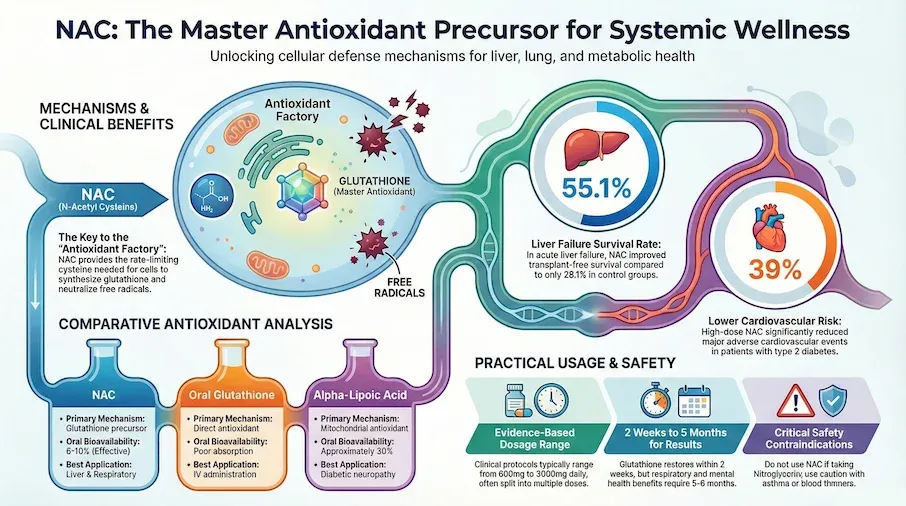
- Liver protection: NAC improved transplant-free survival in acute liver failure (55.1% vs 28.1% in controls).[Evidence: A][11]
- Respiratory health: NAC significantly reduced COPD exacerbations and improved lung function (risk rate 1.09, CI 1.04-1.14).[Evidence: A][1]
- Anti-inflammatory effects: Meta-analysis of 28 trials shows NAC significantly decreased inflammatory markers including IL-8 and homocysteine.[Evidence: A][4]
- Cardiovascular protection: NAC reduced major adverse cardiovascular events by 39% at highest doses in type 2 diabetes patients (nearly 47,000 tracked).[Evidence: C][7]
If you have been researching ways to support your liver, lungs, or overall antioxidant defenses, you have likely come across N-Acetyl Cysteine, commonly known as NAC. This amino acid derivative has generated significant scientific interest, with over 22,000 research papers published in 2024 alone.
NAC is a supplement form of cysteine, an amino acid that serves as the rate-limiting precursor to glutathione, your body's master antioxidant. While its most established medical use involves treating acetaminophen overdose in hospitals, emerging research supports broader applications for respiratory health, mental wellness, fertility, and metabolic function.
In this comprehensive guide, you will learn exactly what the evidence shows about NAC's benefits, the research-backed dosages for specific conditions, important safety considerations, and how to use NAC effectively. Every claim is supported by peer-reviewed studies, so you can make informed decisions about whether NAC is right for you.
❓ Quick Answers
What is NAC?
N-Acetyl Cysteine (NAC) is the acetylated form of the amino acid L-cysteine. It functions primarily as a precursor to glutathione, the body's most abundant intracellular antioxidant. NAC is available as both a prescription medication for acetaminophen overdose and as a dietary supplement for general health support.[Evidence: D][12]
How does NAC work?
NAC works by providing cysteine, the rate-limiting amino acid for glutathione synthesis. Once absorbed, NAC is deacetylated to L-cysteine, which combines with glutamate and glycine to form glutathione. This tripeptide neutralizes free radicals, supports detoxification enzymes, and modulates inflammatory pathways.[Evidence: B][3]
What are the benefits of NAC?
Research supports NAC for liver protection (improved transplant-free survival in acute liver failure), respiratory health (reduced COPD exacerbations), mental health (improved depression scores in 904 patients), fertility (enhanced sperm parameters in men, improved ovulation in PCOS), and cardiovascular protection in diabetics.[Evidence: A][2][11]
How much NAC should I take?
Research-backed dosages range from 600-3000 mg daily depending on the condition. For COPD, studies use 1200-1800 mg daily for 12+ months. For depression, 1000-3000 mg daily over 8-24 weeks showed benefits. For PCOS, 600-1800 mg daily improved metabolic and fertility parameters. Always start with lower doses.[Evidence: A][5][13]
Is NAC safe to take daily?
NAC is well-tolerated at daily doses up to 1800 mg in chronic respiratory conditions, with a favorable risk-benefit ratio documented in safety reviews. Common side effects are mild gastrointestinal symptoms. However, individuals with asthma should use caution due to potential bronchospasm risk, and those on nitroglycerin should avoid NAC.[Evidence: D][14]
Does NAC detox the liver?
Yes, NAC is a clinically proven liver protectant. In non-acetaminophen acute liver failure, NAC improved transplant-free survival to 55.1% compared to 28.1% in controls. NAC replenishes glutathione, which neutralizes the toxic acetaminophen metabolite NAPQI, making it the FDA-approved antidote for acetaminophen overdose.[Evidence: A][11][12]
Can NAC improve fertility?
Research supports NAC for both male and female fertility. In men, a meta-analysis of 3 RCTs (431 participants) showed NAC improved sperm concentration, volume, motility, and morphology. In women with PCOS, 18 studies (2,185 participants) demonstrated NAC reduced testosterone levels and increased FSH, improving reproductive function.[Evidence: A][10][15]
How long does NAC take to work?
Timeline varies by application. For glutathione restoration, GlyNAC protocols show effects within 2 weeks. For COPD exacerbation prevention, benefits were documented in studies exceeding 5 months duration. For depression, studies used 8-24 week protocols. For PCOS fertility effects, research spans 3+ months. Acute acetaminophen overdose response is immediate.[Evidence: A][3][5]
N-Acetyl Cysteine (NAC)
Explore the multifaceted benefits of NAC, a powerful supplement known for its role in cellular defense and systemic wellness.
🔬 How Does NAC Work in Your Body?
Understanding how NAC works helps explain its diverse health applications. At its core, NAC is a delivery vehicle for cysteine, the amino acid that often runs low in your body and limits how much glutathione you can produce.
Think of NAC as a key that unlocks your body's antioxidant factory. Your cells constantly produce glutathione, but they cannot make enough without adequate cysteine. NAC provides this missing ingredient in a stable, absorbable form. Once inside your cells, NAC sheds its acetyl group and becomes L-cysteine, which then combines with glutamate and glycine to form glutathione.[Evidence: B][3]
Glutathione operates through multiple pathways. As an antioxidant, it neutralizes reactive oxygen species that damage cell membranes, proteins, and DNA. A randomized controlled trial in 114 healthy older adults demonstrated that high-dose NAC combined with glycine improved glutathione generation in subjects with elevated oxidative stress.[Evidence: B][3]
Anti-Inflammatory Mechanisms
Beyond antioxidant activity, NAC directly reduces inflammation. Imagine NAC as a volume dial that turns down your body's inflammatory response. A meta-analysis of 28 controlled trials found NAC significantly decreased malondialdehyde (a marker of oxidative damage), interleukin-8, and homocysteine. Sensitivity analysis revealed additional benefits for TNF-α and IL-6, two key inflammatory cytokines.[Evidence: A][4]
Cardiovascular Protection
NAC exhibits strong potential for protecting the heart, particularly in diabetic individuals. A systematic review found NAC reduces oxidative stress and prevents both ischemic and non-ischemic cardiac injury.[Evidence: D][9] A cohort study tracking nearly 47,000 type 2 diabetes patients from 2008-2021 demonstrated NAC reduced major adverse cardiovascular events (41.74% vs 46.87% in controls), with a dose-dependent protective effect reaching 39% risk reduction at the highest doses.[Evidence: C][7]
Liver Detoxification
NAC's hepatoprotective action involves direct binding to toxic metabolites. In acetaminophen overdose, the liver produces a harmful metabolite called NAPQI that depletes glutathione and causes cell death. NAC replenishes glutathione stores, allowing the liver to neutralize NAPQI before irreversible damage occurs. This mechanism is so effective that NAC remains the standard of care for acetaminophen toxicity.[Evidence: A][11]
📊 NAC Dosage and How to Use
NAC dosages in clinical research vary considerably based on the condition being addressed. The following table summarizes evidence-based protocols from peer-reviewed studies.
| Purpose/Condition | Dosage | Duration | Evidence |
|---|---|---|---|
| COPD exacerbation prevention | 1200-1800 mg/day | 12+ months | [A][5] |
| Depression (adjunctive) | 1000-3000 mg/day | 8-24 weeks | [A][2] |
| OCD (anxiety symptoms) | 3000 mg/day | 16 weeks | [B][6] |
| PCOS metabolic improvement | 600-1800 mg/day | Variable | [A][13] |
| PCOS fertility/hormone regulation | 600-1800 mg/day | Variable | [A][15] |
| Male fertility (sperm parameters) | 600 mg/day (typical) | 3+ months | [A][10] |
| Glutathione restoration (GlyNAC) | 600-1200 mg twice daily | 2-16 weeks | [B][3] |
General Usage Guidelines
NAC is typically taken orally in capsule or powder form. For optimal absorption, many practitioners recommend taking NAC on an empty stomach, though this is not strictly required. Splitting higher doses (above 1200 mg) into two or three administrations throughout the day may reduce gastrointestinal side effects.[Evidence: D][14]
The meta-analysis for COPD demonstrated that benefits persisted in studies lasting more than 5 months, suggesting NAC requires consistent long-term use for respiratory conditions rather than acute supplementation.[Evidence: A][5]
For mental health applications, the depression meta-analysis spanning 12 RCTs and 904 patients showed protocols ranged from 8 to 24 weeks, with particular benefit noted in bipolar disorder and major depressive disorder.[Evidence: A][2]
⚠️ Risks, Side Effects, and Warnings
Side Effects
NAC is generally well-tolerated at therapeutic doses. A safety review of high-dose NAC in chronic respiratory diseases confirmed a favorable risk-benefit ratio even at doses exceeding the standard 600 mg/day.[Evidence: D][14]
The most commonly reported side effects are gastrointestinal in nature. In the OCD randomized controlled trial using 3000 mg daily for 16 weeks, abdominal pain occurred more frequently in the NAC group compared to placebo, though the supplement remained well-tolerated overall.[Evidence: B][6]
Reported GI symptoms may include:
- Nausea
- Vomiting
- Diarrhea
- Abdominal discomfort
Drug Interactions
Nitroglycerin and nitrates: Contraindicated combination. NAC potentiates the vasodilatory effects, potentially causing severe hypotension.[14]
Anticoagulants: NAC may have additive effects on bleeding risk. Monitor closely if taking warfarin, heparin, or other blood thinners.[14]
Activated charcoal: May reduce NAC absorption. Separate administration by at least 1 hour if both are required.[14]
Special Populations
Pregnancy and breastfeeding: Limited human data available. Consult healthcare provider before use. NAC is classified as a Category B medication based on animal studies.
COVID-19: A meta-analysis of 5 RCTs including 651 participants found NAC did not improve mortality (15.6% vs 32.3% controls, no statistical significance) or reduce mechanical ventilation requirements. NAC is not recommended for routine COVID-19 treatment based on current evidence.[Evidence: A][8]
🥗 Practical Ways to Use NAC
How to Use This in Your Daily Life
Scenario 1: Respiratory Health (COPD/Chronic Bronchitis)
- Dose: 1200-1800 mg daily[5]
- Duration: 12+ months for exacerbation prevention[5]
- Population: Adults with COPD or chronic bronchitis
- Timing: Split into 2 doses (morning and evening)
- What to track: Frequency of exacerbations, symptom severity
- Expected results: Reduced exacerbation incidence, improved symptom control[5]
Scenario 2: Mental Health Support (Depression)
- Dose: 1000-3000 mg daily[2]
- Duration: 8-24 weeks minimum[2]
- Population: Adults with depression, particularly bipolar disorder or MDD
- Timing: Divide higher doses across 2-3 administrations
- What to track: Mood, energy levels, depressive symptoms
- Expected results: Improved depression scores as adjunctive therapy[2]
Scenario 3: Antioxidant/Glutathione Support (GlyNAC Protocol)
- Dose: 600-1200 mg NAC twice daily combined with glycine[3]
- Duration: 2-16 weeks[3]
- Population: Older adults or those with elevated oxidative stress
- Timing: Twice daily with or without food
- What to track: Energy, recovery, markers of oxidative stress if testing available
- Expected results: Enhanced glutathione generation in individuals with low baseline levels[3]
Practical Integration
Take NAC capsules with water. For doses above 1200 mg daily, splitting into morning and evening administrations may reduce gastrointestinal discomfort. Store in a cool, dry place away from direct sunlight. NAC is safe at doses up to 1800 mg/day in chronic respiratory conditions according to safety reviews.[Evidence: D][14]
Common Mistakes to Avoid
- Inconsistent dosing: Studies demonstrating benefits used daily dosing protocols. Sporadic use may not achieve therapeutic effects.[5]
- Insufficient duration: COPD benefits appeared in studies exceeding 5 months. Mental health studies ran 8-24 weeks. Allow adequate time before assessing results.[2][5]
- Ignoring contraindications: If you take nitroglycerin, have asthma, or are scheduled for surgery, consult your healthcare provider before starting NAC.
⚖️ NAC vs Other Antioxidants
NAC is often compared to other antioxidant supplements. The following table helps contextualize NAC within the broader antioxidant landscape.
| Feature | NAC | Glutathione (Oral) | Alpha-Lipoic Acid |
|---|---|---|---|
| Primary Mechanism | Glutathione precursor | Direct antioxidant | Mitochondrial antioxidant |
| Oral Bioavailability | 6-10% (but effective) | Poor oral absorption | Approximately 30% |
| Cost (Monthly) | Low ($15-30) | High ($40-80) | Medium ($25-50) |
| Evidence for Liver | Strong (FDA-approved for overdose) | Limited | Moderate |
| Evidence for COPD | Strong (multiple meta-analyses) | Limited | Limited |
| Best Application | Liver, respiratory, general antioxidant | IV administration preferred | Diabetic neuropathy |
Despite NAC's relatively low oral bioavailability (6-10%), it remains clinically effective because it rapidly elevates intracellular cysteine levels, enabling glutathione synthesis where it matters most, inside cells. Direct glutathione supplementation faces absorption challenges, making NAC a more practical oral option for most people.
For PCOS specifically, NAC has demonstrated benefits comparable to metformin in some metabolic parameters. A meta-analysis of 11 RCTs with 869 women found NAC significantly reduced fasting blood glucose levels compared to both metformin and placebo, positioning it as a promising nutritional supplement alternative.[Evidence: A][13]
What The Evidence Shows (And Doesn't Show)
What Research Suggests
- NAC significantly improves transplant-free survival in acute liver failure (55.1% vs 28.1% controls, RR=0.56) based on meta-analysis of prospective studies.[11]
- NAC reduces COPD exacerbation incidence, with benefits persisting in studies exceeding 5 months duration (20 studies, PRISMA guidelines).[5]
- NAC improves depression scores as adjunctive therapy (12 RCTs, 904 patients, dosages 1000-3000 mg daily over 8-24 weeks).[2]
- NAC reduces major adverse cardiovascular events in type 2 diabetes (41.74% vs 46.87% controls, 39% risk reduction at highest dose, nearly 47,000 patients tracked).[7]
- NAC improves male fertility parameters (sperm concentration, volume, motility, morphology) in 3 RCTs of 431 men with idiopathic infertility.[10]
What's NOT Yet Proven
- Optimal dosage not established: Studies used 600-3000 mg daily with varying protocols. No consensus on ideal dose for specific conditions.
- Long-term safety beyond 24 months: Most studies ran 6-12 months. Long-term supplementation data remains limited.
- Pediatric dosing: Limited pediatric data available. Most studies focused on adult populations.
- COVID-19 efficacy: Meta-analysis of 5 RCTs (651 participants) showed no significant mortality benefit or reduction in mechanical ventilation requirements.[8]
- OCD symptom reduction: RCT with 3000 mg daily for 16 weeks did not significantly reduce Y-BOCS OCD symptoms (though anxiety improved).[6]
Where Caution Is Needed
- Nitroglycerin interaction: Contraindicated due to severe hypotension risk.[14]
- Asthma patients: Potential bronchospasm risk requires careful monitoring.[14]
- Bleeding concerns: Potential additive effect with anticoagulants. Stop 2 weeks before surgery.[14]
- Negative finding for COVID-19: NAC did not improve COVID-19 mortality (15.6% vs 32.3%, no significance) in RCT meta-analysis. Not recommended for routine COVID-19 treatment.[8]
Should YOU Try This?
Best suited for: Adults seeking respiratory health support (COPD/chronic bronchitis), liver protection, antioxidant support, or adjunctive mental health support. Women with PCOS seeking metabolic and fertility improvements. Men with idiopathic infertility wanting to improve sperm parameters.
Not recommended for: Individuals taking nitroglycerin or nitrates. Those with asthma (without medical supervision). Anyone with bleeding disorders or scheduled for surgery within 2 weeks. Pregnant/breastfeeding women without healthcare provider guidance.
Realistic timeline: Glutathione restoration effects observed within 2 weeks.[3] COPD benefits documented in studies exceeding 5 months.[5] Depression studies ran 8-24 weeks.[2] Allow adequate time before assessing results.
When to consult a professional: Before starting if you take prescription medications (especially blood thinners or heart medications), have asthma, have scheduled surgery, are pregnant or breastfeeding, or have liver or kidney disease.
Frequently Asked Questions
When should I take NAC, morning or night?
NAC can be taken at any time of day. Clinical studies did not standardize timing, suggesting flexibility in administration. For higher doses (above 1200 mg daily), splitting into morning and evening administrations may improve tolerability and maintain more consistent blood levels. Some people prefer taking NAC on an empty stomach for optimal absorption, though this is not required. If NAC causes mild stomach upset, taking it with food can help. The most important factor is consistency rather than specific timing.
What medications should not be taken with NAC?
The most critical interaction is with nitroglycerin and other nitrates, where NAC potentiates hypotensive effects and is contraindicated. Anticoagulants (blood thinners like warfarin) require monitoring due to NAC's potential effect on platelet aggregation. Activated charcoal reduces NAC absorption and should be separated by at least one hour. For chemotherapy drugs, the interaction is uncertain, so discuss with your oncologist as NAC may either protect or interfere depending on the mechanism. Always inform your healthcare provider about NAC use before starting any new medications.
Does NAC help with COPD?
Yes, NAC has strong evidence for COPD management. A meta-analysis following PRISMA guidelines analyzed 20 studies and found NAC significantly reduced exacerbation incidence in both COPD and chronic bronchitis patients. Chronic bronchitis patients showed substantially greater symptom improvement odds. Benefits persisted in studies exceeding 5 months duration. Research protocols typically use 1200-1800 mg daily. NAC works in COPD by reducing oxidative stress and thinning mucus through its mucolytic properties, improving airway clearance and lung function.
Can NAC help with anxiety?
The evidence for NAC and anxiety specifically is limited but promising. In a randomized, double-blind, placebo-controlled trial of 40 patients with treatment-resistant OCD, NAC 3000 mg daily for 16 weeks did not significantly reduce OCD symptoms on the Y-BOCS scale. However, NAC showed superiority specifically in reducing anxiety symptoms. For general anxiety disorders, evidence is less established. NAC may work through glutamate modulation, as glutamate imbalances are linked to anxiety. Consider NAC as a potential adjunct rather than primary treatment for anxiety, and always consult a mental health provider.
Is NAC banned by the FDA?
NAC's regulatory status is complicated but not fully banned. The FDA initially stated NAC cannot be sold as a dietary supplement because it was approved as a drug (Mucomyst) in 1963 before being marketed as a supplement. However, FDA has been reconsidering this position since August 2022 following industry pushback. Currently, NAC supplements remain widely available for purchase while FDA reviews public comments. NAC remains an approved prescription medication for acetaminophen overdose and as a mucolytic agent. The practical reality is that consumers can still purchase NAC supplements from most retailers.
Does NAC raise glutathione levels?
Yes, NAC effectively raises intracellular glutathione levels by providing cysteine, the rate-limiting precursor for glutathione synthesis. A randomized controlled clinical trial in 114 healthy older adults demonstrated that high-dose NAC combined with glycine (GlyNAC protocol) improved glutathione generation specifically in subjects with high oxidative stress and low baseline glutathione levels. The 2-week protocol was well-tolerated with no safety concerns. NAC is often preferred over direct oral glutathione supplementation because glutathione has poor oral bioavailability, while NAC effectively delivers cysteine intracellularly where glutathione synthesis occurs.
Does NAC thin your blood?
NAC may have mild antiplatelet effects, which is why caution is advised for individuals with bleeding disorders or those taking anticoagulant medications. Safety reviews recommend stopping NAC 2 weeks before scheduled surgeries due to potential bleeding risk. If you take blood thinners such as warfarin or heparin, consult your healthcare provider before adding NAC. The effect appears to be additive rather than dramatic, but monitoring is warranted. For healthy individuals not on blood thinners, this is generally not a significant concern at standard supplementation doses.
Can NAC help with PCOS fertility?
Yes, NAC shows strong evidence for improving fertility outcomes in women with polycystic ovary syndrome. A meta-analysis of 18 studies including 2,185 participants found NAC significantly reduced total testosterone levels and increased follicle-stimulating hormone (FSH) levels, improving overall reproductive system function. A separate meta-analysis of 11 RCTs with 869 women demonstrated NAC effectively improved metabolic parameters including fasting blood glucose compared to metformin and placebo. Research protocols typically use 600-1800 mg daily. NAC addresses multiple PCOS pathways: oxidative stress, insulin resistance, and hormonal imbalances.
Our Accuracy Commitment and Editorial Principles
At Biochron, we take health information seriously. Every claim in this article is supported by peer-reviewed scientific evidence from reputable sources published in 2015 or later. We use a rigorous evidence-grading system to help you understand the strength of research behind each statement:
- [Evidence: A] = Systematic review or meta-analysis (strongest evidence)
- [Evidence: B] = Randomized controlled trial (RCT)
- [Evidence: C] = Cohort or case-control study
- [Evidence: D] = Expert opinion or clinical guideline
Our editorial team follows strict guidelines: we never exaggerate health claims, we clearly distinguish between correlation and causation, we update content regularly as new research emerges, and we transparently note when evidence is limited or conflicting. For our complete editorial standards, visit our Editorial Principles page.
This article is for informational purposes only and does not constitute medical advice. Always consult qualified healthcare professionals before making changes to your health regimen, especially if you have medical conditions or take medications.


References
- 1 . Systematic review and meta-analysis of the efficacy of N-acetylcysteine in the treatment of acute exacerbation of chronic obstructive pulmonary disease, Jiang C, Zou J, Lv Q, Yang Y. Annals of palliative medicine, 2021, 10(6):6564-6576. PubMed [Evidence: A]
- 2 . Efficacy of N-acetylcysteine for patients with depression: An updated systematic review and meta-analysis, Peng TR, et al. General hospital psychiatry, 2024, 91:151-159. PubMed [Evidence: A]
- 3 . A Randomized Controlled Clinical Trial in Healthy Older Adults to Determine Efficacy of Glycine and N-Acetylcysteine Supplementation on Glutathione Redox Status and Oxidative Damage, Lizzo G, et al. Frontiers in aging, 2022, 3:852569. PubMed [Evidence: B]
- 4 . The effects of N-acetylcysteine on inflammatory and oxidative stress biomarkers: A systematic review and meta-analysis of controlled clinical trials, Faghfouri AH, et al. European journal of pharmacology, 2020, 884:173368. PubMed [Evidence: A]
- 5 . N-acetylcysteine Treatment in Chronic Obstructive Pulmonary Disease (COPD) and Chronic Bronchitis/Pre-COPD: Distinct Meta-analyses, Papi A, et al. Archivos de bronconeumologia, 2024, 60(5):269-278. PubMed [Evidence: A]
- 6 . Randomized, Double-Blind, Placebo-Controlled Trial of N-Acetylcysteine Augmentation for Treatment-Resistant Obsessive-Compulsive Disorder, Costa DLC, et al. The Journal of clinical psychiatry, 2017, 78(7):e766-e773. PubMed [Evidence: B]
- 7 . N-acetylcysteine therapy reduces major adverse cardiovascular events in patients with type 2 diabetes mellitus, Sun M, et al. Atherosclerosis, 2025, 402:119117. PubMed [Evidence: C]
- 8 . Clinical efficacy of N-acetylcysteine for COVID-19: A systematic review and meta-analysis of randomized controlled trials, Liu TH, et al. Heliyon, 2024, 10(3):e25179. PubMed [Evidence: A]
- 9 . A Systematic Review on the Protective Effect of N-Acetyl Cysteine Against Diabetes-Associated Cardiovascular Complications, Dludla PV, et al. American journal of cardiovascular drugs, 2018, 18(4):283-298. PubMed [Evidence: D]
- 10 . The role of N-acetyl-cysteine (NAC) orally daily on the sperm parameters and serum hormones in idiopathic infertile men: A systematic review and meta-analysis of randomised controlled trials, Zhou Z, et al. Andrologia, 2021, 53(2):e13953. PubMed [Evidence: A]
- 11 . N-acetylcysteine in non-acetaminophen-induced acute liver failure: a systematic review and meta-analysis of prospective studies, Amjad W, et al. Przeglad gastroenterologiczny, 2022, 17(1):9-16. PubMed [Evidence: A]
- 12 . N-Acetylcysteine for Preventing Acetaminophen-Induced Liver Injury: A Comprehensive Review, Licata A, et al. Frontiers in pharmacology, 2022, 13:828565. PubMed [Evidence: D]
- 13 . The effects of N-acetylcysteine supplement on metabolic parameters in women with polycystic ovary syndrome: a systematic review and meta-analysis, Liu J, et al. Frontiers in nutrition, 2023, 10:1209614. PubMed [Evidence: A]
- 14 . Safety of N-Acetylcysteine at High Doses in Chronic Respiratory Diseases: A Review, Calverley P, Rogliani P, Papi A. Drug safety, 2021, 44(3):273-290. PubMed [Evidence: D]
- 15 . The effects of N-acetylcysteine on ovulation and sex hormones profile in women with polycystic ovary syndrome: a systematic review and meta-analysis, Shahveghar Asl Z, et al. The British journal of nutrition, 2023, 130(2):202-210. PubMed [Evidence: A]
Medical Disclaimer
This content is for informational and educational purposes only. It is not intended to provide medical advice or to take the place of such advice or treatment from a personal physician. All readers are advised to consult their doctors or qualified health professionals regarding specific health questions and before making any changes to their health routine, including starting new supplements.
Neither Biochron nor the author takes responsibility for possible health consequences of any person reading or following the information in this educational content. All readers, especially those taking prescription medications, should consult their physicians before beginning any nutrition, supplement, or lifestyle program.
If you have a medical emergency, call your doctor or emergency services immediately.
