


💡 What You Need to Know Right Away
- Mulberry supplementation significantly reduces fasting blood glucose by 0.47 mmol/L and HbA1c by 2.92 mmol/mol with 8+ weeks of use[Evidence: A][3]
- A meta-analysis of randomized controlled trials confirmed mulberry reduces LDL cholesterol, triglycerides, and the inflammatory marker C-reactive protein[Evidence: A][1]
- The active compound DNJ (1-deoxynojirimycin) inhibits alpha-glucosidase four times more effectively than the diabetes drug acarbose[Evidence: B][8]
- As little as 0.37g of mulberry fruit extract reduces postprandial blood glucose by 20.4% in healthy adults[Evidence: B][6]
If you've been searching for a natural way to support healthy blood sugar levels and protect your heart, you've likely come across mulberries. These small, sweet berries from the Morus tree family have been used in traditional medicine for centuries—but now modern science is validating what ancient healers knew all along.
Whether you're managing type 2 diabetes, looking to improve your cholesterol profile, or simply want the antioxidant benefits of a nutrient-dense superfruit, mulberries deserve your attention. In this comprehensive guide, we'll explore what the clinical research actually shows about mulberry benefits, how much to take, and what precautions to consider.
You'll discover the specific compounds that make mulberries effective—particularly DNJ (1-deoxynojirimycin) and powerful anthocyanins like cyanidin-3-glucoside—and learn how to incorporate them into your daily routine safely.
❓ Quick Answers
What is mulberry good for?
Mulberries are most effective for blood sugar control and cardiovascular health. Clinical research shows they reduce fasting blood glucose, HbA1c, LDL cholesterol, and triglycerides. The active compounds—including DNJ, anthocyanins, and flavonoids—provide antioxidant and anti-inflammatory benefits.[Evidence: A][1][2]
Is mulberry good for diabetes and blood sugar?
Yes, mulberry is beneficial for blood sugar management. A systematic review found mulberry leaf supplementation reduces fasting blood glucose by 0.47 mmol/L and HbA1c by 2.92 mmol/mol when taken for 8 weeks or longer. It works by inhibiting alpha-glucosidase, slowing carbohydrate absorption.[Evidence: A][3]
What are the side effects of mulberry?
The most common side effects are gastrointestinal: bloating, flatulence, and loose stools. One study noted a 15% increase in serum creatinine. Mulberry has an excellent safety profile with no serious adverse events in clinical trials lasting up to 12 weeks.[Evidence: B][14][10]
How much mulberry should I take daily?
Research supports 250-1000mg of mulberry leaf extract taken with meals, or 12mg of DNJ (the active compound) daily. For mulberry fruit extract, as little as 0.37g (370mg) is effective for blood sugar control. Higher doses up to 3000mg daily have been studied safely.[Evidence: B][5][14]
Are mulberries safe to eat?
Mulberries are very safe. Toxicity studies show an LD50 higher than 15.0 g/kg body weight with no genotoxicity or mutagenic activity detected. Clinical trials up to 12 weeks report no serious harmful effects. Those on diabetes medications should monitor blood sugar closely.[Evidence: D][13]
Nature's Purple Jewel
Explore the remarkable health benefits of Mulberries, a nutrient-dense superfruit revered for centuries in traditional wellness.
🔬 How Do Mulberries Work?
Understanding how mulberries benefit your health starts with their remarkable active compounds. Three key groups drive most of the health effects: polyhydroxylated alkaloids (especially DNJ), flavonoids (like quercetin), and polysaccharides.[Evidence: A][2]
Think of DNJ as a traffic controller on the sugar highway. When you eat carbohydrates, your body breaks them down into simple sugars using an enzyme called alpha-glucosidase. DNJ essentially slows this process—like a traffic controller reducing the speed limit—preventing sugar from flooding your bloodstream all at once. The result? Gentler, more controlled blood sugar rises after meals.
Clinical research confirms this mechanism is powerful. A standardized mulberry extract inhibits alpha-glucosidase four times more effectively than acarbose, a prescription diabetes medication.[Evidence: B][8] This explains why mulberry fruit extract at doses as low as 0.37g reduces postprandial glucose by 20.4% to 27.2%.[Evidence: B][6]
Beyond blood sugar, mulberries contain cyanidin-3-glucoside, a powerful anthocyanin that acts like a cellular shield. Imagine each cell surrounded by a protective force field that neutralizes harmful free radicals. Studies demonstrate this antioxidant protects red blood cells from hemolysis (breakdown) and reduces oxidative stress markers like MDA (malondialdehyde).[Evidence: C][7][4]
The cardiovascular benefits emerge from multiple pathways. Mulberry consumption reduces inflammation (lowering C-reactive protein), improves lipid profiles, and decreases blood pressure. In individuals with obesity, Thai mulberry reduced systolic blood pressure, diastolic blood pressure, and mean arterial pressure alongside triglycerides.[Evidence: B][12]
📊 Dosage and How to Use
Mulberry dosing varies based on the form you choose and your health goals. Clinical trials provide clear guidance on effective doses for different purposes.
| Purpose/Form | Dosage | Frequency/Duration | Evidence |
|---|---|---|---|
| Blood glucose control (extract) | 250 mg | With carbohydrate meals | [B][5] |
| Postprandial glucose (fruit extract) | 370 mg (0.37g) minimum | Single dose with meal | [B][6] |
| Type 2 diabetes management | 1000 mg | Three times daily with meals, 12 weeks | [B][10] |
| Prediabetes/blood sugar (DNJ) | 12 mg DNJ | Daily for 12 weeks | [B][14] |
| Metabolic/cardiovascular health | 100 g concentrated mulberry drink | Daily for 6 weeks | [B][12] |
| Type 2 diabetes (metabolic profiles) | 300 mg | Twice daily for 12 weeks | [B][4] |
Key takeaway: For general blood sugar support, 250-370mg of mulberry extract with meals is effective. For those with type 2 diabetes, higher doses of 1000mg three times daily (3000mg total) have been studied safely. When shopping for supplements, look for standardized DNJ content—12mg daily is the minimum effective dose.[Evidence: B][14]
Long-term supplementation (8 weeks or longer) produces the most significant improvements in fasting blood glucose, HbA1c, and fasting plasma insulin.[Evidence: A][3]
⚠️ Risks, Side Effects, and Warnings
Despite these precautions, mulberry has an excellent safety profile. Toxicity studies found an LD50 higher than 15.0 g/kg body weight with no observed adverse effect level (NOAEL) of 7.50 g/kg/day. No genotoxicity was detected in the Ames assay.[Evidence: D][13]
In clinical trials lasting up to 12 weeks, no serious adverse events were reported. The most frequent complaints were mild digestive issues that typically resolve with continued use or dose adjustment.[Evidence: B][14]
🥗 Practical Ways to Use Mulberries
Incorporating mulberries into your daily routine is straightforward. Here are evidence-based approaches to maximize benefits:
1. Fresh Mulberries
When in season (June-August), fresh mulberries can be eaten by the handful. Rinse gently and enjoy as a snack or add to yogurt, oatmeal, or salads. Fresh berries provide the full spectrum of anthocyanins, including cyanidin-3-glucoside and cyanidin-3-rutinoside for antioxidant protection.[Evidence: C][7]
2. Dried Mulberries
Available year-round, dried mulberries make excellent snacks. They're slightly sweeter than fresh due to concentration but retain beneficial compounds. Add them to trail mixes, baked goods, or morning cereal.
3. Mulberry Leaf Tea
Steep 1-2 teaspoons of dried mulberry leaves in hot water for 5-10 minutes. Drinking with meals may help moderate post-meal blood sugar spikes. Mulberry leaf is particularly high in DNJ, the compound responsible for alpha-glucosidase inhibition.[Evidence: A][2]
4. Mulberry Extract Supplements
For targeted blood sugar support, standardized extracts provide consistent dosing. Look for products specifying DNJ content (aim for 12mg or more daily) or total phenolic content. Take with meals containing carbohydrates for maximum effect.[Evidence: B][14]
5. Smoothie Addition
Blend fresh or frozen mulberries into smoothies. Combine with leafy greens, protein powder, and healthy fats for a blood-sugar-friendly meal replacement. The fiber helps slow glucose absorption.
Quality tip: When purchasing mulberry supplements, choose products from reputable manufacturers with third-party testing. The phenolic content can vary significantly—research shows effective products contain approximately 1,041mg total phenolics and 35mg anthocyanins per 100g serving.[Evidence: B][12]
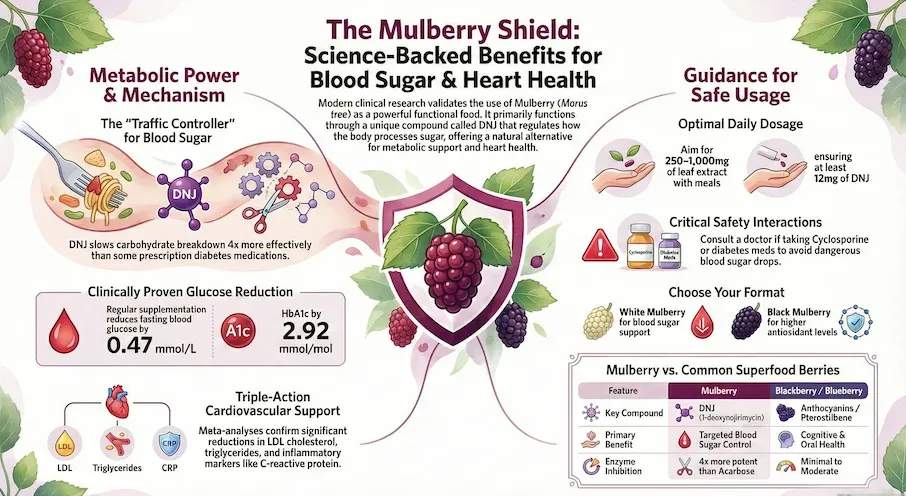
⚖️ Mulberry vs Other Berries
How do mulberries compare to other popular berries? Here's an evidence-based comparison:
| Feature | Mulberry | Blackberry | Blueberry |
|---|---|---|---|
| Plant Type | Tree (Morus) | Bush (Rubus) | Bush (Vaccinium) |
| Key Active Compound | DNJ (1-deoxynojirimycin) | Ellagic acid | Pterostilbene |
| Primary Benefit | Blood sugar control | Oral health, antioxidant | Cognitive function |
| Alpha-glucosidase Inhibition | 4x more potent than acarbose[8] | Minimal | Moderate |
| Clinical Evidence for Diabetes | Strong (14 trials) | Limited | Moderate |
| Main Anthocyanin | Cyanidin-3-glucoside | Cyanidin-3-glucoside | Malvidin |
| Availability | Seasonal (summer), year-round dried | Widely available | Widely available |
The mulberry advantage: While all berries offer antioxidant benefits, mulberries stand out for blood sugar management due to their unique DNJ content. For those focused on glycemic control, mulberries (especially white mulberry, Morus alba) offer targeted benefits that other berries cannot match.[Evidence: B][8]
Black mulberry (Morus nigra) has a stronger flavor and higher anthocyanin content, while white mulberry has more DNJ for blood sugar benefits. Both varieties offer cardiovascular protection through their effects on cholesterol and inflammation.[Evidence: A][1]
Frequently Asked Questions
What is DNJ (1-deoxynojirimycin) in mulberry?
DNJ (1-deoxynojirimycin), also known as moranoline or duvoglustat, is a naturally occurring compound found primarily in mulberry leaves. It's a polyhydroxylated alkaloid that mimics glucose molecules, allowing it to bind to alpha-glucosidase enzymes in your intestines. When DNJ occupies these enzymes, they cannot break down complex carbohydrates into simple sugars, slowing glucose absorption into your bloodstream. Clinical research shows mulberry DNJ inhibits alpha-glucosidase four times more effectively than the prescription drug acarbose. The minimum effective dose is 12mg daily, typically achieved through standardized mulberry leaf extract supplements.
Can I take mulberry with diabetes medication?
Mulberry can be taken alongside diabetes medications, but caution is required. Because mulberry independently lowers blood sugar through alpha-glucosidase inhibition, combining it with diabetes drugs (like metformin, sulfonylureas, or insulin) may enhance blood-sugar-lowering effects, potentially causing hypoglycemia. If you take diabetes medications, start with a low mulberry dose and monitor blood glucose closely. Work with your healthcare provider to potentially adjust medication dosing. Also note that mulberry may interact with cyclosporine (reducing its absorption by over 50%) and other drugs metabolized by CYP3A4 or transported by P-glycoprotein. Always inform your healthcare provider about mulberry supplementation.
What are the different types of mulberries?
Three main species of mulberry exist: white mulberry (Morus alba), black mulberry (Morus nigra), and red mulberry (Morus rubra). White mulberry, native to China, is the most researched for health benefits and has the highest DNJ content, making it ideal for blood sugar support. Black mulberry, originating from western Asia, has a richer, more intense flavor and higher anthocyanin content—better for antioxidant benefits. Red mulberry is native to North America but less commonly used medicinally. For diabetes and metabolic health, research primarily uses Morus alba (white mulberry) leaf extract due to its superior alpha-glucosidase inhibition.
Does mulberry lower cholesterol?
Yes, clinical evidence supports mulberry's cholesterol-lowering effects. A meta-analysis of randomized controlled trials found mulberry consumption significantly reduces LDL cholesterol and triglycerides while improving overall cardiometabolic profiles. In dyslipidemic subjects, a mulberry-containing nutraceutical helped 56.5% of participants achieve LDL cholesterol below 130 mg/dL, while also reducing triglycerides and increasing beneficial HDL cholesterol. The mechanisms involve improved insulin sensitivity (reduced HOMA index), reduced inflammation (lower C-reactive protein), and enhanced endothelial function. For cholesterol benefits, consistent supplementation over several weeks appears necessary, with studies typically lasting 6-12 weeks.
What vitamins and minerals are in mulberries?
Mulberries are nutrient-dense berries rich in vitamin C, iron, vitamin K, potassium, and fiber. Fresh mulberries contain approximately 36.4mg vitamin C and 1.85mg iron per 100g. They're particularly notable for their polyphenolic content—a concentrated mulberry drink provides 1,041.90mg total phenolic compounds and 35.34mg anthocyanins per 100g serving. The primary anthocyanin is cyanidin-3-glucoside (also called kuromanin), which provides powerful antioxidant protection and helps prevent red blood cell hemolysis. Additionally, mulberries contain quercetin (a flavonoid with anti-inflammatory properties), rutin, and polysaccharides that contribute to their therapeutic effects for diabetes and heart health.
How do mulberries support heart health?
Mulberries support cardiovascular health through multiple mechanisms. First, they reduce inflammation—clinical trials show significant decreases in C-reactive protein (CRP), a key inflammatory marker linked to heart disease. Second, they improve lipid profiles by lowering LDL cholesterol and triglycerides while increasing protective HDL cholesterol. Third, mulberries reduce blood pressure; a study in individuals with obesity found significant reductions in systolic, diastolic, and mean arterial pressure. Fourth, their antioxidant compounds protect blood vessels from oxidative damage. Finally, by improving insulin sensitivity and reducing HOMA index, mulberries address metabolic dysfunction that underlies cardiovascular risk. These effects are enhanced with 6-12 weeks of consistent supplementation.
Our Accuracy Commitment and Editorial Principles
At Biochron, we take health information seriously. Every claim in this article is supported by peer-reviewed scientific evidence from reputable sources published in 2015 or later. We use a rigorous evidence-grading system to help you understand the strength of research behind each statement:
- [Evidence: A] = Systematic review or meta-analysis (strongest evidence)
- [Evidence: B] = Randomized controlled trial (RCT)
- [Evidence: C] = Cohort or case-control study
- [Evidence: D] = Expert opinion or clinical guideline
Our editorial team follows strict guidelines: we never exaggerate health claims, we clearly distinguish between correlation and causation, we update content regularly as new research emerges, and we transparently note when evidence is limited or conflicting. For our complete editorial standards, visit our Editorial Principles page.
This article is for informational purposes only and does not constitute medical advice. Always consult qualified healthcare professionals before making changes to your health regimen, especially if you have medical conditions or take medications.


References
- 1 . Impact of mulberry consumption on cardiometabolic risk factors: A systematic review and meta-analysis of randomized-controlled trials, Journal of Clinical Pharmacy and Therapeutics, 2022, Chen X et al., PubMed, DOI [Evidence: A]
- 2 . A Systematic Review of the Medicinal Potential of Mulberry in Treating Diabetes Mellitus, American Journal of Chinese Medicine, 2018, Wei H et al., PubMed, DOI [Evidence: A]
- 3 . Effect of mulberry leaf or mulberry leaf extract on glycemic traits: a systematic review and meta-analysis, Food & Function, 2023, Cui W et al., PubMed, DOI [Evidence: A]
- 4 . Morus Alba leaf extract affects metabolic profiles, biomarkers inflammation and oxidative stress in patients with type 2 diabetes mellitus: A double-blind clinical trial, Clinical Nutrition ESPEN, 2022, Taghizadeh M et al., PubMed, DOI [Evidence: B]
- 5 . Mulberry-extract improves glucose tolerance and decreases insulin concentrations in normoglycaemic adults: Results of a randomised double-blind placebo-controlled study, PLoS One, 2017, Lown M et al., PubMed, DOI [Evidence: B]
- 6 . Dose-response efficacy of mulberry fruit extract for reducing post-prandial blood glucose and insulin responses: randomised trial evidence in healthy adults, British Journal of Nutrition, 2023, Mela DJ et al., PubMed, DOI [Evidence: B]
- 7 . Antioxidant and Hemolysis Protective Effects of Polyphenol-Rich Extract from Mulberry Fruits, Pharmacognosy Magazine, 2018, Krishna PGA et al., PubMed, DOI [Evidence: C]
- 8 . Evaluation of a Standardized Extract from Morus alba against α-Glucosidase Inhibitory Effect and Postprandial Antihyperglycemic in Patients with Impaired Glucose Tolerance: A Randomized Double-Blind Clinical Trial, Evidence-Based Complementary and Alternative Medicine, 2016, Hwang SH et al., PubMed, DOI [Evidence: B]
- 9 . Effects of a new combination of nutraceuticals with Morus alba on lipid profile, insulin sensitivity and endotelial function in dyslipidemic subjects. A cross-over, randomized, double-blind trial, High Blood Pressure and Cardiovascular Prevention, 2015, Trimarco V et al., PubMed, DOI [Evidence: B]
- 10 . Impact of mulberry leaf extract on type 2 diabetes (Mul-DM): A randomized, placebo-controlled pilot study, Complementary Therapies in Medicine, 2017, Riche DM et al., PubMed, DOI [Evidence: B]
- 11 . Preclinical Evidence of Mulberry Leaf Polysaccharides on Diabetic Kidney Disease: a Systematic Review and Meta-Analysis, Planta Medica, 2024, Wang Y et al., PubMed, DOI [Evidence: A]
- 12 . Nutraceutical Properties of Thai Mulberry (Morus alba L.) and Their Effects on Metabolic and Cardiovascular Risk Factors in Individuals with Obesity: A Randomized, Single-Blind Crossover Trial, Nutrients, 2024, Parklak W et al., PubMed, DOI [Evidence: B]
- 13 . Safety evaluation of mulberry leaf extract: Acute, subacute toxicity and genotoxicity studies, Regulatory Toxicology and Pharmacology, 2018, Li Y et al., PubMed, DOI [Evidence: D]
- 14 . A randomized controlled study of dose-finding, efficacy, and safety of mulberry leaves on glycemic profiles in obese persons with borderline diabetes, Complementary Therapies in Medicine, 2020, Thaipitakwong T et al., PubMed, DOI [Evidence: B]
Medical Disclaimer
This content is for informational and educational purposes only. It is not intended to provide medical advice or to take the place of such advice or treatment from a personal physician. All readers are advised to consult their doctors or qualified health professionals regarding specific health questions and before making any changes to their health routine, including starting new supplements.
Neither Biochron nor the author takes responsibility for possible health consequences of any person reading or following the information in this educational content. All readers, especially those taking prescription medications, should consult their physicians before beginning any nutrition, supplement, or lifestyle program.
If you have a medical emergency, call your doctor or emergency services immediately.
