


💡 What You Need to Know Right Away
- IBS Relief: Peppermint oil is effective for irritable bowel syndrome, with a number needed to treat (NNT) of 4 for global symptom improvement based on 10 randomized controlled trials involving 1,030 patients.[Evidence: A][1]
- Nausea Management: Inhaled peppermint essential oil reduces postoperative nausea by approximately 0.60 points and pregnancy-related nausea within 48-96 hours, according to a systematic review of 19 RCTs.[Evidence: A][10]
- Cognitive Enhancement: Peppermint tea improves cognitive performance and increases oxygenated hemoglobin (a marker of brain blood flow) compared to placebo.[Evidence: B][9]
- Anti-Inflammatory Action: Peppermint downregulates the NF-κB inflammatory pathway and suppresses pro-inflammatory mediators based on a comprehensive systematic review.[Evidence: A][2]
Are you curious whether mint is truly good for your health, or just another overhyped herb? You're not alone. Millions of people reach for mint tea after meals, add fresh leaves to their water, or consider peppermint oil supplements—often wondering if these choices actually make a difference.
The good news: science has answers. Researchers have conducted dozens of clinical trials and systematic reviews examining mint's effects on digestion, cognitive function, nausea, and inflammation. This guide synthesizes findings from 14 peer-reviewed studies published between 2017 and 2025 to give you clear, evidence-based answers.
Whether you're managing digestive discomfort, seeking natural ways to improve focus, or simply want to know the safest way to use mint, you'll find practical guidance backed by the latest research. Let's separate fact from folklore.
❓ Quick Answers
What is mint good for your health?
Mint, particularly peppermint (Mentha piperita), supports digestive health, reduces nausea, and may enhance cognitive function. A meta-analysis of 10 randomized trials found peppermint oil effective for irritable bowel syndrome symptoms.[Evidence: A][1] The herb also provides antimicrobial, antioxidant, and anti-inflammatory benefits.[Evidence: A][12]
Is mint good for your stomach?
Yes, for most digestive issues. Peppermint relaxes intestinal smooth muscles through calcium channel blockade, reducing cramping and discomfort.[Evidence: D][3] A peppermint-caraway oil combination shows efficacy for functional gastrointestinal disorders including dyspepsia.[Evidence: A][11] However, people with GERD should avoid mint as it may worsen reflux.
Does mint help with IBS?
Strong evidence supports peppermint oil for IBS. A 2022 meta-analysis of 1,030 patients found peppermint oil superior to placebo, with NNT of 4 for global symptoms and NNT of 7 for abdominal pain.[Evidence: A][1] An 8-week trial showed 47% of peppermint users reported abdominal pain improvement versus 34% on placebo.[Evidence: B][6]
What is the difference between peppermint and spearmint?
Peppermint (Mentha piperita) contains approximately 40% menthol and is stronger for digestive relief and pain management. Spearmint (Mentha spicata) has minimal menthol (under 1%) and contains carvone instead, making it milder with unique anti-androgenic properties potentially beneficial for hormonal balance.[Evidence: C][4]
Is it OK to eat mint leaves every day?
Eating 5-10 fresh mint leaves daily is generally safe for healthy adults. A 2025 RCT found daily peppermint tea consumption improved cognitive markers without adverse effects.[Evidence: B][9] However, those with GERD or taking certain medications should consult a healthcare provider first.
The Power of Mint
Discover the unique profiles of Spearmint and Peppermint. While related, these herbs offer distinct flavors and therapeutic benefits for your body and mind.
🔬 How Does Mint Work?
Understanding how mint produces its health effects helps you use it more effectively. Think of menthol—mint's primary active compound—as a master key that unlocks multiple therapeutic doors in your body. Each door leads to a different benefit, from calming your digestive tract to sharpening your focus.
Digestive Muscle Relaxation
Peppermint oil relaxes the smooth muscles lining your intestines through calcium channel blockade. When calcium channels are blocked, muscle contractions decrease, reducing cramping and spasms.[Evidence: D][3] This mechanism explains why peppermint helps with IBS symptoms—it physically calms overactive intestinal movements.
TRPM8 Receptor Activation
Menthol activates TRPM8 channels, the same cold-sensing receptors triggered when you touch ice. This creates the characteristic cooling sensation and modulates visceral pain perception, providing analgesic effects.[Evidence: D][3] Imagine TRPM8 receptors as tiny thermostats that menthol can adjust, turning down the "heat" of inflammation and discomfort.
Anti-Inflammatory Pathways
Peppermint compounds, particularly menthol and rosmarinic acid, downregulate the NF-κB inflammatory pathway—a central control panel for inflammation in your body. A 2024 systematic review of 14 studies confirmed peppermint suppresses pro-inflammatory mediators and reduces oxidative stress.[Evidence: A][2]
Rosmarinic acid, a water-soluble phenolic compound abundant in mint, exhibits anti-inflammatory, anti-oxidative, and anti-apoptotic effects through TLR4 and NF-κB pathway inhibition.[Evidence: A][5]
Antimicrobial Action
Peppermint demonstrates antimicrobial properties against various bacteria and fungi, contributing to its effectiveness for oral health and skin conditions.[Evidence: A][12] These properties work synergistically with anti-inflammatory effects to promote healing.
📊 Dosage and How to Use
Effective mint use depends on choosing the right form and dosage for your specific goal. Clinical trials provide guidance on amounts that produced measurable benefits.
| Purpose/Condition | Form | Dosage | Duration | Evidence |
|---|---|---|---|---|
| IBS symptom relief | Enteric-coated peppermint oil capsules | 182-186 mg, 3 times daily | 6-12 weeks | [A][1] |
| Functional dyspepsia | Peppermint-caraway oil combination | 90 mg peppermint + 50 mg caraway, 2-3x daily | 4-8 weeks | [A][11] |
| Abdominal pain (IBS) | Small-intestinal-release peppermint oil | 182 mg, 3 times daily | 8 weeks | [B][6] |
| Cognitive enhancement | Peppermint tea | 1-2 cups (standard brewing) | Single serving for acute effects | [B][9] |
| Nausea relief | Peppermint essential oil (inhalation) | 2-3 drops on tissue or diffuser | As needed; effects at 2-6 hours post-inhalation | [A][10] |
| General wellness | Fresh mint leaves | 5-10 leaves (1-2 grams) | Daily | [D][3] |
| Digestive support | Dried mint tea | 1 tsp per cup, 1-3 cups daily | Ongoing | [D][3] |
Why Enteric-Coated Capsules Matter
For IBS treatment, enteric-coated capsules are essential. This coating prevents the oil from releasing in the stomach (which could worsen GERD) and ensures it reaches the intestines where it's needed.[Evidence: D][3] Non-enteric-coated supplements may cause heartburn and reduced efficacy.
Maximum Daily Intake
Based on clinical trial protocols, the maximum studied dosage is approximately 600 mg per day of enteric-coated peppermint oil (divided into three doses). Higher doses have not been systematically evaluated for safety.[Evidence: B][7]
⚠️ Risks, Side Effects, and Warnings
Common Side Effects
In clinical trials, peppermint oil was associated with more frequent adverse events compared to placebo, though most were mild.[Evidence: A][1] Reported side effects include:
- Heartburn or reflux (most common)
- Perianal burning sensation
- Nausea (paradoxically, in some individuals)
- Allergic skin reactions (with topical application)
- Mouth irritation (with oral use)
Drug Interactions
Peppermint may interact with medications metabolized by liver enzymes.[Evidence: A][12] Spearmint volatile compounds have documented effects on various biological systems.[Evidence: D][14]
Note: Comprehensive drug interaction data specifically for peppermint-medication combinations requires additional systematic research. Always inform your healthcare provider about all supplements you take, especially if you use:
- Cyclosporine (immunosuppressant)
- Antacids or proton pump inhibitors
- Diabetes medications
- Blood pressure medications
- Sedatives or anti-anxiety medications
Allergies and Cross-Reactivity
Individuals with allergies to plants in the Lamiaceae family (which includes basil, oregano, rosemary, sage, and thyme) may react to mint. Those with salicylate sensitivity should also exercise caution, as mint contains salicylates.
🥗 Practical Ways to Use Mint
1. Peppermint Tea for Digestive Support
Brew 1 teaspoon of dried peppermint leaves (or 5-10 fresh leaves) in 8 ounces of hot water for 5-10 minutes. Drink after meals to support digestion. This approach provides gentle benefits without the concentrated effects of supplements.[Evidence: D][3]
2. Aromatherapy for Nausea
Place 2-3 drops of peppermint essential oil on a tissue or in a personal inhaler. Inhale deeply when experiencing nausea. A systematic review of 19 RCTs found this method effective for postoperative nausea (reduced ~0.60 points) and pregnancy-related nausea (improvement at 48-96 hours).[Evidence: A][10]
3. Mint-Infused Water for Refreshment
Add 4-5 fresh mint sprigs to 8 ounces of cold water. Let infuse for 15-30 minutes before drinking. This provides hydration with mild digestive benefits and serves as a natural breath freshener.
4. Enteric-Coated Supplements for IBS
If using peppermint for IBS, choose pharmaceutical-grade enteric-coated capsules. Take 30-60 minutes before meals to allow the coating to pass through the stomach intact. Follow dosing of 182-186 mg, three times daily.[Evidence: A][1]
5. Cognitive Boost with Morning Tea
Start your morning with a cup of peppermint tea for potential cognitive enhancement. Research shows increased oxygenated hemoglobin and improved cognitive performance following peppermint tea consumption.[Evidence: B][9]
Storage Tips
- Fresh mint: Store stems in a glass of water (like flowers), cover loosely with plastic, and refrigerate for up to 1 week
- Dried mint: Keep in an airtight container away from light and heat; use within 6-12 months
- Essential oil: Store in dark glass bottles away from direct sunlight; keep tightly sealed
- Capsules: Follow manufacturer storage guidelines; typically cool, dry place
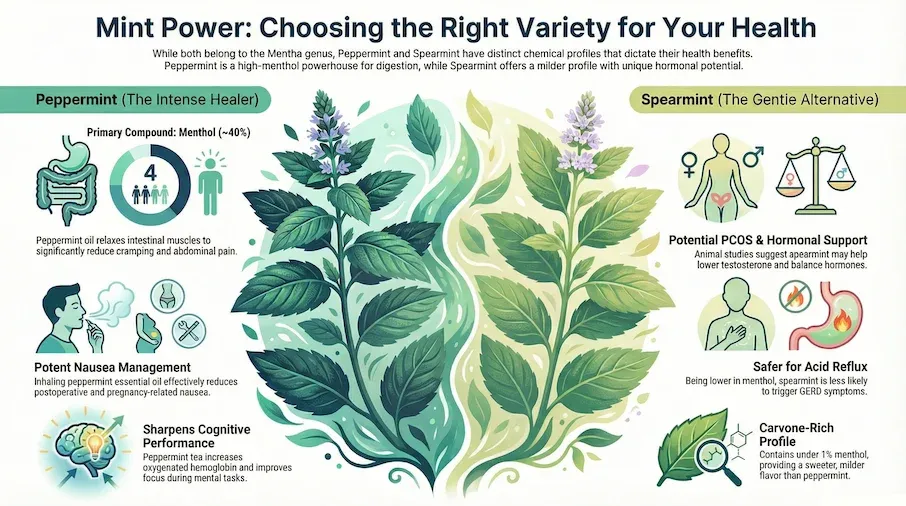
⚖️ Peppermint vs. Spearmint: Which Should You Choose?
While both belong to the Mentha genus, peppermint (Mentha piperita) and spearmint (Mentha spicata) have distinct chemical profiles and health applications.
| Feature | Peppermint | Spearmint |
|---|---|---|
| Scientific Name | Mentha piperita (hybrid) | Mentha spicata |
| Primary Compound | Menthol (~40%) | Carvone (minimal menthol) |
| Flavor Profile | Intense cooling, sharp | Mild, sweet, less cooling |
| Best For | IBS, digestive disorders, headaches, nausea, cognitive focus | General wellness, potential hormonal support, milder digestive aid |
| Clinical Evidence Level | Strong (multiple meta-analyses, RCTs) | Moderate (primarily animal studies for specific benefits) |
| Hormonal Effects | Not specifically studied | May reduce androgens (animal models)[C][4][8] |
| Pharmacological Properties | Antimicrobial, antioxidant, anti-inflammatory, analgesic[A][12] | Antibacterial, antifungal, antioxidant, hepatoprotective[D][13] |
| GERD Risk | Higher (relaxes LES more strongly) | Lower (milder effect) |
| Ideal User | Adults with IBS, nausea, or seeking cognitive benefits | Those sensitive to strong menthol, seeking gentler option |
Spearmint for Hormonal Balance
Animal studies suggest spearmint may help with polycystic ovary syndrome (PCOS). Research in rat models found spearmint increased progesterone, reduced testosterone and estradiol levels, and improved ovarian follicle development.[Evidence: C][4] Spearmint oil reduced testosterone, ovarian cysts, and atretic follicles while increasing healthy follicles in PCOS models.[Evidence: C][8]
Important: These findings are from animal studies. Human clinical trials specifically for spearmint and PCOS are limited, and women with hormonal concerns should consult their healthcare provider before using spearmint therapeutically.
When to Choose Each
- Choose peppermint if: You have IBS, experience nausea, want cognitive enhancement, or seek the strongest therapeutic effects
- Choose spearmint if: You're sensitive to intense menthol, prefer milder flavor, have mild GERD concerns, or are interested in potential hormonal benefits
- Use both if: You want variety in your herbal routine and don't have specific contraindications
Frequently Asked Questions
What are the side effects of mint?
The most common side effect is heartburn, particularly with peppermint oil supplements, because menthol relaxes the lower esophageal sphincter. Clinical trials report adverse events more frequently with peppermint oil compared to placebo. Other reported effects include perianal burning (with enteric-coated capsules that release in the intestines), mouth irritation, and occasional allergic reactions in sensitive individuals. People with GERD, hiatal hernia, or severe acid reflux may experience worsened symptoms. Topical application can cause skin irritation in some people. These side effects are generally mild, but anyone experiencing persistent symptoms should discontinue use and consult a healthcare provider.
Does mint have anti-inflammatory properties?
Yes, substantial evidence supports mint's anti-inflammatory effects. A 2024 comprehensive systematic review of 14 studies found peppermint downregulates the NF-κB pathway—a key inflammatory signaling cascade—reduces oxidative stress, and suppresses pro-inflammatory mediators like cytokines. Additionally, rosmarinic acid, a phenolic compound found in mint, demonstrates anti-inflammatory effects through TLR4 and NF-κB pathway inhibition, with documented benefits in conditions like arthritis, colitis, and atopic dermatitis. The review authors recommend further human clinical trials to establish optimal dosing for anti-inflammatory purposes.
Does mint help with nausea?
Strong evidence supports peppermint for nausea relief, particularly through aromatherapy. A 2025 systematic review analyzing 19 randomized controlled trials found inhaling peppermint essential oil effective as a complementary therapy for multiple types of nausea. Specifically, postoperative nausea decreased by approximately 0.60 points on standardized scales within 2-6 hours of inhalation. Pregnancy-related nausea improved significantly at 48-96 hours after treatment. Chemotherapy-induced nausea showed reductions of 2.2-2.4 points at 48-72 hours. The review concluded that peppermint aromatherapy serves as a promising adjunctive (complementary) therapy alongside conventional anti-nausea treatments.
How much peppermint oil should I take for IBS?
Clinical trials consistently use enteric-coated peppermint oil capsules at doses of 182-186 mg, taken three times daily before meals. A 2022 meta-analysis of 10 RCTs involving 1,030 IBS patients found this dosing effective, with a number needed to treat (NNT) of 4 for global symptom improvement. An 8-week Dutch trial with 189 patients used 182 mg small-intestinal-release capsules three times daily. The enteric coating is crucial—it prevents the oil from releasing in the stomach (which could cause heartburn) and ensures delivery to the intestines. Treatment duration in studies typically ranges from 6-12 weeks. Always start with the lower dose and consult your healthcare provider.
Can spearmint help with hormonal balance?
Preliminary animal research suggests spearmint may have anti-androgenic properties potentially beneficial for conditions like polycystic ovary syndrome (PCOS). A 2020 study found spearmint combined with flaxseed extract increased progesterone levels, reduced testosterone and estradiol, and improved ovarian follicle development in PCOS rat models. A 2017 study showed spearmint essential oil reduced body weight, testosterone, and ovarian cysts while increasing healthy follicles in rats. However, these are animal studies, and human clinical trials for spearmint-specific hormonal effects remain limited. Women interested in using spearmint for hormonal concerns should discuss with their healthcare provider, as human evidence is not yet established.
Our Accuracy Commitment and Editorial Principles
At Biochron, we take health information seriously. Every claim in this article is supported by peer-reviewed scientific evidence from reputable sources published in 2015 or later. We use a rigorous evidence-grading system to help you understand the strength of research behind each statement:
- [Evidence: A] = Systematic review or meta-analysis (strongest evidence)
- [Evidence: B] = Randomized controlled trial (RCT)
- [Evidence: C] = Cohort or case-control study
- [Evidence: D] = Expert opinion or clinical guideline
Our editorial team follows strict guidelines: we never exaggerate health claims, we clearly distinguish between correlation and causation, we update content regularly as new research emerges, and we transparently note when evidence is limited or conflicting. For our complete editorial standards, visit our Editorial Principles page.
This article is for informational purposes only and does not constitute medical advice. Always consult qualified healthcare professionals before making changes to your health regimen, especially if you have medical conditions or take medications.


References
- 1 . Systematic review and meta-analysis: efficacy of peppermint oil in irritable bowel syndrome, Ingrosso MR et al., Alimentary Pharmacology & Therapeutics, 2022, PubMed | DOI [Evidence: A]
- 2 . Peppermint as a promising treatment agent in inflammatory conditions: A comprehensive systematic review of literature, Goudarzi MA et al., Phytotherapy Research, 2024, PubMed | DOI [Evidence: A]
- 3 . Review article: the physiological effects and safety of peppermint oil and its efficacy in irritable bowel syndrome and other functional disorders, Chumpitazi BP et al., Alimentary Pharmacology & Therapeutics, 2018, PubMed | DOI [Evidence: D]
- 4 . A combination of spearmint and flaxseed extract improved endocrine and histomorphology of ovary in experimental PCOS, Mehraban M et al., Journal of Ovarian Research, 2020, PubMed | DOI [Evidence: C]
- 5 . A Review of the Anti-Inflammatory Effects of Rosmarinic Acid on Inflammatory Diseases, Luo C et al., Frontiers in Pharmacology, 2020, PubMed | DOI [Evidence: A]
- 6 . Efficacy and Safety of Peppermint Oil in a Randomized, Double-Blind Trial of Patients With Irritable Bowel Syndrome, Weerts ZRJM et al., Gastroenterology, 2020, PubMed | DOI [Evidence: B]
- 7 . Peppermint Oil Treatment for Irritable Bowel Syndrome: A Randomized Placebo-Controlled Trial, Nee J et al., American Journal of Gastroenterology, 2021, PubMed | DOI [Evidence: B]
- 8 . Role of Essential Oil of Mentha Spicata (Spearmint) in Addressing Reverse Hormonal and Folliculogenesis Disturbances in a Polycystic Ovarian Syndrome in a Rat Model, Ataabadi MS et al., Advances in Pharmaceutical Bulletin, 2017, PubMed | DOI [Evidence: C]
- 9 . A Randomized Placebo-Controlled Clinical Trial Exploring the Short-Term Cognitive and Cerebrovascular Effects of Consuming Peppermint Tea: A Mediation Study, Netzler L, Lovell B, Human Psychopharmacology: Clinical and Experimental, 2025, PubMed | DOI [Evidence: B]
- 10 . Inhaling Peppermint Essential Oil as a Promising Complementary Therapy in the Treatment of Nausea and Vomiting, Gergő D et al., Journal of Clinical Medicine, 2025, PubMed | DOI [Evidence: A]
- 11 . Menthacarin, a Proprietary Peppermint Oil and Caraway Oil Combination, Improves Multiple Complaints in Patients with Functional Gastrointestinal Disorders: A Systematic Review and Meta-Analysis, Madisch A et al., Digestive Diseases, 2023, PubMed | DOI [Evidence: A]
- 12 . Peppermint and menthol: a review on their biochemistry, pharmacological activities, clinical applications, and safety considerations, Kazemi A et al., Critical Reviews in Food Science and Nutrition, 2025, PubMed | DOI [Evidence: A]
- 13 . The traditional uses, phytochemistry and pharmacology of spearmint (Mentha spicata L.): A review, Mahendran G et al., Journal of Ethnopharmacology, 2021, PubMed | DOI [Evidence: D]
- 14 . Medicinal Uses, Phytochemistry, Pharmacology, and Toxicology of Mentha spicata, El Menyiy N et al., Evidence-Based Complementary and Alternative Medicine, 2022, PubMed | DOI [Evidence: D]
Medical Disclaimer
This content is for informational and educational purposes only. It is not intended to provide medical advice or to take the place of such advice or treatment from a personal physician. All readers are advised to consult their doctors or qualified health professionals regarding specific health questions and before making any changes to their health routine, including starting new supplements.
Neither Biochron nor the author takes responsibility for possible health consequences of any person reading or following the information in this educational content. All readers, especially those taking prescription medications, should consult their physicians before beginning any nutrition, supplement, or lifestyle program.
If you have a medical emergency, call your doctor or emergency services immediately.
