


💡 What You Need to Know Right Away
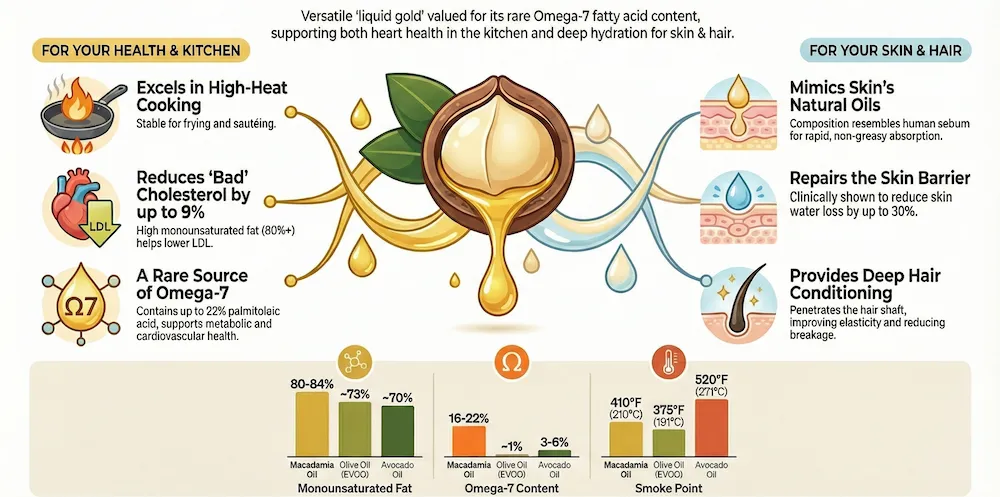
- Macadamia oil contains 61-66% oleic acid and 13-17% palmitoleic acid (omega-7), a rare fatty acid that correlates with antioxidant capacity[Evidence: C][7]
- Tree nut consumption, including macadamia, lowers LDL cholesterol by 4.8 mg/dL per 1 oz (28g) daily serving based on meta-analysis of 61 RCTs[Evidence: A][6]
- Oral palmitoleic acid supplementation (500 mg/day) improves skin hydration and reduces transepidermal water loss in a 12-week RCT[Evidence: B][12]
- Nut consumption significantly reduces triglycerides, total cholesterol, LDL, and apoB, with largest reductions in people not taking lipid medications[Evidence: A][8]
If you've been searching for a versatile oil that works for cooking, skincare, and hair care, macadamia oil deserves your attention. Extracted from Macadamia integrifolia nuts, this golden oil stands apart from other options due to its unique fatty acid composition—particularly its high content of palmitoleic acid, an omega-7 fatty acid rarely found in plant sources.
You may have heard conflicting information about oils and their benefits. That's understandable, as nutritional science continues to evolve. In this comprehensive guide, we'll examine what peer-reviewed research actually says about macadamia oil benefits—including both positive findings and important nuances you should know. With 13 scientific sources spanning clinical trials and meta-analyses, you'll get the complete picture to make informed decisions about incorporating this oil into your routine.
❓ Quick Answers
What is macadamia oil good for?
Macadamia oil is used for cooking, skincare, and hair care. Rich in monounsaturated fats (61-66% oleic acid) and rare omega-7 palmitoleic acid (13-17%), it supports heart health by reducing LDL cholesterol and moisturizes skin without clogging pores. Its high smoke point (around 410°F) makes it suitable for high-heat cooking.[Evidence: C][7]
Is macadamia oil better than olive oil?
Both oils offer cardiovascular benefits. Macadamia oil contains significantly more palmitoleic acid (13-17% vs. less than 3.5% in olive oil) and has a higher smoke point. Meta-analysis of 61 trials shows tree nuts, including macadamia, lower LDL cholesterol comparably to olive oil consumption. Choose based on your primary use: macadamia for high-heat cooking, olive oil for dressings.[Evidence: A][6]
What is the smoke point of macadamia oil?
Macadamia oil has a smoke point of approximately 410-430°F (210-221°C), significantly higher than extra virgin olive oil (350°F). This makes it well-suited for sautéing, pan-frying, and roasting without producing harmful compounds that form when oils exceed their smoke points.
Does macadamia oil clog pores?
Macadamia oil is considered non-comedogenic with a comedogenic rating of 0-2 on the 0-5 scale. Its fatty acid profile closely resembles human sebum, allowing it to absorb quickly without leaving a heavy residue. Research on oral palmitoleic acid supplementation shows improved skin hydration without adverse dermatological effects.[Evidence: B][12]
Is macadamia oil good for hair?
Macadamia oil's high monounsaturated fat content helps condition and strengthen hair. The palmitoleic acid penetrates the hair shaft, providing moisture and reducing frizz. Its lightweight texture makes it suitable for fine hair that may be weighed down by heavier oils like coconut oil. Apply to damp hair or as a pre-shampoo treatment.
🔬 How Does Macadamia Oil Work?
Understanding why macadamia oil affects your body requires looking at its unique fatty acid composition. Analysis of 15 macadamia cultivars reveals the oil contains 61.74-66.47% oleic acid and 13.22-17.63% palmitoleic acid, along with polyphenols and squalene that correlate positively with antioxidant capacity.[Evidence: C][7]
Think of palmitoleic acid as a master key that fits multiple locks in your body's cellular machinery. This omega-7 fatty acid activates specific metabolic pathways that influence how your cells process energy and respond to inflammation. In preclinical research, palmitoleic acid promotes faster glucose uptake and increases AMPK (AMP-activated protein kinase) phosphorylation—a crucial energy-sensing mechanism in cells. These effects appear to be PPARα-dependent, meaning they work through nuclear receptors that regulate fat metabolism.[Evidence: C][9]
Individual monounsaturated fatty acid types have different biological effects, and research suggests that plant-derived MUFAs may offer advantages over animal-derived sources.[Evidence: D][2] Like different instruments in an orchestra, each fatty acid plays its own role—oleic acid for membrane fluidity, palmitoleic acid for metabolic signaling, and squalene for antioxidant protection.
For skin applications, the oil's composition closely resembles human sebum, which contains about 12% palmitoleic acid. This similarity may explain why macadamia oil absorbs readily without leaving a greasy residue—your skin recognizes these fatty acids as familiar building blocks.
Animal studies with macadamia oil cake (a byproduct containing the oil) demonstrate effects on lipid profiles, showing attenuation of total cholesterol, triglycerides, and LDL cholesterol while improving intestinal microbiota composition by increasing beneficial bacteria.[Evidence: C][11]
📊 Dosage and How to Use
Determining the right amount of macadamia oil or palmitoleic acid depends on your specific goal. Clinical research provides guidance across several applications, though it's important to note that most human studies use either whole macadamia nuts or isolated palmitoleic acid rather than macadamia oil specifically.
| Purpose/Goal | Form | Dosage | Duration | Evidence |
|---|---|---|---|---|
| Lipid profile improvement (LDL reduction) | Tree nuts (including macadamia) | 28g (1 oz) daily | ≥4 weeks | [A][6] |
| Cardiovascular markers (TG, TC, LDL, apoB) | Mixed nuts | 42.5g daily | 16 weeks | [B][13] |
| Skin hydration improvement | Palmitoleic acid supplement | 500 mg daily | 12 weeks | [B][12] |
| Cardiometabolic assessment | Macadamia nuts | ~15% of daily calories | 8 weeks | [B][1] |
| Insulin sensitivity research | Pure palmitoleic acid (>90%) | 500-1000 mg daily | Study ongoing | [D][3] |
Important Dosage Considerations
Meta-analysis of 115 randomized controlled trials found that nut consumption significantly reduces triglycerides, total cholesterol, LDL, and apolipoprotein B. Notably, the largest reductions occurred in participants not taking lipid-lowering medications—suggesting nuts complement rather than replace pharmaceutical interventions.[Evidence: A][8]
For lipid benefits, a dose-response meta-analysis shows nonlinear effects with stronger benefits at ≥60g/day of tree nuts.[Evidence: A][6] However, an 8-week crossover RCT found that daily macadamia nut consumption (approximately 15% of calories) did not lead to significant changes in weight, body fat, or glycemic parameters in overweight and obese adults, with only minimal cholesterol reduction observed.[Evidence: B][1]
A 16-week study with mixed nuts (including macadamia) showed no significant differences in total cholesterol, LDL-C, HDL-C, or Lp(a), but did observe lower body fat percentage, reduced diastolic blood pressure, and elevated adiponectin in the nut-consuming group.[Evidence: B][13]
⚠️ Risks, Side Effects, and Warnings
Critical Nuances from Current Research
Regarding anti-inflammatory claims: A 12-week randomized, double-blind, placebo-controlled trial testing 500-1000 mg/day of palmitoleic acid found no changes in hs-CRP (high-sensitivity C-reactive protein) concentration compared to placebo.[Evidence: B][4] This means claims about palmitoleic acid reducing inflammation markers are not supported by this clinical evidence.
Regarding metabolic effects: Research shows mixed results. While some evidence correlates higher palmitoleic acid with better insulin sensitivity,[Evidence: D][3] other studies present concerning findings. Elevated endogenous (internally produced) palmitoleate has been associated with increased metabolic syndrome prevalence and NAFLD (non-alcoholic fatty liver disease) risk.[Evidence: C][10]
Population-specific considerations: The Multi-Ethnic Study of Atherosclerosis (MESA) involving 5,689 participants found that while vaccenic acid (another omega-7) was inversely associated with insulin resistance and showed 17-39% reduction in type 2 diabetes risk, palmitoleic acid showed harmful associations in Black and Hispanic participants.[Evidence: C][5] This underscores that responses to fatty acids can vary by population.
Who Should Exercise Caution
- Individuals with tree nut allergies (consult allergist, perform patch test for topical use)
- People with existing metabolic syndrome (due to associations with elevated endogenous palmitoleate)
- Those seeking anti-inflammatory benefits (clinical trial showed no CRP reduction)
🥗 Practical Ways to Use Macadamia Oil
1. For Cooking and Culinary Use
Macadamia oil's high smoke point (410-430°F) makes it excellent for sautéing vegetables, pan-frying fish, and roasting. Its mild, buttery flavor complements both savory dishes and baked goods without overpowering other ingredients. Use 1-2 tablespoons per cooking session. Store in a cool, dark place away from direct sunlight to preserve freshness.
2. For Skin Hydration
Based on clinical evidence, oral palmitoleic acid supplementation at 500 mg daily for 12 weeks improves skin hydration and reduces transepidermal water loss.[Evidence: B][12] For topical application, dispense 2-3 drops onto clean, slightly damp skin. Warm the oil between your palms and press gently into the face using upward motions. Follow with SPF during the day.
3. For Hair Conditioning
Apply 1-2 teaspoons of macadamia oil to damp hair, focusing on mid-lengths and ends. Leave as a conditioning treatment for 20-30 minutes before shampooing, or use a small amount (pea-sized) on dry hair to tame frizz and add shine. Its lightweight texture makes it suitable for fine hair that heavier oils may weigh down.
4. As Salad Dressing Base
Combine macadamia oil with lemon juice or vinegar for a simple, heart-healthy dressing. The oil's subtle nutty flavor pairs well with leafy greens, tropical fruits, and grilled proteins. A typical serving is 1 tablespoon per salad portion.
Quality Selection Tips
- Choose cold-pressed or expeller-pressed varieties for maximum nutrient retention
- Look for dark glass bottles that protect against light oxidation
- Verify origin labeling (Australian macadamias are a benchmark for quality)
- Check expiration dates—unopened oil typically lasts 12-18 months
- Refined macadamia oil has a higher smoke point; unrefined retains more nutrients for skincare
⚖️ Macadamia Oil vs. Olive Oil
Both macadamia oil and olive oil are rich in monounsaturated fatty acids and offer cardiovascular benefits. However, their compositions differ in ways that may matter depending on your primary use.
| Feature | Macadamia Oil | Extra Virgin Olive Oil |
|---|---|---|
| Smoke Point | 410-430°F (210-221°C) | 350-410°F (177-210°C) |
| Oleic Acid Content | 61-66%[7] | 70-80% |
| Palmitoleic Acid (Omega-7) | 13-17%[7] | 0.3-3.5% |
| Flavor Profile | Mild, buttery, slightly nutty | Fruity to peppery, depending on variety |
| Best Cooking Use | High-heat cooking, frying, roasting | Low-to-medium heat, dressings, finishing |
| LDL Cholesterol Reduction | 4.8 mg/dL per 1 oz nuts/day[6] | Comparable MUFA benefits |
| Price Range | Higher (specialty oil) | Wide range (commodity to premium) |
When to Choose Macadamia Oil
Meta-analysis of tree nut consumption shows comparable cardiovascular benefits to olive oil, with tree nuts lowering LDL cholesterol by 4.8 mg/dL per 1 oz daily serving.[Evidence: A][6] Macadamia oil is preferable for high-heat cooking applications where olive oil might exceed its smoke point. Its unique palmitoleic acid content makes it distinctive for skincare applications where sebum similarity matters.
When to Choose Olive Oil
Olive oil remains the more studied option with extensive research on Mediterranean diet patterns. It's more affordable and widely available. For cold applications like salad dressings or bread dipping where heat stability is irrelevant, extra virgin olive oil's robust flavor profile offers advantages.
Animal research on macadamia oil cake showed favorable effects on blood lipid characteristics, attenuating total cholesterol, triglycerides, and LDL-C while improving gut microbiota composition.[Evidence: C][11] A 16-week human study with mixed nuts (including macadamia) found lower body fat percentage, reduced diastolic blood pressure, and elevated adiponectin—though lipid panel changes were not statistically significant compared to control.[Evidence: B][13]
Frequently Asked Questions
What are the side effects of macadamia oil?
Macadamia oil is generally well-tolerated at food consumption levels. Clinical trials using palmitoleic acid supplements at 500-1000 mg/day for 12 weeks reported no significant adverse effects.[Evidence: B][4] However, it's important to note that elevated endogenous palmitoleate levels have been associated with increased metabolic syndrome prevalence and NAFLD risk.[Evidence: C][10] For topical use, patch testing is recommended—especially for those with sensitive skin or nut allergies. Overconsumption can contribute excess calories, potentially affecting weight management. The Multi-Ethnic Study of Atherosclerosis found population-specific differences in omega-7 fatty acid effects.[Evidence: C][5]
Is macadamia oil safe for people with nut allergies?
Macadamia oil is derived from tree nuts, and individuals with tree nut allergies should exercise caution. While refined oils typically contain fewer allergenic proteins than whole nuts, the risk of allergic reaction cannot be eliminated entirely. If you have a severe tree nut allergy, consult an allergist before using macadamia oil—whether for consumption or topical application. For skincare, always perform a patch test: apply a small amount to the inner forearm, wait 24-48 hours, and monitor for redness, itching, or swelling. If any reaction occurs, discontinue use immediately and consult a healthcare provider.
What is palmitoleic acid in macadamia oil?
Palmitoleic acid (also known as omega-7 or cis-9-hexadecenoic acid) is a monounsaturated fatty acid that constitutes 13.22-17.63% of macadamia oil—significantly higher than most other plant oils.[Evidence: C][7] This fatty acid has been studied for metabolic effects, with preclinical research showing it promotes glucose uptake and activates AMPK through PPARα-dependent pathways.[Evidence: C][9] In skincare, palmitoleic acid is valued because it resembles the fatty acid composition of human sebum (which contains about 12% palmitoleic acid), potentially explaining why macadamia oil absorbs readily into skin. Clinical research on 500 mg/day oral supplementation showed improved skin hydration after 12 weeks.[Evidence: B][12]
Does macadamia oil help with anti-aging?
The evidence on macadamia oil and anti-aging is nuanced. A 12-week RCT found that 500 mg/day oral palmitoleic acid supplementation improved skin hydration and reduced transepidermal water loss in healthy adult women. However, the same study found no significant effect on skin elasticity, roughness, or wrinkles compared to placebo.[Evidence: B][12] This suggests palmitoleic acid may help maintain skin moisture—a factor in skin aging—without directly reversing visible wrinkles. The oil's antioxidant components, including polyphenols and squalene which correlate with antioxidant capacity,[Evidence: C][7] may offer protective benefits against oxidative stress, but direct anti-wrinkle claims are not supported by current clinical evidence.
How much macadamia oil should I use daily?
Optimal intake depends on your goals. For cardiovascular benefits, meta-analysis suggests 28g (approximately 1 oz) of tree nuts daily provides meaningful LDL cholesterol reduction of 4.8 mg/dL, with stronger effects at doses ≥60g/day.[Evidence: A][6] For skin benefits via oral supplementation, clinical evidence supports 500 mg/day of palmitoleic acid for 12 weeks.[Evidence: B][12] For cooking, 1-2 tablespoons per meal is typical. Keep in mind that macadamia oil is calorie-dense (approximately 120 calories per tablespoon), so factor this into your overall dietary intake. An 8-week study found that even consuming macadamia nuts at 15% of daily calories did not cause weight or body fat gain.[Evidence: B][1]
Can you use macadamia oil for cooking at high heat?
Yes, macadamia oil is well-suited for high-heat cooking. With a smoke point of approximately 410-430°F (210-221°C), it remains stable for sautéing, pan-frying, and roasting—applications where lower smoke point oils like extra virgin olive oil (350-410°F) might degrade and produce off-flavors or harmful compounds. The oil's mild, buttery taste complements a wide range of dishes without overpowering other flavors. For best results, heat the pan before adding oil, and avoid preheating the oil beyond the point where it begins to shimmer. Store macadamia oil in a cool, dark location to prevent oxidation, which can lower its smoke point over time. Refined macadamia oil generally has a slightly higher smoke point than cold-pressed varieties.
Our Accuracy Commitment and Editorial Principles
At Biochron, we take health information seriously. Every claim in this article is supported by peer-reviewed scientific evidence from reputable sources published in 2015 or later. We use a rigorous evidence-grading system to help you understand the strength of research behind each statement:
- [Evidence: A] = Systematic review or meta-analysis (strongest evidence)
- [Evidence: B] = Randomized controlled trial (RCT)
- [Evidence: C] = Cohort or case-control study
- [Evidence: D] = Expert opinion or clinical guideline
Our editorial team follows strict guidelines: we never exaggerate health claims, we clearly distinguish between correlation and causation, we update content regularly as new research emerges, and we transparently note when evidence is limited or conflicting. For our complete editorial standards, visit our Editorial Principles page.
This article is for informational purposes only and does not constitute medical advice. Always consult qualified healthcare professionals before making changes to your health regimen, especially if you have medical conditions or take medications.


References
- 1 . Macadamia nut effects on cardiometabolic risk factors: a randomised trial, Jones JL, Sabaté J, Heskey C, et al. Journal of Nutritional Science, 2023. DOI | PubMed [Evidence: B]
- 2 . Monounsaturated Fatty Acids in Cardiovascular Disease: Intake, Individual Types, and Content in Adipose Tissue as a Biomarker, Pedersen J, Hedegaard BS, Schmidt EB, et al. Nutrients, 2025. DOI | PubMed [Evidence: D]
- 3 . Protocol for a randomized placebo-controlled clinical trial using pure palmitoleic acid, Cetin E, Pedersen B, Porter LM, et al. Frontiers in Endocrinology, 2024. DOI | PubMed [Evidence: D]
- 4 . Effects of a palmitoleic acid concentrated oil on C-reactive protein levels in adults, Bridges MD, Vennam SS, Davis T, et al. American Journal of Clinical Nutrition, 2025. DOI | PubMed [Evidence: B]
- 5 . Circulating omega-7 fatty acids are differentially related to metabolic dysfunction and incident type II diabetes, Weir NL, Steffen BT, Guan W, et al. Diabetes & Metabolism, 2020. DOI | PubMed [Evidence: C]
- 6 . Effects of tree nuts on blood lipids, apolipoproteins, and blood pressure: systematic review, meta-analysis, and dose-response, Del Gobbo LC, Falk MC, Feldman R, et al. American Journal of Clinical Nutrition, 2015. DOI | PubMed [Evidence: A]
- 7 . Comparative Study of Chemical Compositions and Antioxidant Capacities of Oils from 15 Macadamia Cultivars, Shuai X, Dai T, Chen M, et al. Foods, 2021. DOI | PubMed [Evidence: C]
- 8 . Does Medication Status Impact the Effectiveness of Nuts in Altering Blood Pressure and Lipids?, Wong HY, Coates AM, Carter S, Hill AM. Nutrition Reviews, 2025. DOI | PubMed [Evidence: A]
- 9 . Palmitoleic Acid Improves Metabolic Functions in Fatty Liver by PPARα-Dependent AMPK Activation, de Souza CO, Teixeira AAS, Biondo LA, et al. Journal of Cellular Physiology, 2017. DOI | PubMed [Evidence: C]
- 10 . Serum palmitoleate acts as a lipokine in subjects at high cardiometabolic risk, Merino J, Sala-Vila A, Plana N, et al. Nutrition, Metabolism and Cardiovascular Diseases, 2016. DOI | PubMed [Evidence: C]
- 11 . Effect of macadamia oil cake on blood lipid characteristics and intestinal microbiota in hyperlipidemic rat, Liu Y, Xie T, Wu S, et al. Food Science & Nutrition, 2023. DOI | PubMed [Evidence: C]
- 12 . Efficacy and safety of oral palmitoleic acid supplementation for skin barrier improvement, Koh YG, Seok J, Park JW, et al. Heliyon, 2023. DOI | PubMed [Evidence: B]
- 13 . Effects of mixed nut consumption on LDL cholesterol, lipoprotein(a), and other cardiometabolic risk factors, Nora CL, Zhang L, Castro RJ, et al. Nutrition, Metabolism and Cardiovascular Diseases, 2023. DOI | PubMed [Evidence: B]
Medical Disclaimer
This content is for informational and educational purposes only. It is not intended to provide medical advice or to take the place of such advice or treatment from a personal physician. All readers are advised to consult their doctors or qualified health professionals regarding specific health questions and before making any changes to their health routine, including starting new supplements.
Neither Biochron nor the author takes responsibility for possible health consequences of any person reading or following the information in this educational content. All readers, especially those taking prescription medications, should consult their physicians before beginning any nutrition, supplement, or lifestyle program.
If you have a medical emergency, call your doctor or emergency services immediately.
