


Algae oil is a plant-based omega-3 supplement extracted from marine microalgae species including Schizochytrium and Ulkenia. It contains docosahexaenoic acid (DHA) and eicosapentaenoic acid (EPA), the same omega-3 fatty acids found in fish oil. Unlike fish oil, algae oil is vegan, mercury-free, and produced sustainably without depleting ocean ecosystems.
💡 What You Need to Know Right Away
- Bioavailability equals fish oil: Clinical trials show algae oil DHA and EPA absorption is statistically non-inferior to fish oil (112% geometric mean ratio).[Evidence: B][1]
- Supports heart health: Meta-analysis of 38 randomized trials (149,051 participants) found omega-3 supplementation reduced cardiovascular mortality and coronary heart disease events.[Evidence: A][10]
- Essential for brain function: DHA comprises 97% of omega-3 fatty acids in the brain and 15% of the frontal cortex.[Evidence: A][2][Evidence: D][12]
- Safe for pregnancy: Clinical trials with up to 957 pregnant women demonstrate algal DHA (200-400 mg/day) is well tolerated with no adverse effects.[Evidence: B][11]
You've heard that omega-3 fatty acids are essential for your health. But if you're vegetarian, vegan, pregnant, or simply concerned about ocean sustainability, traditional fish oil supplements present a dilemma. How can you get these vital nutrients without compromising your values or worrying about mercury contamination?
Algae oil offers a solution that's gaining significant attention—and for good reason. This plant-based omega-3 source delivers the same DHA and EPA found in fish oil, but comes directly from where fish get their omega-3s: marine microalgae. The global algae oil market is projected to grow from $2.52 billion in 2025 to $3.62 billion by 2035, reflecting rising consumer demand for sustainable, vegan-friendly supplements.
In this comprehensive guide, you'll discover what the science actually says about algae oil benefits, backed by 12 peer-reviewed studies. We'll cover proper dosages, safety considerations, and how algae oil compares to fish oil—so you can make an informed decision about whether it's right for you.
❓ Quick Answers
What is algae oil?
Algae oil is a plant-based supplement extracted from marine microalgae, primarily Schizochytrium species. It contains docosahexaenoic acid (DHA) and eicosapentaenoic acid (EPA)—the same omega-3 fatty acids found in fish. Microalgae are cultivated in controlled fermentation systems, producing a pure, sustainable omega-3 source.[Evidence: D][8]
Is algae oil vegan?
Yes, algae oil is 100% vegan and plant-based. It's derived from marine microalgae grown in controlled environments without any animal products or byproducts. Algae oil provides the only direct, non-animal source of preformed DHA and EPA, making it the recommended omega-3 supplement for vegetarians and vegans.[Evidence: D][9]
Does algae oil contain mercury or heavy metals?
No, properly produced algae oil does not contain mercury, PCBs, or dioxins. Unlike fish oil, which may accumulate ocean-borne contaminants, algae is grown in controlled fermentation systems isolated from environmental pollutants. This makes algae oil a purer omega-3 source, particularly important for pregnant women and children.[Evidence: D][8]
How much algae oil should I take?
General recommendations suggest 250 mg/day of combined DHA and EPA for women of childbearing age. During pregnancy and breastfeeding, 200-400 mg/day of DHA is recommended based on clinical trial data. Consult your healthcare provider for personalized dosage, especially if taking medications.[Evidence: D][9][Evidence: B][11]
Does algae oil have omega-3?
Yes, algae oil is rich in omega-3 fatty acids, specifically DHA and EPA. Clinical studies demonstrate that DHA and EPA from microalgal oil achieve bioavailability statistically non-inferior to fish oil, with a geometric mean ratio of 112% for plasma phospholipid incorporation in healthy adults.[Evidence: B][1]
🔬 How Does Algae Oil Work?
To understand algae oil's benefits, think of DHA as the premium building material for your brain's architecture. Just as a house needs specific materials for its foundation, walls, and wiring, your brain cells require DHA to build and maintain their membranes—the protective outer layers that allow neurons to communicate efficiently.
DHA comprises approximately 97% of the omega-3 fatty acids in your brain and about 15% of all fatty acids in the frontal cortex—the region responsible for decision-making, attention, and complex thinking.[Evidence: A][2][Evidence: D][12] This high concentration isn't accidental; your brain specifically selects and retains DHA because it keeps cell membranes fluid and flexible, optimizing signal transmission between neurons.
EPA and DHA work through several biological pathways to support your health:
Anti-inflammatory action: Like a skilled mediator resolving conflicts, omega-3 fatty acids help regulate your body's inflammatory response. They modulate the COX and LOX enzyme pathways, inhibit NF-κB (a key inflammation trigger), and produce specialized pro-resolving mediators called resolvins and protectins.[Evidence: D][5] These compounds actively resolve inflammation rather than simply blocking it.
Cardiovascular protection: A comprehensive meta-analysis of 38 randomized controlled trials involving 149,051 participants found that omega-3 supplementation reduced cardiovascular mortality, non-fatal myocardial infarction (heart attack), and coronary heart disease events.[Evidence: A][10]
Brain and neural development: During fetal development, particularly in the third trimester, adequate maternal DHA supply is critical for proper brain formation. Insufficient levels during this period correlate with behavioral changes and learning difficulties in children.[Evidence: D][12]
The bioavailability question is often raised: can your body absorb omega-3s from algae as effectively as from fish? Clinical evidence says yes. Studies comparing microalgal oil to fish oil in healthy adults demonstrate plasma phospholipid incorporation is statistically equivalent, with algae oil achieving a 112% geometric mean ratio compared to fish oil.[Evidence: B][1] Research on Phaeodactylum tricornutum microalgae showed EPA increases and omega-6 to omega-3 ratio improvements comparable to fish sources.[Evidence: B][6]
📊 Dosage and How to Use Algae Oil
Determining the right algae oil dosage depends on your health goals and life stage. The following recommendations are based on clinical trial data and expert guidelines. Always consult your healthcare provider before starting any supplement regimen.
| Purpose/Population | Dosage | Duration/Notes | Evidence |
|---|---|---|---|
| General health (women of childbearing age) | 250 mg DHA+EPA daily | Ongoing; baseline recommendation | [D][9] |
| Pregnancy | 200-400 mg DHA daily | From enrollment through delivery | [B][11][D][9] |
| Breastfeeding/Lactation | 200 mg DHA daily | 8+ weeks; increases breast milk DHA | [B][4] |
| Pregnancy + additional supplementation | 250 mg DHA+EPA + 100-200 mg extra | Throughout pregnancy and lactation | [D][9] |
| Maximum safe intake (FDA) | ≤3 g omega-3 daily | Upper limit; higher doses require medical supervision | FDA guideline |
How to Take Algae Oil
Timing: Algae oil supplements can be taken at any time of day. Taking with a meal containing fat may improve absorption, as omega-3 fatty acids are fat-soluble.
Form: Algae oil is available in softgel capsules and liquid form. Softgels are convenient for travel and precise dosing. Liquid forms may be preferable for those who have difficulty swallowing pills or need flexible dosing.
Storage: Store algae oil supplements in a cool, dark place. Refrigeration after opening helps preserve freshness and prevents oxidation. Check expiration dates and discard any supplements with a rancid odor.
Consistency: Omega-3 benefits develop over time. Clinical trials demonstrating bioavailability and health effects typically span 6-14 weeks of consistent supplementation.[Evidence: B][1]
⚠️ Risks, Side Effects, and Warnings
Common Side Effects (Generally Mild)
- Fishy aftertaste or burps (less common with algae oil than fish oil)
- Mild gastrointestinal discomfort
- Bloating or gas
- Nausea (usually resolves when taken with food)
Who Should Exercise Caution
- People with bleeding disorders: While clinical evidence shows no increased bleeding risk, individual monitoring is appropriate
- Those on blood thinners: Evidence shows no interaction, but inform your healthcare provider
- People with atrial fibrillation: Discuss with your cardiologist given the meta-analysis findings
- Scheduled surgery patients: While discontinuation isn't evidence-based, follow your surgeon's specific instructions
Pregnancy and Breastfeeding Safety
Clinical trials specifically examined algal DHA safety during pregnancy and lactation:
- The DHANI trial enrolled 957 pregnant women taking 400 mg/day algal DHA from enrollment through delivery, with no adverse effects reported on birth outcomes.[Evidence: B][11]
- A randomized controlled trial with 160 lactating women found 200 mg/day algal DHA safely increased breast milk DHA concentrations.[Evidence: B][4]
Consult your healthcare provider before starting any supplement, especially if you are pregnant, breastfeeding, taking medications, or have existing health conditions.
🥗 Practical Ways to Use Algae Oil
Incorporating algae oil into your daily routine doesn't have to be complicated. Here are evidence-based, practical recommendations:
1. Choose the Right Supplement Form
Algae oil supplements come in several forms:
- Softgel capsules: Most convenient for daily use; typical serving provides 200-500 mg DHA+EPA
- Liquid algae oil: Allows flexible dosing; often has neutral or light citrus flavor
- Combined formulas: Some products pair algae oil with vitamin D3 (also vegan-sourced from lichen) for synergistic benefits
2. Optimize Absorption
To maximize the bioavailability demonstrated in clinical studies:[Evidence: B][1]
- Take with meals containing healthy fats (avocado, nuts, olive oil)
- Consistency matters more than timing—choose a time you'll remember daily
- If taking multiple capsules, split between meals rather than all at once
3. Look for Quality Markers
When selecting an algae oil supplement:
- Third-party testing (NSF, USP, or independent lab verification)
- Species disclosure (Schizochytrium sp. or similar)
- Clear DHA and EPA content per serving on the label
- Vegan certification if important to you
- Dark bottle packaging to prevent light oxidation
- No unnecessary additives like carrageenan
4. Pair with a Balanced Diet
Algae oil supplements work best as part of an overall healthy eating pattern:
- Include ALA-rich foods (walnuts, flaxseed, chia seeds) for complementary omega-3s
- Minimize omega-6-heavy processed foods to improve your omega-6 to omega-3 ratio
- Eat plenty of antioxidant-rich fruits and vegetables to protect omega-3s from oxidation
Note: Culinary algae oil (used for cooking) differs from supplement algae oil. Cooking oils are typically high in omega-9 and have high smoke points (up to 535°F), while supplement oils are specifically formulated for omega-3 DHA and EPA content.
⚖️ Algae Oil vs. Fish Oil: Complete Comparison
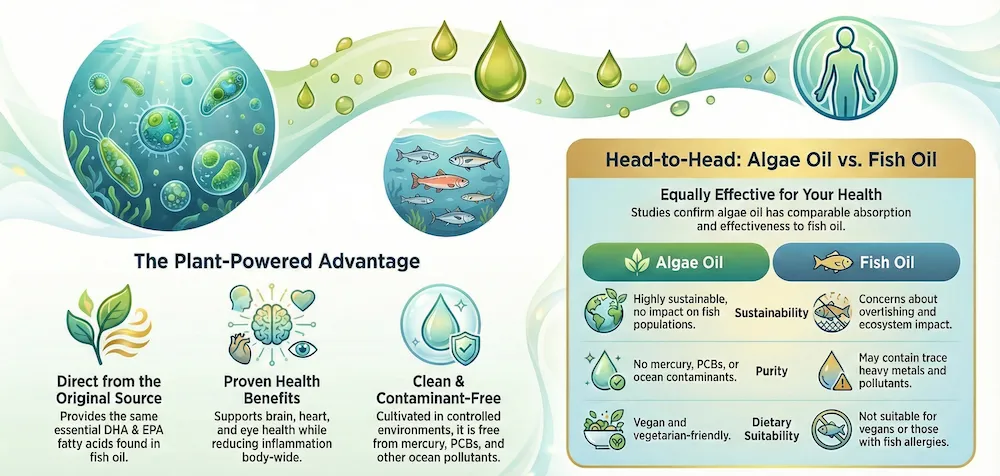
One of the most common questions about algae oil is how it compares to traditional fish oil. Here's what the research shows:
| Feature | Algae Oil | Fish Oil |
|---|---|---|
| Source | Marine microalgae (Schizochytrium, Ulkenia, Phaeodactylum tricornutum) | Cold-water fish (salmon, mackerel, sardines, anchovies) |
| Omega-3 Content | DHA-dominant; some products include EPA | Contains both EPA and DHA; ratios vary by fish species |
| Bioavailability | Statistically non-inferior to fish oil (112% geometric mean ratio)[B][1] | Well-established absorption |
| Contaminants (Mercury, PCBs) | None—grown in controlled environments[D][8] | Possible—requires purification and testing |
| Vegan/Vegetarian Suitable | ✓ Yes—100% plant-based | ✗ No—animal-derived |
| Environmental Impact | Sustainable—no ocean depletion; controlled cultivation[D][8] | Variable—depends on fishing practices; concerns about overfishing |
| Fish Allergy Safe | ✓ Yes—no fish proteins | ✗ No—may contain fish allergens |
| Taste/Odor | Generally milder; less fishy aftertaste | Can have strong fishy taste and burps |
The Bottom Line on Bioavailability
The critical question—does your body absorb algae omega-3s as well as fish omega-3s—has been answered by clinical research. A 2025 randomized controlled trial with 74 healthy adults compared microalgal oil to fish oil and found the bioavailability of DHA and EPA from algae was statistically non-inferior, with plasma phospholipid incorporation demonstrating equivalence.[Evidence: B][1]
Similarly, research on Phaeodactylum tricornutum microalgae showed EPA increases and improvements in the omega-6 to omega-3 ratio comparable to fish oil sources.[Evidence: B][6]
When to Choose Algae Oil
- You follow a vegetarian or vegan diet
- You're concerned about mercury and ocean contaminants
- You have fish or shellfish allergies
- Environmental sustainability is important to you
- You experience fishy burps or aftertaste with fish oil
- You're pregnant and want a contaminant-free omega-3 source
When Fish Oil May Be Preferred
- You specifically need higher EPA content (some conditions respond better to EPA)
- Cost is a primary concern (fish oil is often less expensive)
- You're already taking fish oil successfully with no issues
Frequently Asked Questions
What are the side effects of algae oil?
Algae oil side effects are generally mild and similar to fish oil. Common effects include mild gastrointestinal discomfort, bloating, gas, and occasional fishy burps—though these are typically less pronounced than with fish oil due to its plant origin. Serious side effects are rare. A meta-analysis examining bleeding risk in 120,643 patients found no increased bleeding with omega-3 supplementation compared to controls, even at high doses.[Evidence: A][3] Taking algae oil with meals usually minimizes digestive discomfort. If you experience persistent side effects, reduce your dose or consult your healthcare provider.
Is algae oil safe during pregnancy and breastfeeding?
Yes, clinical evidence supports algae oil safety during pregnancy and breastfeeding. The DHANI trial—a randomized controlled study with 957 pregnant women—found that 400 mg/day of algal DHA from enrollment through delivery was well tolerated with no adverse effects on birth outcomes.[Evidence: B][11] For breastfeeding mothers, a randomized trial with 160 lactating women demonstrated that 200 mg/day of algal DHA safely increased breast milk DHA concentrations, benefiting infant nutrition.[Evidence: B][4] Expert recommendations suggest 200 mg/day of DHA during pregnancy and breastfeeding, with some guidelines recommending 250 mg DHA+EPA plus an additional 100-200 mg.[Evidence: D][9]
Is algae oil as good as fish oil?
For most purposes, yes. Clinical research demonstrates that algae oil provides omega-3 fatty acids with bioavailability equivalent to fish oil. A 2025 randomized controlled trial comparing microalgal oil to fish oil in 74 healthy adults found the geometric mean ratio was 112%—meaning algae oil absorption was statistically non-inferior to fish oil for plasma phospholipid incorporation.[Evidence: B][1] Algae oil has additional advantages: it's free from mercury and ocean contaminants, vegan-friendly, and environmentally sustainable. The main consideration is that algae oil is typically higher in DHA than EPA, while fish oil contains both. If you specifically need higher EPA, check product labels or consider a combined supplement.
Can algae oil help with brain health?
DHA—the primary omega-3 in algae oil—is essential for brain structure and function. A systematic review confirmed that DHA comprises 97% of all omega-3 fatty acids in the brain, making it crucial for neural health.[Evidence: A][2] Research shows DHA makes up about 15% of all fatty acids in the frontal cortex, the brain region responsible for decision-making and complex thinking.[Evidence: D][12] DHA maintains cell membrane fluidity, supporting efficient neuron communication. During fetal development, adequate maternal DHA supply during the third trimester is critical—insufficient levels correlate with behavioral changes and learning difficulties.[Evidence: D][12] For ongoing cognitive support, consistent omega-3 intake helps maintain brain health throughout life.
Does algae oil help with inflammation?
Omega-3 fatty acids from algae oil have documented anti-inflammatory properties. DHA and EPA modulate inflammation through several mechanisms: they influence the COX and LOX enzyme pathways that produce inflammatory compounds, inhibit NF-κB (a key inflammation trigger), and generate specialized pro-resolving mediators called resolvins and protectins.[Evidence: D][5] Unlike typical anti-inflammatory drugs that simply block inflammation, these omega-3-derived compounds actively help resolve inflammatory processes. This makes algae oil particularly relevant for conditions involving chronic low-grade inflammation. However, effects vary by individual and condition—algae oil supports overall inflammatory balance rather than treating specific inflammatory diseases. Consult your healthcare provider about omega-3s as part of your health management plan.
Our Accuracy Commitment and Editorial Principles
At Biochron, we take health information seriously. Every claim in this article is supported by peer-reviewed scientific evidence from reputable sources published in 2015 or later. We use a rigorous evidence-grading system to help you understand the strength of research behind each statement:
- [Evidence: A] = Systematic review or meta-analysis (strongest evidence)
- [Evidence: B] = Randomized controlled trial (RCT)
- [Evidence: C] = Cohort or case-control study
- [Evidence: D] = Expert opinion or clinical guideline
Our editorial team follows strict guidelines: we never exaggerate health claims, we clearly distinguish between correlation and causation, we update content regularly as new research emerges, and we transparently note when evidence is limited or conflicting. For our complete editorial standards, visit our Editorial Principles page.
This article is for informational purposes only and does not constitute medical advice. Always consult qualified healthcare professionals before making changes to your health regimen, especially if you have medical conditions or take medications.


References
- 1 . Comparative Bioavailability of DHA and EPA from Microalgal and Fish Oil in Adults, Bailey E, et al., International Journal of Molecular Sciences, 2025, PubMed, DOI [Evidence: B]
- 2 . How does high DHA fish oil affect health? A systematic review of evidence, Ghasemi Fard S, et al., Critical Reviews in Food Science and Nutrition, 2019, PubMed, DOI [Evidence: A]
- 3 . Bleeding Risk in Patients Receiving Omega-3 Polyunsaturated Fatty Acids: A Systematic Review and Meta-Analysis of Randomized Clinical Trials, Javaid M, et al., Journal of the American Heart Association, 2024, PubMed, DOI [Evidence: A]
- 4 . Impact of DHA from Algal Oil on the Breast Milk DHA Levels of Lactating Women: A Randomized Controlled Trial in China, Yang Y, et al., Nutrients, 2022, PubMed, DOI [Evidence: B]
- 5 . Omega-3 fatty acids and inflammatory processes: from molecules to man, Calder PC, Biochemical Society Transactions, 2017, PubMed, DOI [Evidence: D]
- 6 . Oral Bioavailability of Omega-3 Fatty Acids and Carotenoids from the Microalgae Phaeodactylum tricornutum in Healthy Young Adults, Stiefvatter L, et al., Marine Drugs, 2021, PubMed, DOI [Evidence: B]
- 7 . No impact of fish oil supplements on bleeding risk: a systematic review, Begtrup KM, et al., Danish Medical Journal, 2017, PubMed [Evidence: A]
- 8 . Recent advances in enhancing the production of long chain omega-3 fatty acids in microalgae, Kumari A, et al., Critical Reviews in Food Science and Nutrition, 2024, PubMed, DOI [Evidence: D]
- 9 . Docosahexaenoic Acid (DHA) and Eicosapentaenoic Acid (EPA)—Should They Be Mandatory Supplements in Pregnancy?, Amza M, et al., Biomedicines, 2024, PubMed, DOI [Evidence: D]
- 10 . Effect of omega-3 fatty acids on cardiovascular outcomes: A systematic review and meta-analysis, Khan SU, et al., EClinicalMedicine, 2021, PubMed, DOI [Evidence: A]
- 11 . Prenatal Maternal Docosahexaenoic Acid (DHA) Supplementation and Newborn Anthropometry in India: Findings from DHANI, Khandelwal S, et al., Nutrients, 2021, PubMed, DOI [Evidence: B]
- 12 . Maternal Docosahexaenoic Acid Status during Pregnancy and Its Impact on Infant Neurodevelopment, Basak S, et al., Nutrients, 2020, PubMed, DOI [Evidence: D]
Medical Disclaimer
This content is for informational and educational purposes only. It is not intended to provide medical advice or to take the place of such advice or treatment from a personal physician. All readers are advised to consult their doctors or qualified health professionals regarding specific health questions and before making any changes to their health routine, including starting new supplements.
Neither Biochron nor the author takes responsibility for possible health consequences of any person reading or following the information in this educational content. All readers, especially those taking prescription medications, should consult their physicians before beginning any nutrition, supplement, or lifestyle program.
If you have a medical emergency, call your doctor or emergency services immediately.
